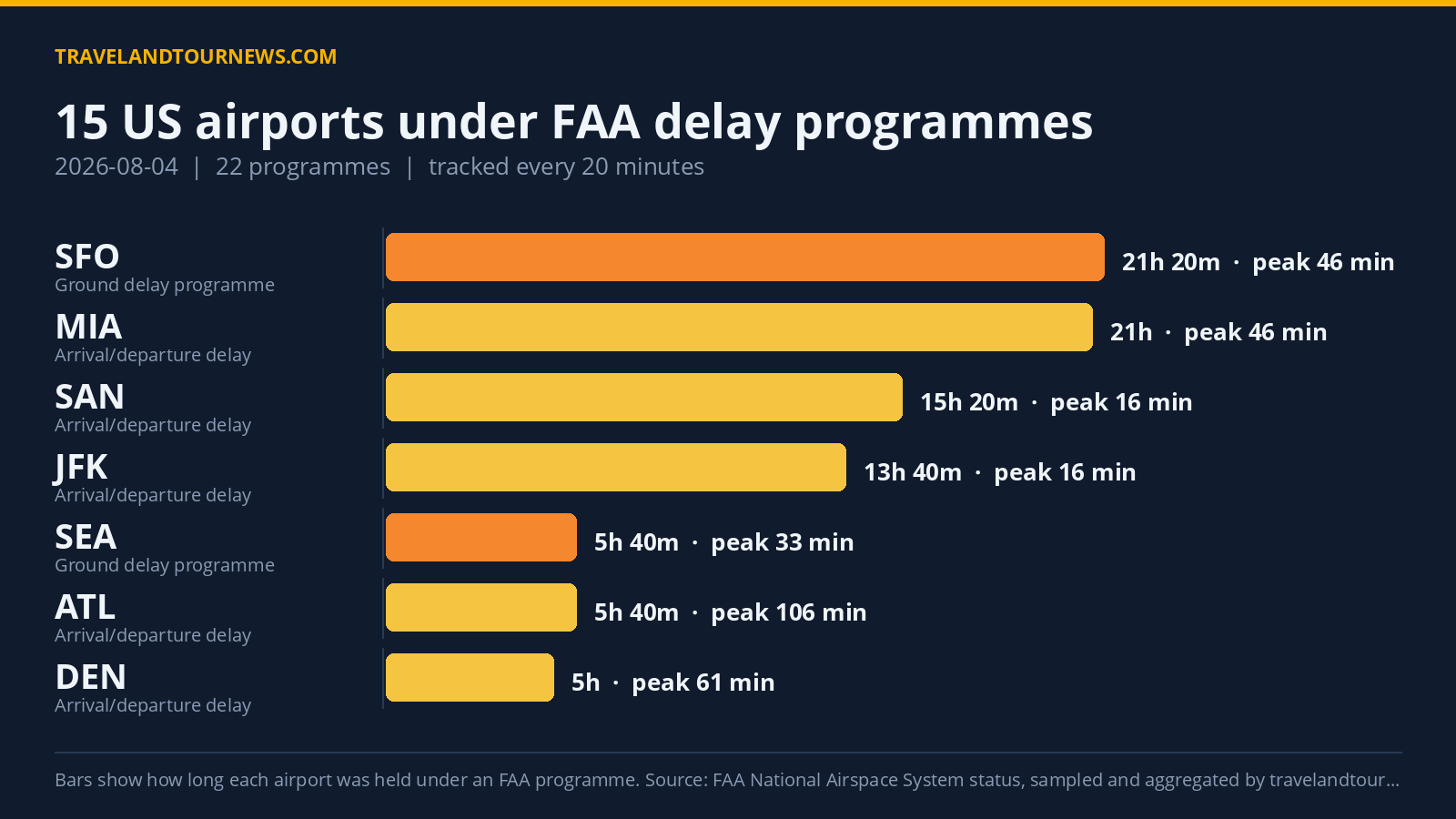

On August 4, 2026, the Federal Aviation Administration (FAA) held 15 United States airports under 22 delay programmes. The worst-hit airport was Denver International (DEN), with a peak delay reaching 551 minutes.
Duration and Scope of Delay Programmes at US Airports
Across the United States, delay programmes spanned three types: 4 Ground Stop Programs, 5 Ground Delay Programs, and 13 General Arrival/Departure Delay Info programmes. Ground stops hold departures bound for an airport on the ground at their origin, while ground delay programmes meter arrivals by assigning later departure times.
Denver International (DEN) carried the longest-running delay programme, a ground delay programme active for 21 hours and 20 minutes and resulting in peak average delays of 46 minutes and maximum delays up to 144 minutes. DEN also experienced a ground stop due to wind lasting 2 hours 20 minutes, and ground
delays for an additional 2 hours with an average peak delay of 86 minutes.
Hartsfield-Jackson Atlanta International (ATL) reported two ground stop programmes caused by thunderstorms, lasting 1 hour 40 minutes with zero peak delay minutes, and 5 hours 40 minutes of general delay information driven by thunderstorms, with peak average delays of 106 minutes and maximum delays of 120 minutes.
Seattle-Tacoma International (SEA) faced a ground stop related to wind for 1 hour, a ground delay programme caused by wind lasting 5 hours 40 minutes with a peak average delay of 33 minutes, and general arrival/departure delay info for
1 hour 40 minutes due to compacted demand, showing delays up to 30 minutes.
San Diego International (SAN) had a brief 20-minute ground stop due to airport volume and a general delay programme for 15 hours 20 minutes for compacted demand, with average delays peaking at 16 minutes.
Boston Logan (BOS) experienced a 1-hour ground delay programme due to thunderstorms, reaching average delays of 136 minutes and a maximum of 220 minutes.
Newark Liberty (EWR) had a 3 hour 40 minute ground delay programme caused by thunderstorms, recording an average peak delay of 117 minutes and a maximum of 551
minutes, the highest maximum delay across all airports that day.
Additional general delay programmes affected Miami International (MIA) for 21 hours under Traffic Management Initiatives related to weather and volume, and Chicago O’Hare (ORD) for 2 hours 40 minutes due to volume and multiple taxiway congestion, both with delays under 50 minutes on average.
| Airport | FAA programme | Cause | Peak average delay | In force (UTC) |
|---|---|---|---|---|
| Denver International (DEN) | Ground Stop Programs | wind | – | 00:00 to 02:20 (2 hours 20 minutes) |
| Hartsfield-Jackson Atlanta International (ATL) | Ground Stop Programs | thunderstorms | – | 16:00 to 17:40 (1 hour 40 minutes) |
| Seattle-Tacoma International (SEA) | Ground Stop Programs | wind | – | 03:20 to 04:20 (1 hour) |
| San Diego International (SAN) | Ground Stop Programs | airport volume | – | 02:20 to 02:40 (20 minutes) |
| Boston Logan International (BOS) | Ground Delay Programs | thunderstorms | 136 min | 00:00 to 01:00 (1 hour) |
| Newark Liberty International (EWR) | Ground Delay Programs | thunderstorms | 117 min | 00:00 to 03:40 (3 hours 40 minutes) |
| Denver International (DEN) | Ground Delay Programs | other | 86 min | 02:40 to 04:40 (2 hours) |
| San Francisco International (SFO) | Ground Delay Programs | other | 46 min | 00:00 to 21:20 (21 hours 20 minutes) |
| Seattle-Tacoma International (SEA) | Ground Delay Programs | wind | 33 min | 00:00 to 05:40 (5 hours 40 minutes) |
| Hartsfield-Jackson Atlanta International (ATL) | General Arrival/Departure Delay Info | WX:Thunderstorms | 106 min | 16:20 to 22:00 (5 hours 40 minutes) |
| Denver International (DEN) | General Arrival/Departure Delay Info | WX:Thunderstorms; ZDV / WX:Wind | 61 min | 00:00 to 05:00 (5 hours) |
| Miami International (MIA) | General Arrival/Departure Delay Info | TM Initiatives:MIT:WX; TM Initiatives:ESP:VOL | 46 min | 01:20 to 22:20 (21 hours) |
| Fort Lauderdale-Hollywood International (FLL) | General Arrival/Departure Delay Info | TM Initiatives:MIT:WX | 46 min | 21:40 to 22:20 (40 minutes) |
| Chicago O’Hare International (ORD) | General Arrival/Departure Delay Info | VOL:Volume; VOL:Multi-taxi | 31 min | 13:00 to 15:40 (2 hours 40 minutes) |
Primary Causes Behind Delay Programmes
The leading cause across the 22 programmes was categorized as “other,” comprising 45 instances. Weather-related issues were also significant: wind accounted for 29 programmes, thunderstorms for 22, and thunderstorm-related traffic management initiatives (TM Initiatives:MIT:WX) for 15.
Specific causes included airport volume constraints, compacted demand, runway construction,
and aircraft emergencies for select airports. The FAA specified wind as the reason behind Denver’s initial ground stop, while thunderstorms dominated delays at several East Coast hubs including Boston, Newark, and Atlanta.
Comparisons with Previous Days
Compared to August 3, 2026, when 22 airports were affected by 40 delay programmes, August 4 showed a notable reduction with 15 airports and 22 delay programmes. The current number of affected airports is below the 7-day average of 22.4. August 4 was not the worst day in the recent tracking window for delay programmes.
FAA data tracked by travelandtournews.com
Methodology. travelandtournews.com samples the FAA’s National Airspace System
status feed every 20 minutes throughout the US operating day and aggregates the result. This report is built from 64 samples taken between 00:00 and 22:20 UTC on 2026-08-04. Durations are the observed window between the first and last sample in which a programme was in force, so a programme’s true length may be slightly longer than shown. Ground stops, ground delay programmes, airport closures and general delays are all published by the FAA in real time; the daily aggregation is ours.