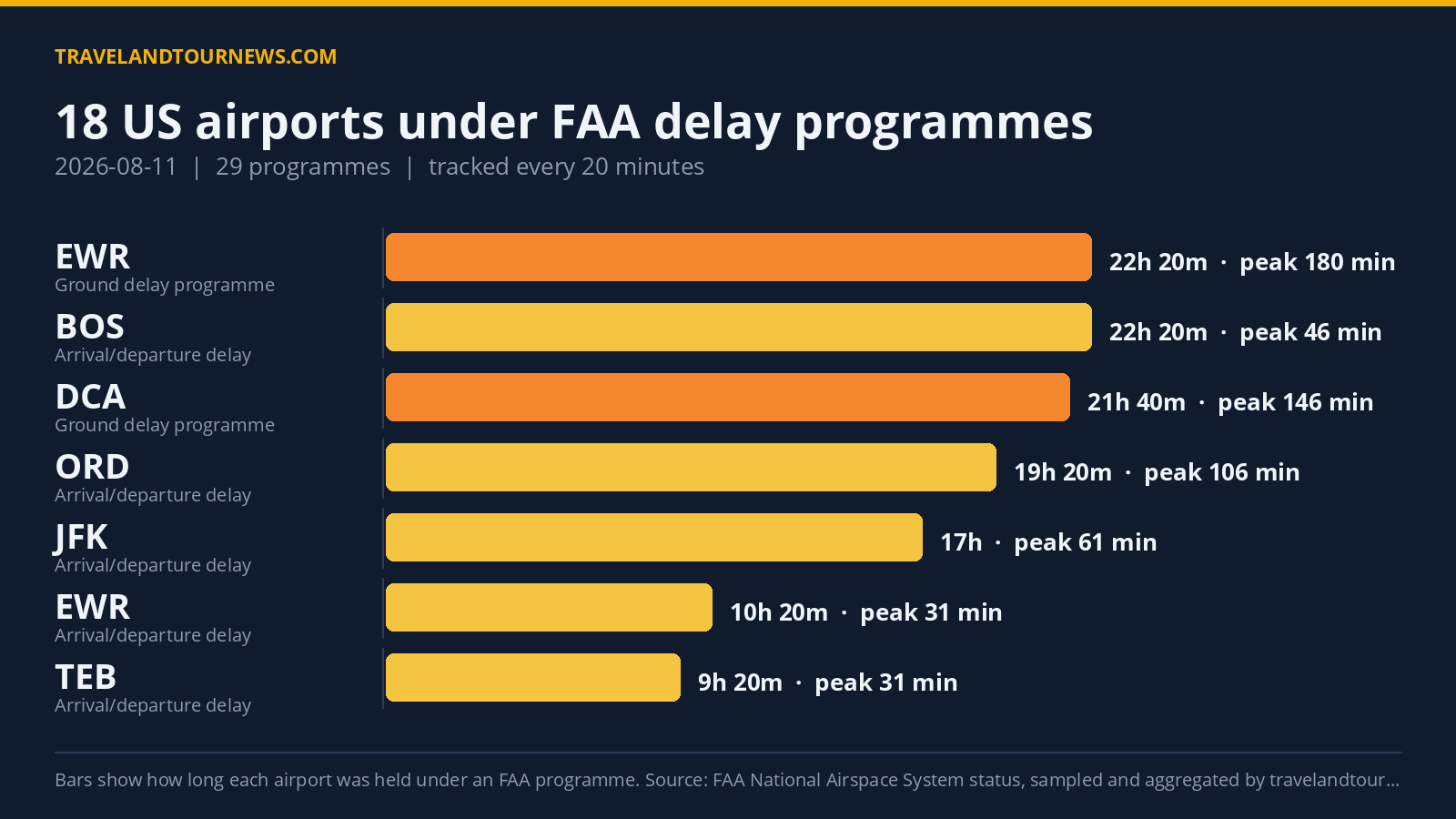

On August 11, 2026, 18 airports across the United States were affected by 29 separate FAA delay programmes. The most heavily impacted airport was Chicago O’Hare International (ORD), where multiple ground stop and ground delay programmes due to thunderstorms resulted in observed delay durations extending up to nearly 22 hours and peak delays including a maximum of 1024 minutes.
Distribution and Duration of Delay Programmes Across Airports
Eighteen airports entered delay programmes throughout the day, spanning several types. There were seven Ground Stop programmes, which hold departures at originating airports bound for affected destinations. Nine Ground Delay programmes were implemented to meter arrivals by assigning later departure times to reduce airport congestion. Additionally, thirteen programmes provided general arrival or departure delay information without restricting departures.
The longest programme recorded was a Ground Delay programme at Newark Liberty International (EWR), effective for 22 hours and 20 minutes, starting at midnight UTC and continuing to 22:20 UTC. Newark also experienced the highest peak average delay of 180 minutes and
a peak maximum delay of 475 minutes under that programme.
Chicago O’Hare stood out for multiple programmes. It had a Ground Stop lasting 5 hours and 40 minutes between 14:20 and 20:00 UTC due to thunderstorms. Concurrently, a Ground Delay programme operated from 13:20 to 22:20 UTC, lasting 9 hours. A separate general arrival/departure delay info programme covered 19 hours and 20 minutes that day at O’Hare.
Other airports with notable Ground Stop programmes include Chicago Midway (MDW), in force for 1 hour and 40 minutes; Hartsfield-Jackson Atlanta International (ATL), active for 1 hour; and several smaller stop programmes at
Teterboro (TEB), JFK, Spokane (GEG), and Raleigh-Durham (RDU) lasting under 40 minutes each.
Ground Delay programmes run for substantial periods at John F. Kennedy International (JFK) for 6 hours, Ronald Reagan Washington National (DCA) for nearly 22 hours, LaGuardia (LGA) for 6 hours, and other airports such as San Francisco (SFO), Las Vegas (LAS), Seattle-Tacoma (SEA), and San Diego (SAN) with programmes lasting between 3 to 5 hours.
| Airport | FAA programme | Cause | Peak average delay | In force (UTC) |
|---|---|---|---|---|
| Chicago O’Hare International (ORD) | Ground Stop Programs | thunderstorms; THUNDERSTORMS | – | 14:20 to 20:00 (5 hours 40 minutes) |
| Chicago Midway International (MDW) | Ground Stop Programs | thunderstorms | – | 15:20 to 17:00 (1 hour 40 minutes) |
| Hartsfield-Jackson Atlanta International (ATL) | Ground Stop Programs | thunderstorms | – | 19:20 to 20:20 (1 hour) |
| TEB | Ground Stop Programs | thunderstorms | – | 21:40 to 22:20 (40 minutes) |
| John F. Kennedy International (JFK) | Ground Stop Programs | thunderstorms | – | 00:00 to 00:00 (20 minutes) |
| GEG | Ground Stop Programs | OCL: | – | 18:40 to 18:40 (20 minutes) |
| Raleigh-Durham International (RDU) | Ground Stop Programs | thunderstorms | – | 22:20 to 22:20 (20 minutes) |
| Newark Liberty International (EWR) | Ground Delay Programs | other; thunderstorms | 180 min | 00:00 to 22:20 (22 hours 20 minutes) |
| John F. Kennedy International (JFK) | Ground Delay Programs | thunderstorms | 177 min | 16:20 to 22:20 (6 hours) |
| Ronald Reagan Washington National (DCA) | Ground Delay Programs | thunderstorms | 146 min | 00:00 to 21:40 (21 hours 40 minutes) |
| Chicago O’Hare International (ORD) | Ground Delay Programs | thunderstorms | 144 min | 13:20 to 22:20 (9 hours) |
| LaGuardia (LGA) | Ground Delay Programs | thunderstorms | 120 min | 16:20 to 22:20 (6 hours) |
| San Francisco International (SFO) | Ground Delay Programs | other | 58 min | 00:00 to 05:40 (5 hours 40 minutes) |
| Harry Reid International (LAS) | Ground Delay Programs | other | 41 min | 02:00 to 05:20 (3 hours 20 minutes) |
Thunderstorms Caused Most Delay Programmes
The primary causes for delay programmes were clearly identified by the FAA. Thunderstorms drove the majority of these programmes, reflected in 126 instances cited across the dataset, including direct references to “thunderstorms”
and FAA-coded weather delays.
Following thunderstorms, traffic management initiatives involving weather factors accounted for 80 delay references documented as “TM Initiatives:SWAP:WX.” Other causes included miscellaneous reasons categorized as “other” in 54 instances and airport volume constraints causing 10 delay programmes. Specific weather elements such as wind were cited in certain airports but less frequently.
Thunderstorms were responsible for all Ground Stop programmes except one at Spokane (GEG), which cited an unspecified obstruction. All delay programmes at Chicago O’Hare, Midway, Atlanta, Teterboro, JFK, and Raleigh-Durham were weather related, mainly thunderstorms.
Comparison with Previous Day and Recent Averages
Compared to August 10, when 23 airports were affected by 43
programmes, August 11 showed a decrease to 18 airports and 29 programmes. This represents a drop of five programmes versus the previous day. The affected airports count also dropped below the recent seven-day average of 21.9 airports.
This indicates a moderate reduction in overall FAA delay programme activity on August 11 relative to the prior day and the recent average.
Methodology. travelandtournews.com samples the FAA’s National Airspace System status feed every 20 minutes throughout the US operating day and aggregates the result. This report is built from 68 samples taken between 00:00 and 22:20 UTC on 2026-08-11. Durations are the
observed window between the first and last sample in which a programme was in force, so a programme’s true length may be slightly longer than shown. Ground stops, ground delay programmes, airport closures and general delays are all published by the FAA in real time; the daily aggregation is ours.