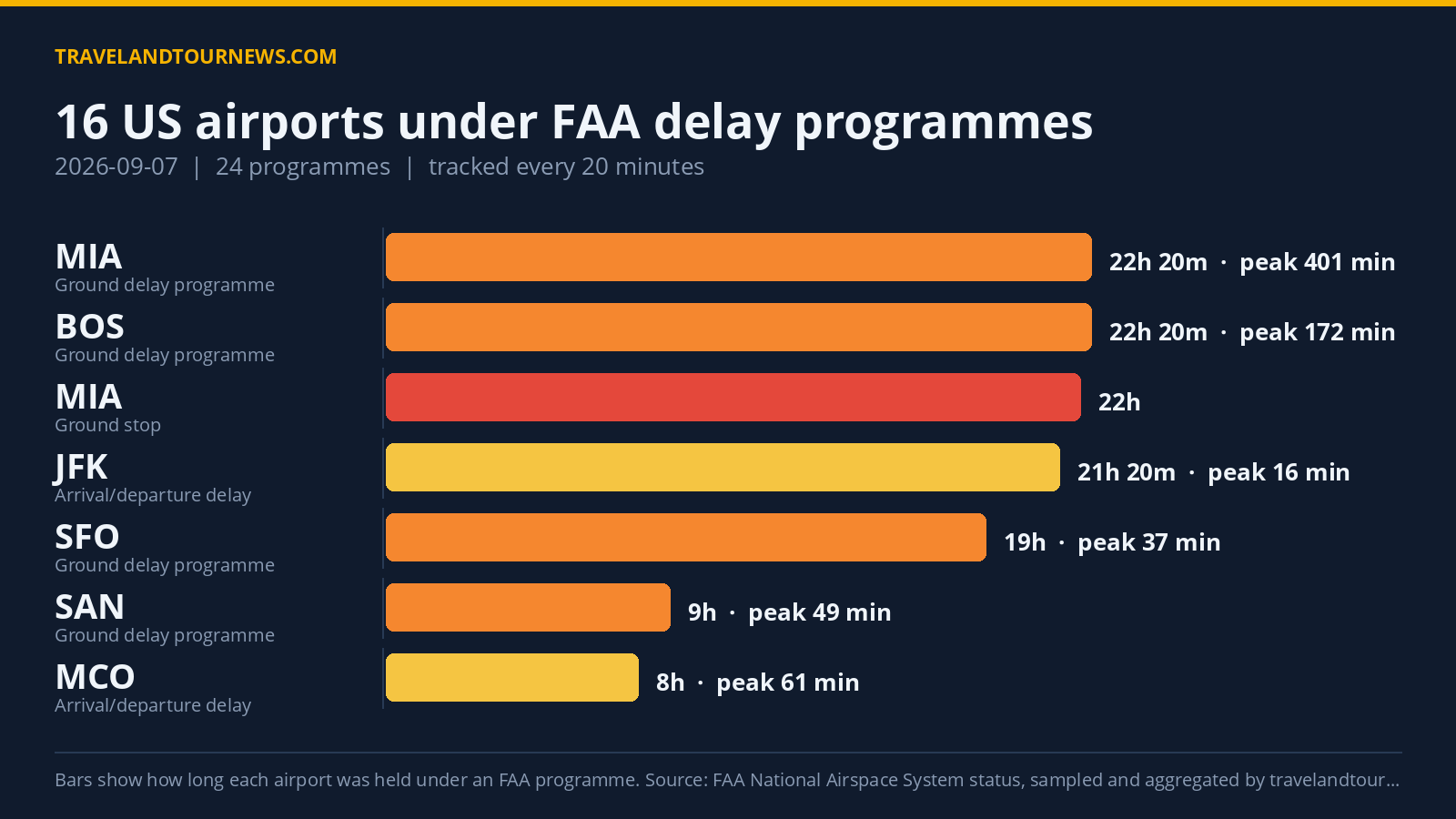
An Amazon Prime Air Boeing 767 cargo jet operating flight 7598 from Luis Muñoz Marín International Airport in San Juan, Puerto Rico, overran Runway 30 at Miami International Airport on Sunday, September 6, 2026, around 2 p.m. local time. The aircraft struck vehicles beyond the airfield near Northwest 67th Avenue and caught fire. At least five fatalities and multiple injuries were reported, including among people on the ground. Following the crash, the Federal Aviation Administration (FAA) imposed a full ground stop at Miami International Airport at approximately 3 p.m. local time, closing all runways and taxiways.
Flight disruptions and ripple effects at Texas airports
The complete shutdown of
Miami International, a major domestic and international hub, caused widespread cancellations and rolling delays for passenger and cargo flights. Two of the airport’s four runways reopened on Monday morning, September 7, but recovery efforts and inspections continued. The disruptions extended to key Texas airports, including Dallas Fort Worth International, Houston’s major airports, and Austin-Bergstrom International Airport, all experiencing rolling delays, cancellations, and rebooking issues during the busy Labor Day holiday period. Dallas Fort Worth International had projected serving roughly 1.4 million passengers between September 3 and 8, identifying Labor Day Monday as the busiest day within that span. Connections to
and from Miami were notably affected, with passengers encountering extended wait times and limited seat availability, leading some to be stranded for additional days or rerouted through hubs such as Atlanta, Charlotte, or Chicago.
Official statements and air traffic control confirmation
Miami International Airport officials and 21 Air released a joint statement confirming the Amazon Prime Air Boeing 767 “overran Miami International Airport’s diagonal runway and is disabled at the northwest end of the airport.” The FAA announced the unprecedented full ground stop due to the disabled aircraft blocking runways and taxiways. Air traffic control recordings captured by LiveATC.com include a ground vehicle operator notifying the tower,
stating, “Looks like we have an aircraft that overran the runway on 30.” FlightRadar24 data showed all movements abruptly ceased following the ground stop directive.
Ongoing investigation by the FAA
Federal aviation investigators began a formal inquiry into the crash, gathering flight data, cockpit voice recordings, runway condition reports, braking action reports, and reviewing crew decision-making. The cause of the runway overrun has not yet been confirmed. Neither the FAA nor the airlines have suggested causes such as weather, mechanical failure, or human error as of September 7. A preliminary summary is expected in the days following the incident with a comprehensive report to follow.
Passenger impact and airline response
Hundreds of flights at Miami International were delayed or canceled after the incident, and the effects persisted into Monday. Airlines serving affected routes allowed passengers to change itineraries without additional fees. However, high demand and limited alternative seats increased disruptions, especially for Texas travelers connecting through Miami or flying direct to Florida. Long lines at ticket counters and rebooking desks were reported at Dallas Fort Worth, Houston, and Austin airports. Travelers were advised to closely monitor flight status and consider carry-on luggage and alternate routing due to continuing operational constraints.
Miami International Airport and Labor Day travel context
Miami International is one of the busiest U.S. airports and
serves as a key gateway to Latin America and the Caribbean. The cargo jet crash occurred during the peak Labor Day holiday travel period, intensifying the operational strain. Dallas Fort Worth International, with projected record passenger volumes for early September 2026, had little slack capacity to absorb cascading delays. The crash’s impact spread widely, affecting passenger flows and cargo schedules on routes between Texas, Florida, the Caribbean, and Latin America, with underlying ripple effects expected to continue beyond the holiday Monday.