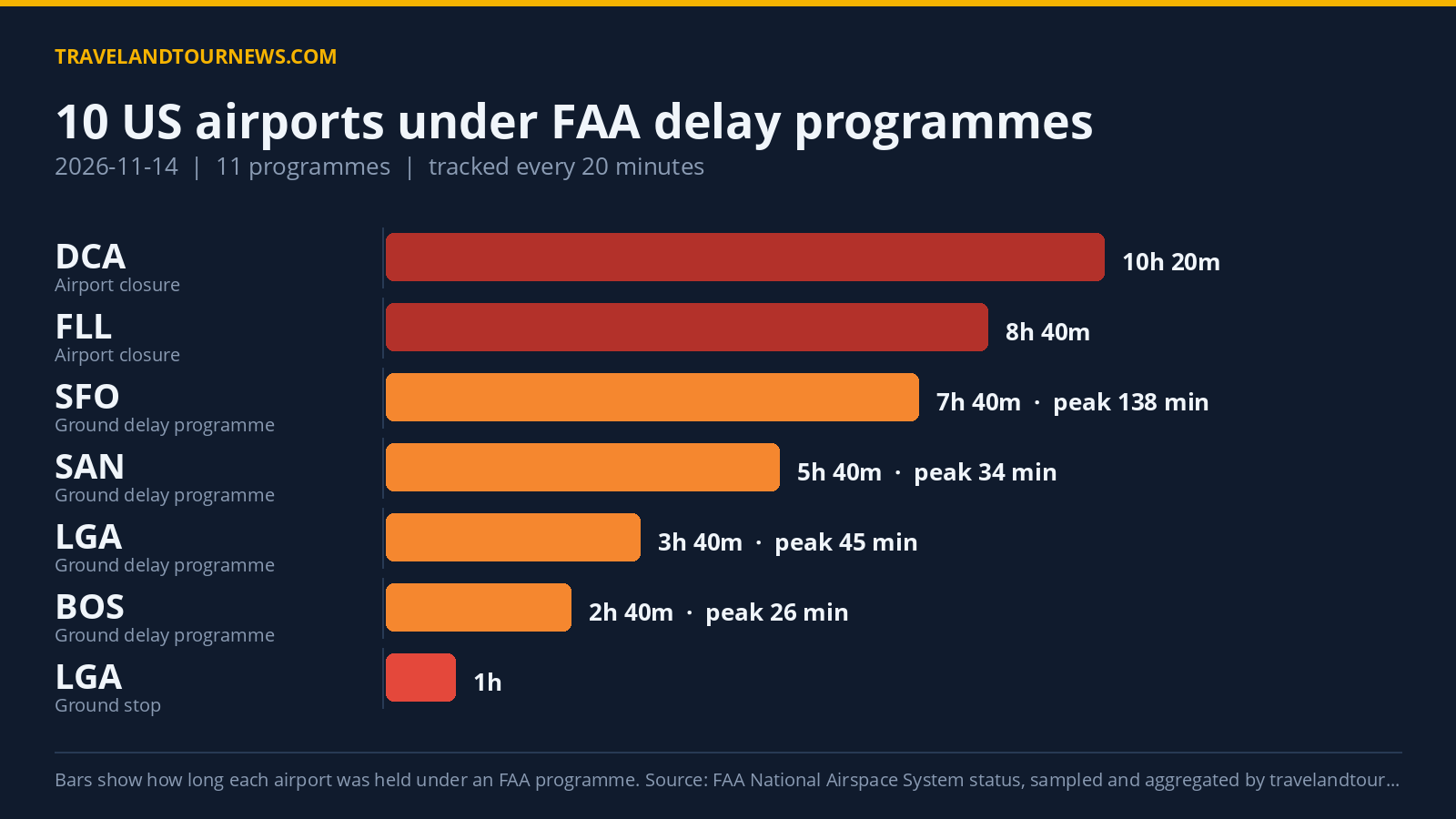
The Federal Aviation Administration (FAA) implemented a nationwide ground stop lasting approximately five hours on November 13, 2026, preventing most U.S. flights from taking off and disrupting air traffic coast to coast. This was the longest nationwide halt in 25 years and only the second since 9/11. According to KCRA, the stoppage caused widespread delays and cancellations across major airports, including Chicago O’Hare International and Chicago Midway, where hundreds of flights were affected.
Impact on Chicago O’Hare and Midway Airports
Chicago O’Hare and Midway airports experienced significant operational disruptions during the FAA ground stop. Flight departure screens showed delays across the board, leaving passengers uncertain about their
travel plans. Hundreds of flights were delayed or canceled, forcing travelers to reconsider overnight accommodations or alternative transportation. Some flights scheduled to depart were forced to return to their origin airports or diverted to alternate locations such as Washington Dulles, Los Angeles International, Cincinnati/Northern Kentucky, and Nashville International Airports.
Government Response and Cause of the Ground Stop
Secretary of Homeland Security Markwayne Mullin stated the cause was new technology overwhelming the FAA’s aging air traffic control systems, leading to intermittent communication failures and radar gaps. He emphasized that no danger was posed to travelers and denied any indication of a cyberattack or rogue artificial intelligence involvement. Secretary of
Transportation Sean Duffy warned that recovery would be slow and did not exclude the possibility of similar future disruptions.
Flight Data and Passenger Impact
At the ground stop’s start, about 3,500 airplanes were in U.S. airspace, decreasing to fewer than 400 by late afternoon. Cirium, an aviation analytics firm, reported that as of 7:05 p.m. EST, 670 flights had returned to their departure airports, while 157 were diverted to alternate airports. More than 827 flights had been diverted overall. Over 11,000 flights carrying over 1.5 million passengers were originally scheduled to take off after 4 p.m. EST nationwide. Chicago airports saw a substantial share of
these disruptions.
Traveler Experiences and Recovery Outlook
Passengers at Chicago airports struggled with limited information amid delays, with some debating whether to wait or seek overnight lodging. Sports teams from NBA, NHL, and NCAA faced travel halts, with NCAA teams prioritized ahead of upcoming football games. Cargo operations were delayed, with FedEx preparing contingency plans to minimize cargo disruption. U.S. airlines transport about 61,000 tons of goods daily to and from more than 220 countries. Limited flights resumed late Friday evening after the ground stop was lifted, but officials expect several days will be needed to fully restore normal operations before the Thanksgiving travel period.
Technical Background and Separate System Confirmations
The FAA ground stop stemmed from the integration of new technology overloading older air traffic control systems, causing intermittent communications and radar outages. Past regional air traffic disruptions involved equipment failures or physical damage, unlike the nationwide scale seen on November 13. The National Weather Service confirmed that weather radar systems remained fully operational during the FAA ground stop, dismissing rumors of a radar outage. Additionally, Microsoft and federal officials denied any connection between the FAA’s ground stop and a major Microsoft Outlook outage occurring the previous day.