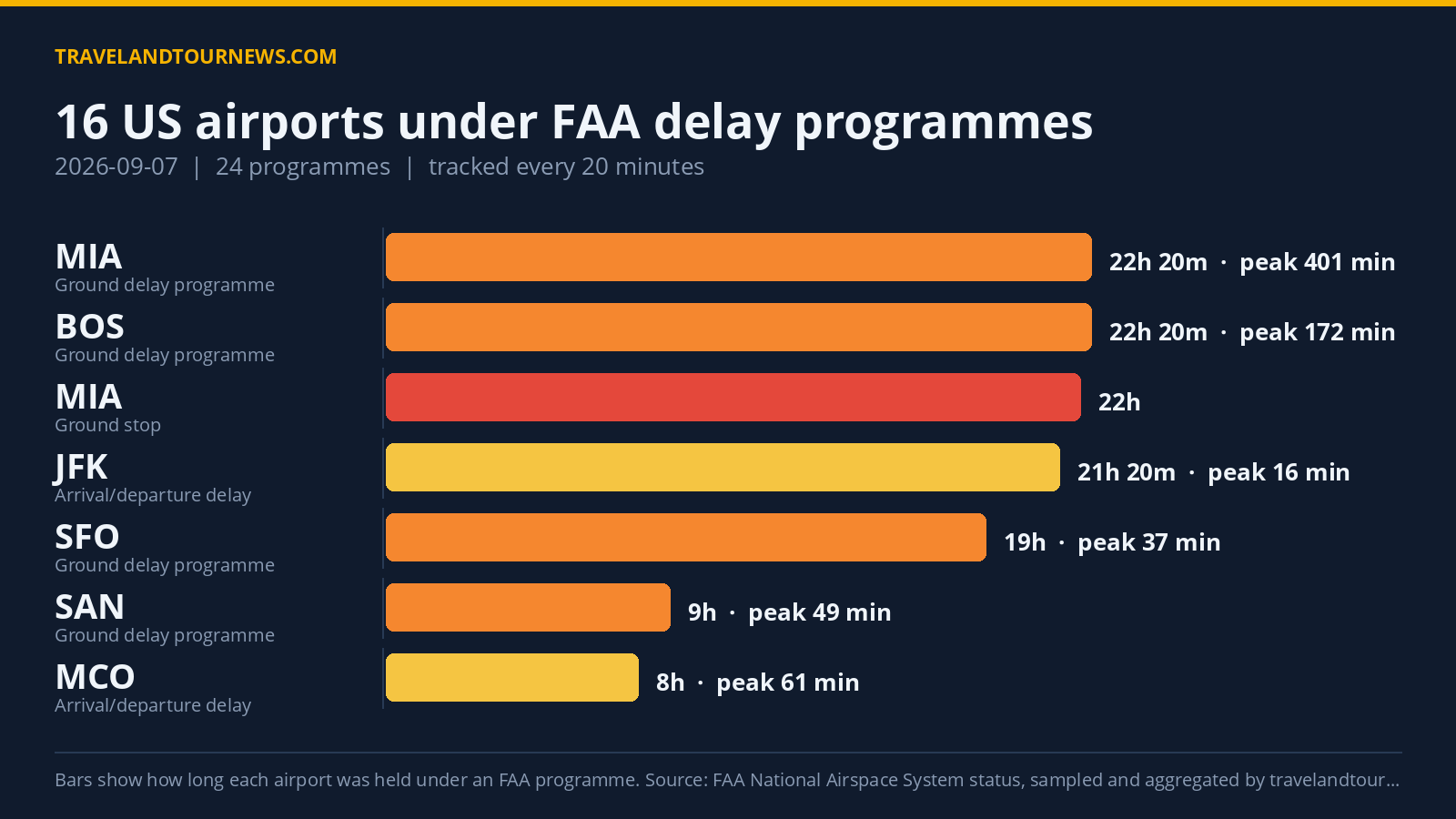
An Amazon Prime Air Boeing 767 cargo jet overran Runway 30 at Miami International Airport on Sunday, September 6, 2026, around 2 p.m. local time, resulting in a fatal crash that struck vehicles beyond the airfield and erupted in flames. The aircraft had arrived from Luis Muñoz Marín International Airport in San Juan, Puerto Rico. The incident caused at least five fatalities and multiple injuries, including to people on the ground. In response, the Federal Aviation Administration (FAA) imposed a full ground stop, closing all runways and taxiways at Miami International Airport by 3 p.m.
Emergency Response and Airport Operations
Emergency services, including Miami-Dade Fire
Rescue, responded and remained on site for several hours to manage the scene. Miami International Airport has four runways; after initial closures to facilitate rescue and investigation efforts, two runways were reopened by Monday, September 7, 2026. However, capacity remained limited as recovery operations and inspections continued. The crash disabled the aircraft on the northwest end of the airport, blocking one runway and causing extended operational disruptions.
Ripple Effects on Texas Airports and Flight Operations
The crash led to cascading flight delays and cancellations at major Texas airports. Dallas Fort Worth International Airport, which anticipated about 1.4 million customers between September 3 and 8 with Labor Day Monday
as its busiest day, experienced intensified disruptions. Flight cancellations and delays occurred for services departing from and connecting through Miami International Airport, affecting connections to Dallas Fort Worth, Houston airports, and Austin-Bergstrom International Airport. Ticket counters and rebooking desks at Texas airports saw extended lines, and some passengers faced indefinite holds on flights to Miami awaiting runway and gate updates. Airlines rerouted crews and repositioned aircraft, with some travelers forced to use alternate hubs such as Atlanta, Charlotte, or Chicago.
FAA Investigation and Unresolved Cause
Federal aviation investigators have opened a formal inquiry into the runway overrun. The FAA indicated the cause remains unknown and
is examining multiple factors, including flight data recorders, cockpit voice recordings, runway conditions, aircraft performance, braking action, and crew decisions. Officials have not confirmed if weather, mechanical failure, or human factors contributed to the accident. The FAA described the ground stop as an unusual measure typically associated with severe weather events rather than a single aircraft incident. A joint statement by Miami International Airport and 21 Air confirmed the aircraft was disabled at the northwest end of the airport after overrunning the diagonal runway.
Passenger Impact and Travel Advice
Hundreds of flights at Miami International Airport were delayed or canceled following the runway overrun crash.
Flight operations remained constrained on Monday, September 7, with phased runway reopenings limiting capacity. Airlines urged passengers traveling to or through Miami and South Florida to monitor flight statuses and prepare for schedule changes. Many travelers departing from Texas faced cancellations, delays, and rebooking challenges during the high-volume Labor Day travel period. Some travelers reported multi-day delays or the need to reroute through alternate hubs. Airlines implemented standard policies allowing itinerary changes without fees on affected routes, while travel experts recommended early check-in and carrying only hand luggage to simplify possible rebooking.
Labor Day Travel and Miami’s Role as a Hub
The incident occurred during the peak Labor Day
holiday travel period in the United States, coinciding with heavy passenger volumes at major hubs, especially Miami International Airport, a critical gateway to Latin America and the Caribbean. Miami’s four-runway configuration operates near full capacity during such peak periods. The accident’s timing and location amplified its disruption, with ripple effects spreading to Texas airports serving key routes between Texas, Florida, the Caribbean, and Latin America. Dallas Fort Worth’s anticipated 1.4 million passengers over the Labor Day period faced heightened delays as Miami’s reduced operational capacity constrained connecting flights throughout the region.
A ground crew at Miami International communicated to air
traffic control, “Looks like we have an aircraft that overran the runway on 30,” confirming the runway overrun incident as it unfolded, according to The Traveler.