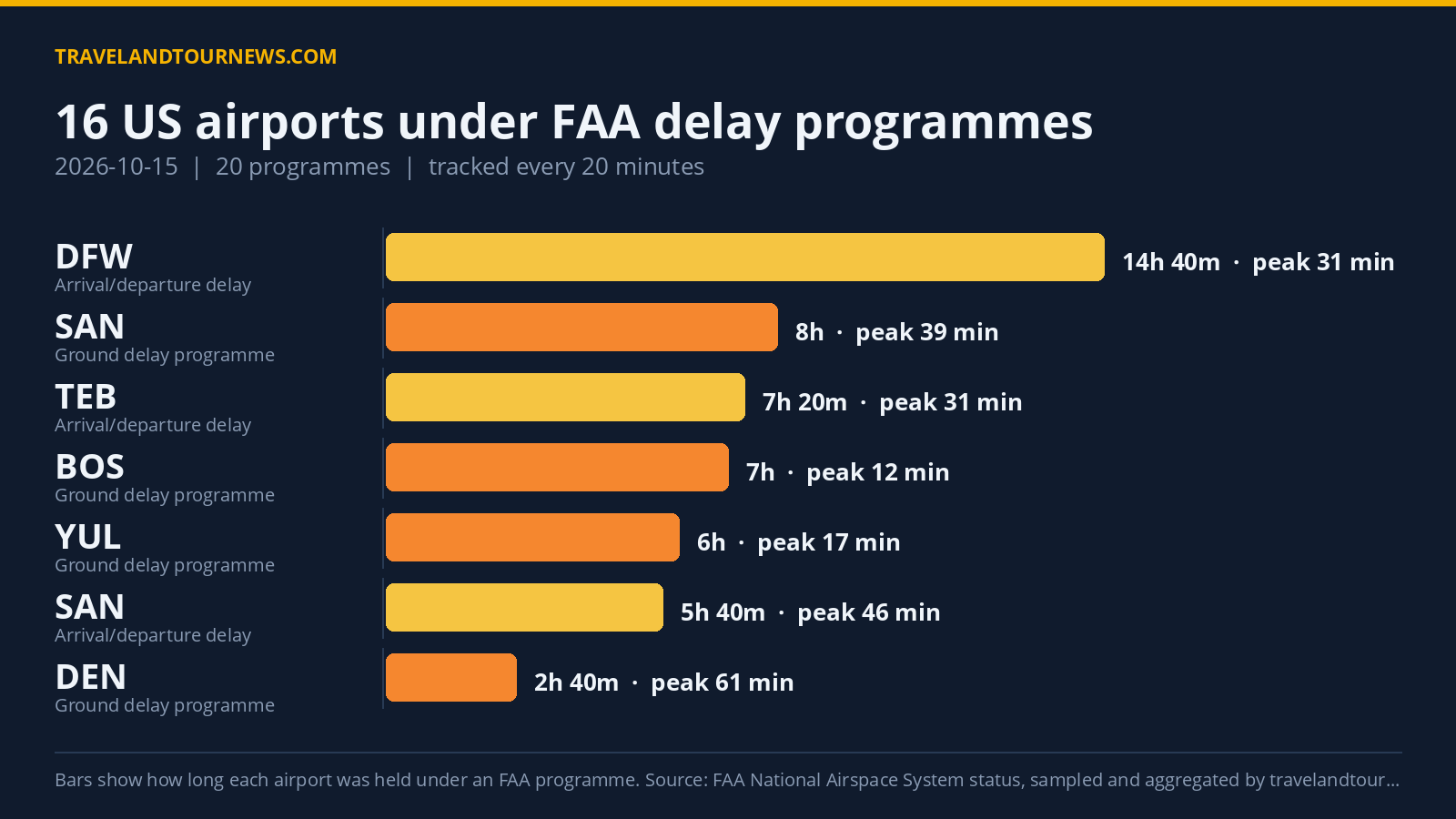
The Federal Aviation Administration imposed ground stops on the weekend of August 8-10, 2026 at five major U.S. airports including Chicago O’Hare, Chicago Midway, Denver International, Las Vegas International, and Tampa International due to severe convective weather. On Sunday, Chicago O’Hare experienced a ground stop lasting over three hours from midday to 3 p.m., leading to 148 canceled departures and 124 canceled arrivals. Flights departing after the stop faced average delays near 100 minutes.
By Monday, August 10, Chicago O’Hare remained the most impacted U.S. airport with 87 reported delays and 48 cancellations. United Airlines alone reported 163 delays and
33 cancellations at O’Hare on that day. Nationwide on Monday, at least 2,036 flights were delayed and 263 were canceled as the effects of weekend thunderstorms persisted across multiple regions.
New York City Airport Disruptions
Severe weather and FAA ground stops earlier in the week on August 7 and 8 forced nearly 2,000 flight cancellations nationwide, centered on New York area’s John F. Kennedy International Airport, Newark Liberty International Airport, and LaGuardia Airport. Ground stops at these Northeast airports on Tuesday, July 28, also contributed to ongoing scheduling challenges for airlines. The heavy cancellations and delays in New York, combined with emerging disruptions in Chicago,
compounded operational difficulties including crew and aircraft positioning.
Ground Stops as a Traffic Management Tool
The FAA classifies ground stops as its most restrictive traffic management measure, intended to hold aircraft at their points of departure to prevent destination airports from becoming saturated or gridlocked during severe weather. By controlling incoming flights, the FAA limits congestion and improves safety around storm-affected airports. However, with global commercial flights hitting a record 153,359 in a 24-hour period in July 2026, capacity constraints exacerbate the impact of ground stops. Airlines face few open seats to rebook displaced passengers, causing delays to cascade over several days.
Severe weather remains the leading
cause of flight delays exceeding 15 minutes in the U.S., accounting for approximately 74.26 percent of such delays, according to FAA data. Summer thunderstorms, combined with high traffic levels and regional weather events, continue to challenge major hubs.
Airline Responses and Passenger Protections
In response to the disruptions at Chicago O’Hare, American Airlines and United Airlines issued flexible rebooking waivers for travelers scheduled on affected days, allowing changes without fees or fare differences. Passengers were advised to rebook promptly when experiencing cancellations. Federal regulations require airlines to provide timely cash refunds for domestic flight delays exceeding three hours if passengers decline rebooking, but no federal
obligation exists for airlines to cover hotel or meal expenses during weather-related delays.
Travelers were encouraged to keep essential items in carry-on luggage to mitigate the impact of overnight cancellations or extended delays, reflecting challenges in crew positioning and aircraft rotations intensified by severe weather and ground stops.
Regional Impact and Operational Challenges
The New York City airport area recorded 30,000 weather-related flight delays exceeding 15 minutes in 2022, underscoring the chronic capacity constraints and weather sensitivity of the region’s hubs. Chicago O’Hare’s weekend weather disruptions followed similar summer storm-related ground stops earlier in 2026, including an April multi-hour arrivals halt and a late July
delay event at Denver International. Las Vegas International Airport experiences additional strain from extreme heat, with days above 110°F doubling compared to mid-20th-century averages, decreasing aerodynamic lift and prompting additional operational delays.