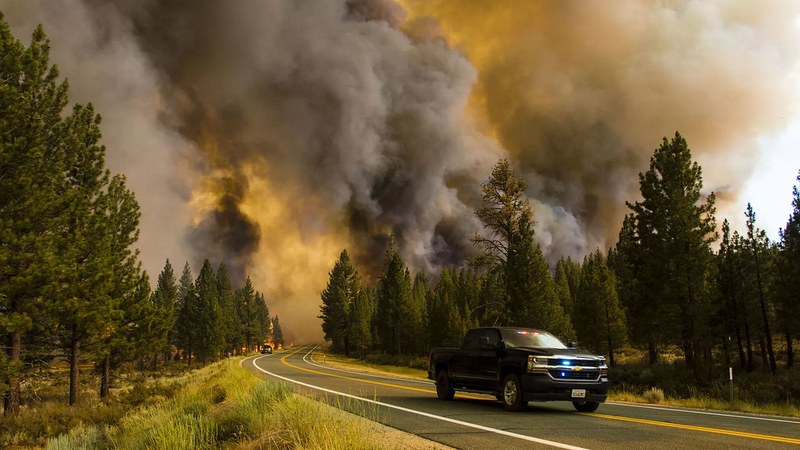
More than 10,700 flights across the United States were delayed on Friday, July 17, 2026, after dense smoke from over 900 active wildfires in Canada spread hazardous air conditions across the US Midwest, Great Lakes, and East Coast regions. Over 100 million Americans in 18 states experienced dangerous particulate matter levels (PM2.5) over six continuous days, severely impacting air traffic operations.
Airline Advisories and Waivers Covering U.S. and Canadian Airports
United Airlines issued a travel advisory from July 16 to 18 for 17 airports in the US and Canada, including Detroit and Toronto Pearson, offering passengers ticket rebooking without change fees or fare differences for flights on July 17
or 18 if purchased by July 16, with rebooking available through July 20. Delta Air Lines released a Midwest Air Quality Advisory for flights spanning July 16 to 18, covering cities such as Detroit, Minneapolis-St. Paul, Milwaukee, and Green Bay, allowing rebooking with no additional cost until July 21. American Airlines faced delays on 42% of its flights on July 17—more than double its 2026 average—and extended travel waivers through July 18 for affected flights across 29 airports.
Operational Disruptions at Philadelphia and Other Key Airports
Philadelphia International Airport experienced 365 flight delays and 12 cancellations on Thursday, July 16, followed by over 200 delays on Friday, July
17. These disruptions forced the Federal Aviation Administration to implement a ground delay program. Other major hubs impacted include Chicago O’Hare, Detroit Metropolitan, and airports within the Great Lakes region, where visibility reduction due to smoke complicated air traffic control beyond typical weather-related challenges. Travelers were advised to allow extra connection time at these airports.
Hazardous Air Quality Levels and Health Guidance
Smoke conditions peaked with PM2.5 measurements exceeding 600 micrograms per cubic meter in Northern Minnesota and Detroit on July 16 and 17, vastly surpassing the Environmental Protection Agency’s hazardous air quality index (AQI) threshold of 500. Chicago’s AQI reached approximately 153 at 6 a.m. on
Sunday, July 19, ranking as the second worst major city globally for air pollution at that time. The EPA recommended limiting outdoor exertion above AQI 150 and avoiding outdoor physical activity entirely above AQI 200. Use of N95 or KN95 masks was advised for improved filtration of fine particulates. The National Weather Service projected a third smoke wave across the Great Lakes and Northeast regions through Sunday.
Political and Trade Tensions Over Wildfire Smoke
Former President Donald Trump posted on July 17 that the costs from smoke pollution “must of necessity be added to the TARIFFS Canada is currently paying,” accusing Canada of “willful negligence” in fire
management. Trump referenced tariffs including a 10% duty imposed in October 2025 and a broader over 45% softwood lumber tariff rate. Prime Minister Mark Carney responded that addressing climate change is “the responsibility of all countries, including the United States” and highlighted U.S. withdrawal from international climate commitments since 2025. Emergency Management Minister Eleanor Olszewski confirmed Canada has invested $12 billion in forest sustainability and fire prevention since 2020. Ontario Premier Doug Ford criticized U.S. tariff threats, calling on the U.S. to lift tariffs if truly supportive of Canadian forest management efforts.
Legally, experts noted Trump’s tariff threats lack a
clear mechanism following a February 2026 Supreme Court ruling restricting presidential tariff authority. Most Canadian goods covered by the Canada-United States-Mexico Agreement remain exempt from the current 10% global tariff, which is set to expire on July 24, 2026.
Climate and Fire Conditions Driving the Smoke and Research Lab Closures
The wildfires ignited amid a record-breaking North American heatwave, with temperatures on July 13 in the Ontario-Minnesota cluster 25.2°F above the daily average, attributed to climate change by meteorologists. Shel Winkley of Climate Central stated such temperatures “would be virtually impossible to occur” without climate change influence. Canada’s 2026 wildfire season reached 134% of the 10-year average through mid-July, while U.S.
wildfires have burned 5,740 square miles in 2026, exceeding the 10-year average by 31%. The U.S. administration’s pending closure of wildfire smoke research facilities, including the Pacific Wildland Fire Sciences Lab in Seattle, threatens ongoing efforts to understand and mitigate wildfire smoke impacts.