
On July 18, the FAA’s official delay programmes impacted 29 airports across the United States with a total of 48 programmes in force. Philadelphia International Airport (PHL) was the worst-hit location, experiencing the longest continuous ground stop spanning 11 hours and 40 minutes.
Ground Stop and Ground Delay Programmes at Major Airports
Of the 48 programmes active on July 18, 17 were ground stop programmes, 12 were ground delay programmes, and 19 were general delay information alerts. A ground stop holds departures bound for an airport on the ground at their origin, while a ground delay programme meters arrivals by assigning later departure times.
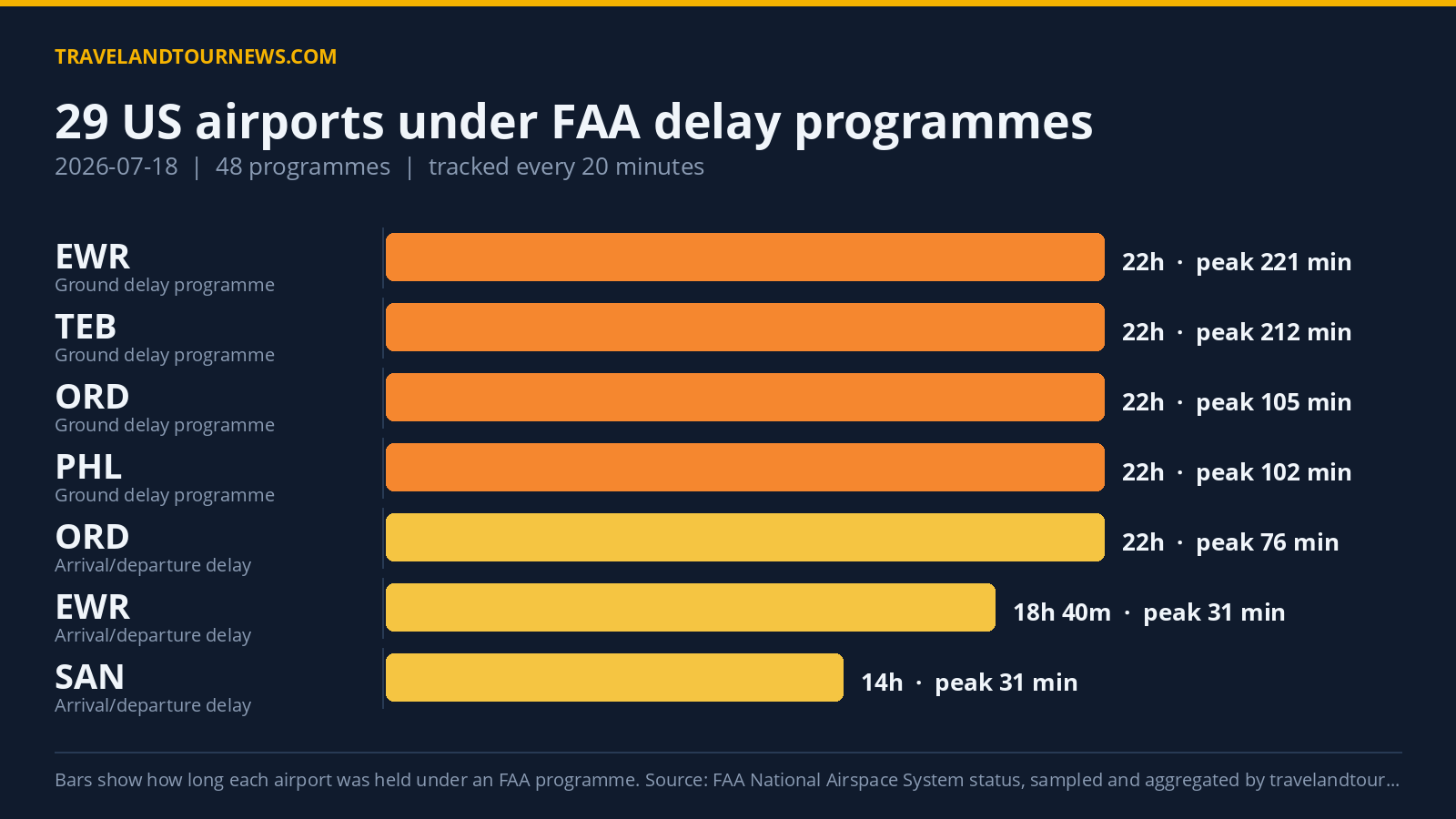
Philadelphia International (PHL) recorded a ground stop lasting from 10:20 UTC to 22:00 UTC, totaling 700 minutes (11 hours 40 minutes). This programme was accompanied by a ground delay programme active for 22 hours (1320 minutes) starting at midnight UTC, with peak average delays of 102 minutes and
maximum delays up to 187 minutes. The ground stop reasons included thunderstorms and other causes, while the ground delay programme cited low visibility along with thunderstorms.
Newark Liberty International Airport (EWR) had both ground stop and ground delay programmes too. The ground stop lasted 700 minutes from 10:20 to 22:00 UTC, driven by thunderstorms. Newark’s ground delay programme lasted 22 hours, with peak average delays reaching 221 minutes and a maximum delay of 540 minutes. Other airports with lengthy ground delay programmes spanning the full 22 hours included Teterboro (TEB) and Chicago O’Hare (ORD).
Several New York City area airports
had ground stop programmes tied to thunderstorms lasting between 4 hours 20 minutes and nearly 12 hours, including LaGuardia (LGA) for 700 minutes, John F. Kennedy (JFK) for 300 minutes, and Westchester County (HPN) for 320 minutes. Boston Logan International (BOS) also saw a combined ground stop programme with a 340-minute duration referencing thunderstorms.
| Airport | FAA programme | Cause | Peak average delay | In force (UTC) |
|---|---|---|---|---|
| Philadelphia International (PHL) | Ground Stop Programs | thunderstorms; other | – | 10:20 to 22:00 (11 hours 40 minutes) |
| LaGuardia (LGA) | Ground Stop Programs | thunderstorms | – | 10:20 to 22:00 (11 hours 40 minutes) |
| Newark Liberty International (EWR) | Ground Stop Programs | thunderstorms | – | 10:20 to 22:00 (11 hours 40 minutes) |
| TEB | Ground Stop Programs | thunderstorms | – | 16:00 to 22:00 (6 hours) |
| Boston Logan International (BOS) | Ground Stop Programs | thunderstorms; THUNDERSTORMS | – | 16:20 to 22:00 (5 hours 40 minutes) |
| HPN | Ground Stop Programs | thunderstorms | – | 16:40 to 22:00 (5 hours 20 minutes) |
| BDL | Ground Stop Programs | thunderstorms | – | 16:40 to 22:00 (5 hours 20 minutes) |
| John F. Kennedy International (JFK) | Ground Stop Programs | thunderstorms | – | 17:00 to 22:00 (5 hours) |
| CDW | Ground Stop Programs | thunderstorms | – | 17:00 to 22:00 (5 hours) |
| MMU | Ground Stop Programs | THUNDERSTORMS; thunderstorms | – | 17:00 to 22:00 (5 hours) |
| Ronald Reagan Washington National (DCA) | Ground Stop Programs | thunderstorms | – | 17:40 to 22:00 (4 hours 20 minutes) |
| Washington Dulles International (IAD) | Ground Stop Programs | thunderstorms | – | 17:40 to 22:00 (4 hours 20 minutes) |
| Baltimore/Washington International (BWI) | Ground Stop Programs | thunderstorms | – | 17:40 to 22:00 (4 hours 20 minutes) |
| FRG | Ground Stop Programs | thunderstorms | – | 19:20 to 21:00 (1 hour 40 minutes) |
Thunderstorms Drove the Majority of Delay Programmes
The dominant cause stated in the FAA’s delay programmes was thunderstorms, which accounted for 391 delay reports, far surpassing all other causes. Secondary reasons included Traffic Management (TM) initiatives prompted by weather (SWAP:WX and MIT:WX) contributing 179 reports combined, with “other” causes at 72 and airport
volume accounting for 22 delay reports.
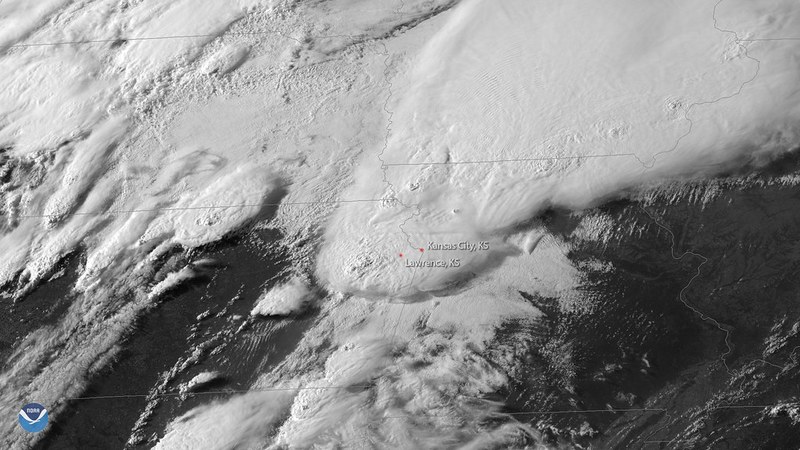
Thunderstorms affected multiple airports simultaneously, explaining the extensive ground stop coverage in the northeastern U.S. and parts of the Midwest. All major northeastern hubs including Philadelphia, Newark, LaGuardia, JFK, Boston Logan, and several smaller regional airports experienced weather-related restrictions due to thunderstorms.
Compared with Previous Days, Delay Programmes Increased
July 18 saw 29 airports affected by FAA delay programmes compared to 23 the previous day, an increase of 6 airports under restrictions. The total number of active programmes rose from 36 to 48. Over the previous five-day average of 18.4 affected airports, July 18 had the highest number of airports under
delay programmes in the tracked window.
This higher concentration of delay programmes and affected airports marks July 18 as the most impacted day within the recent five-day reporting span, based on the FAA data tracked by travelandtournews.com.
Methodology. travelandtournews.com samples the FAA’s National Airspace System status feed every 20 minutes throughout the US operating day and aggregates the result. This report is built from 67 samples taken between 00:00 and 22:00 UTC on 2026-07-18. Durations are the observed window between the first and last sample in which a programme was in force, so a programme’s true length may be slightly
longer than shown. Ground stops, ground delay programmes, airport closures and general delays are all published by the FAA in real time; the daily aggregation is ours.