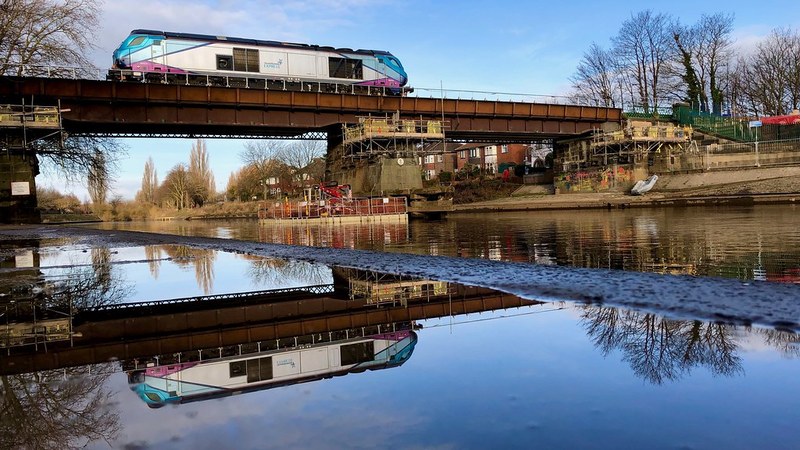
Passenger train services on the cross-border Wunderline railway between Groningen in the Netherlands and Leer in Germany resumed on October 5, 2026, after an almost ten-year interruption caused by the damage to the Friesen Bridge over the River Ems in December 2015. Following the collision by a ship that irreparably damaged the bridge, replacement buses operated between Weener and Leer, while express bus services connected Groningen and Leer during the extended disruption.
Friesen Bridge Replacement Project
Deutsche Bahn invested around €200 million to replace the destroyed Friesen Bridge and reinstate rail services. The original bridge was dismantled in 2021, with the first component of
the new bridge installed in August 2024. The newly constructed bridge measures 335 meters in length, making it Europe’s largest swing and lift rail bridge. Designed by Schlaich Bergermann Partner, the bridge features a swinging section of 145 meters that weighs 1,800 tonnes. It accommodates a single railway track alongside a footpath and cycle lane. The passage width for maritime traffic has been doubled compared to the previous structure, facilitating easier ship navigation through the opening.
Infrastructure Upgrades Along the Wunderline Corridor
Beyond rebuilding the bridge, infrastructure improvements took place across the 173-kilometer Wunderline route. Dutch infrastructure manager ProRail and German counterpart DB InfraGO led upgrades
including track renewal, signalling enhancements, level crossing improvements, and trackbed reinforcement to allow for higher train speeds. While work on the Dutch side was completed in August 2025, criticism arose from the Province of Groningen over what it described as a lack of urgency by the German state of Niedersachsen during autumn 2025.
Current Train Service Operations
Arriva currently operates an hourly passenger train service on weekdays on the Wunderline route, requiring passengers to transfer at Winschoten in the Netherlands. Direct trains running between Groningen and Leer operate during early morning, late evening, and weekend periods. The route faces operational constraints including a speed
restriction at Hurdegaryp and delays caused by bridge swing openings for maritime traffic, as the bridge allows rail traffic only at limited times.
Plans for a Direct Service Between Groningen and Bremen
The Province of Groningen, Niedersachsen, Bremen, ProRail, Deutsche Bahn, and other stakeholders are developing plans for a direct train service between Groningen and Bremen that would eliminate the need to change trains at Leer. This proposed service would reduce travel time by approximately 15 minutes, targeting a journey duration of 2 hours and 11 minutes. The project includes plans for double-tracking sections in Germany; however, funding for these improvements has not yet been confirmed. Regional authorities emphasize
that enhanced international rail connections strengthen economic links and promote sustainable transport across the border.