The Federal Aviation Administration experienced a critical equipment outage on September 21, 2026, resulting in grounded flights and delays at Newark Liberty International, John F. Kennedy International, LaGuardia, Philadelphia International, and Teterboro airports.
The outage was triggered when a construction crew working on the Delco Lead rail project between New Brunswick and North Brunswick, New Jersey, accidentally severed a backup fiber-optic cable around 9:45 a.m. This fiber served as a backup to a primary circuit at the Philadelphia Terminal Radar Approach Control (TRACON) facility that had already failed. FAA Administrator Bryan Bedford confirmed, “The primary circuit in Philadelphia TRACON failed.
The backup line also had a break.” The resulting communications failure disrupted air traffic control frequencies essential for managing flights into the affected airports.
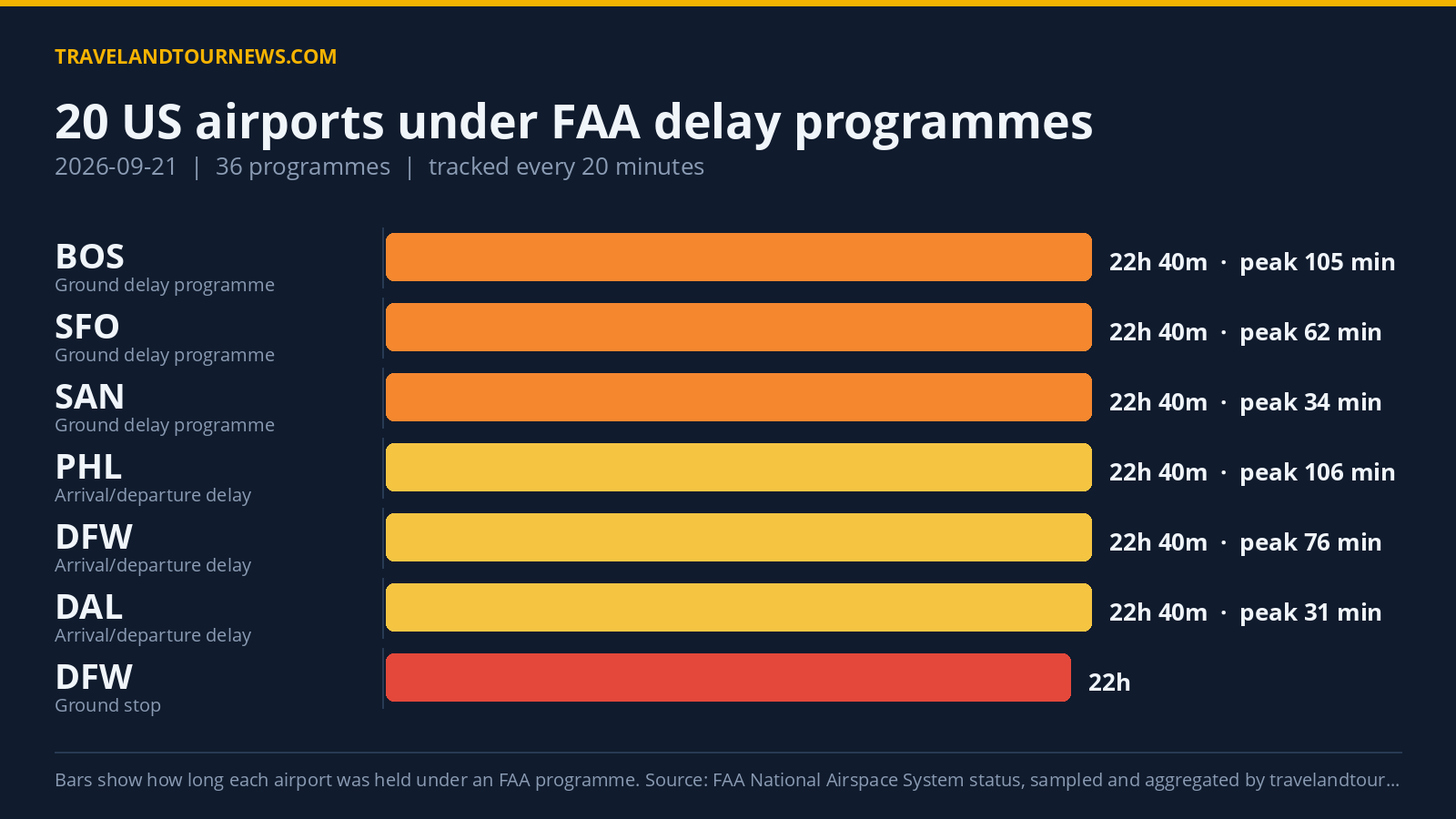
Ground stops for John F. Kennedy International and LaGuardia airports started just before 5:30 p.m., with JFK flights halted until 6:30 p.m. and LaGuardia flights paused until 6:15 p.m. Newark Liberty International had a ground delay lasting until 8:45 p.m. FAA estimated the fiber repair would take approximately 13 hours to complete due to the extent of the damage.
By 5 p.m., Newark Liberty International had canceled more than 600 flights, representing about half of its
daily schedule, and nearly 100 flights were delayed. Philadelphia International Airport saw roughly 200 cancellations and over 400 delays. Flights already in the air at time of the ground stops were diverted to alternate airports including Boston Logan, Detroit Metropolitan Wayne County, and Washington Dulles International Airports. International flights bound for Newark had to divert, originating from locations such as Iceland, Egypt, Greece, Spain, and France.
Major airlines responded by waiving fees amid the disruption. United Airlines announced it would waive flight change fees for affected customers, while American Airlines provided the same waiver and allowed passengers to depart from
alternate airports. According to reports, flights experienced average delays of about 112 minutes at Newark.
FAA, Verizon, NJ Transit, and Transportation Secretary Sean Duffy provided official statements detailing the incident. Verizon clarified, “Construction contractors working in the area dug up and cut our cable. Verizon’s facilities were fully functional up to that point. Verizon bears no responsibility for this incident.” NJ Transit acknowledged the fiber break, stating the crew was operating roughly 10 feet from utility markings and staff were on site assessing repairs and investigating responsibility for the utility markings. Secretary Duffy confirmed the outage was caused by the
cable cut by an Amtrak crew in New Jersey.
FAA spokeswoman commented, “The FAA is pausing flights into Philadelphia International, Teterboro and Newark Liberty International airports due to issues with some frequencies at Philadelphia TRACON.” The incident highlights vulnerabilities within aging air traffic control infrastructure, as the primary and backup systems both failed simultaneously. This disruption occurred the same day as the United Nations General Assembly in New York, which affects the arrival schedules of numerous international leaders.
Federal efforts to modernize air traffic control are underway, with Congress approving $12.5 billion in funding for equipment upgrades and increased staffing
to address systemic challenges. FAA Administrator Bedford emphasized the severity of the break, calling it “massive” and requiring extensive repairs to restore operational capacity.