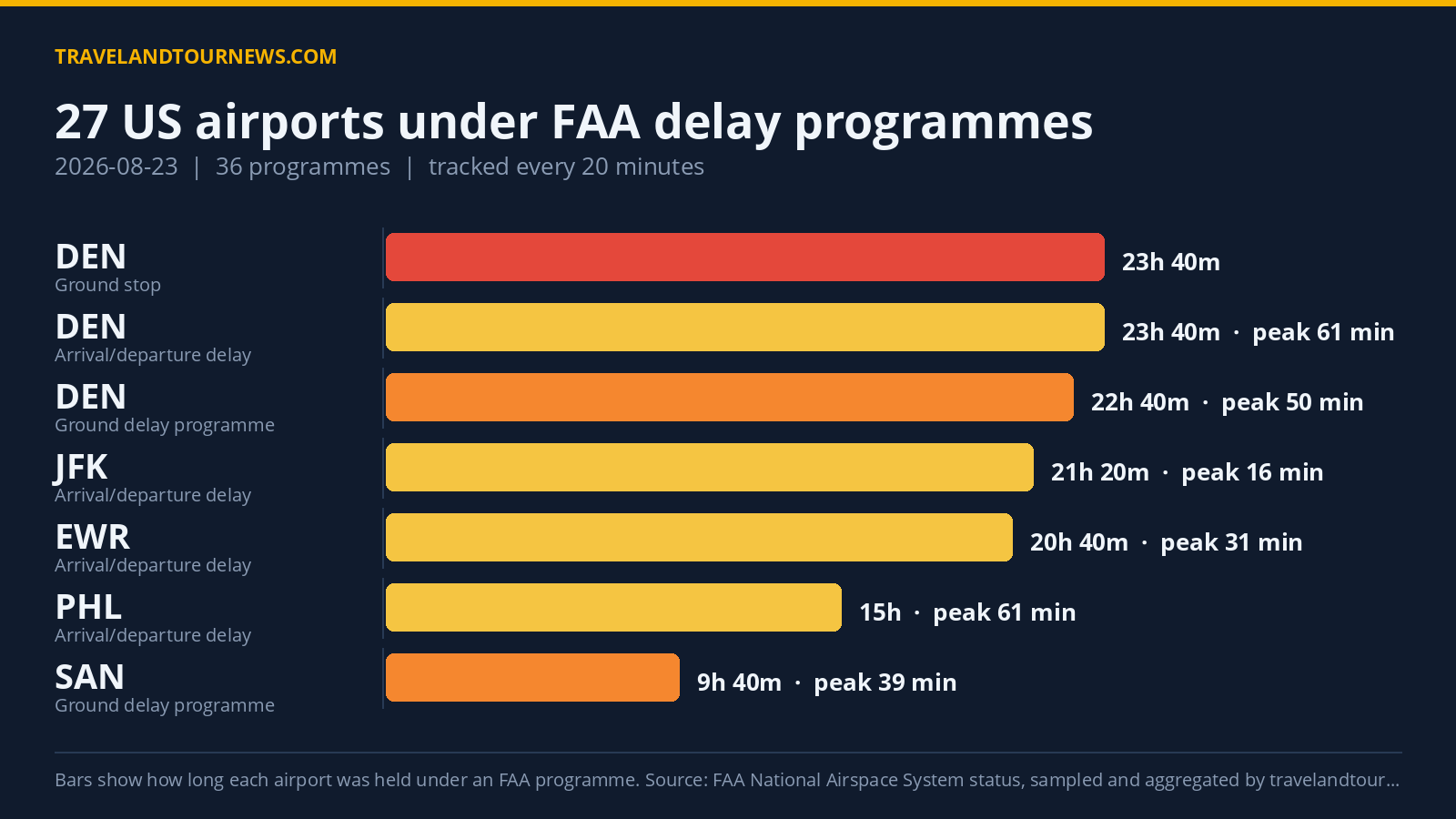

On August 23, 2026, the FAA delay programmes covered 27 airports across the United States, with a total of 36 active programmes. Denver International Airport (DEN) was the worst affected, experiencing programmes lasting almost 24 hours, including a ground stop triggered by thunderstorms.
Delay Programmes by Airport and Type
Among the 36 programmes, 10 were ground stop programmes, 9 were ground delay programmes, and 17 consisted of general arrival and departure delay information. A ground stop holds departures bound for an airport while still on the ground at their origin, and a ground delay programme meters arrivals by assigning later departure times.
Denver International (DEN) had a ground stop programme due to thunderstorms that lasted 23 hours and 40 minutes, effectively the entire day, although without reported peak delays. It also had a ground delay programme for 22 hours and 40 minutes, with peak average delays reaching 50 minutes
and maximum delays up to 140 minutes due to the same thunderstorm conditions. Additionally, DEN recorded general arrival/departure delays linked to weather, where peak delays averaged 61 minutes.
Boston Logan International (BOS) experienced the longest ground delay programme, lasting 7 hours and 40 minutes due to wind, with peak average delays of 124 minutes and a maximum delay reaching 424 minutes, the highest maximum delay of the day. BOS also had a 40-minute ground stop caused by airport volume and thunderstorms and a four-hour general delay period due to thunderstorms, peaking at 91 average delay minutes.
San Diego International (SAN)
held a ground delay programme for 9 hours and 40 minutes due to airport volume, showing peak average delays of 39 minutes. Newark Liberty International (EWR) underwent an 180-minute ground delay programme attributed to other causes and a 40-minute ground stop linked to thunderstorms.
John F. Kennedy International (JFK) was affected by a 4-hour 40-minute ground stop and a 1-hour ground delay programme, both caused by thunderstorms and other reasons, respectively. Other airports with ground stops included Tampa (TPA), Washington Dulles (IAD), and Chicago O’Hare (ORD), mostly triggered by thunderstorms or wind conditions.
| Airport | FAA programme | Cause | Peak average delay | In force (UTC) |
|---|---|---|---|---|
| Denver International (DEN) | Ground Stop Programs | thunderstorms | – | 00:00 to 23:40 (23 hours 40 minutes) |
| John F. Kennedy International (JFK) | Ground Stop Programs | thunderstorms | – | 11:00 to 15:40 (4 hours 40 minutes) |
| YLW | Ground Stop Programs | fire | – | 02:00 to 03:20 (1 hour 20 minutes) |
| YVR | Ground Stop Programs | other | – | 12:00 to 13:20 (1 hour 20 minutes) |
| Tampa International (TPA) | Ground Stop Programs | thunderstorms | – | 16:40 to 17:40 (1 hour) |
| Boston Logan International (BOS) | Ground Stop Programs | airport volume; thunderstorms | – | 15:00 to 15:40 (40 minutes) |
| Newark Liberty International (EWR) | Ground Stop Programs | thunderstorms | – | 15:00 to 15:40 (40 minutes) |
| Chicago O’Hare International (ORD) | Ground Stop Programs | thunderstorms | – | 00:40 to 00:40 (20 minutes) |
| YUL | Ground Stop Programs | thunderstorms | – | 20:00 to 20:00 (20 minutes) |
| Detroit Metropolitan Wayne County (DTW) | Ground Stop Programs | wind | – | 23:00 to 23:00 (20 minutes) |
| TEB | Ground Delay Programs | other | 141 min | 22:00 to 22:40 (40 minutes) |
| YUL | Ground Delay Programs | thunderstorms | 128 min | 22:40 to 22:40 (20 minutes) |
| Boston Logan International (BOS) | Ground Delay Programs | wind | 124 min | 16:00 to 23:40 (7 hours 40 minutes) |
| Newark Liberty International (EWR) | Ground Delay Programs | other | 68 min | 20:40 to 23:40 (3 hours) |
Thunderstorms and Weather Events as Leading Causes
The primary cause driving the highest number
of delay programmes was listed as “TM Initiatives:SWAP:WX,” cited in 67 cases, indicating traffic management adaptations related to weather. Thunderstorms were the next major factor directly causing 37 programmes, closely followed by airport volume with 31 cases. Plain mention of thunderstorms accounted for 28 programmes, and wind was responsible for 25 delay instances.
Specifically, all ground stop programmes affecting Denver, JFK, Boston, Newark, Tampa, Chicago O’Hare, and Washington Dulles referenced thunderstorms as the key cause. Fires triggered a shorter ground stop at YLW, while “other” reasons applied to programs at EWR, JFK, YVR, and TEB. Low ceilings contributed to delays
at San Francisco (SFO).
More Airports and Programmes Than Yesterday and Weekly Average
Compared with the previous day, the number of affected airports rose from 21 to 27, and the total delay programmes increased by 6 from 28 to 36. The affected count also surpasses the 7-day average of 17.7 airports under delay programmes. This marks August 23 as the day with the highest activity in our tracking window.
Methodology. travelandtournews.com samples the FAA’s National Airspace System status feed every 20 minutes throughout the US operating day and aggregates the result. This report is built from 72 samples taken between 00:00 and 23:40 UTC on 2026-08-23. Durations are the
observed window between the first and last sample in which a programme was in force, so a programme’s true length may be slightly longer than shown. Ground stops, ground delay programmes, airport closures and general delays are all published by the FAA in real time; the daily aggregation is ours.