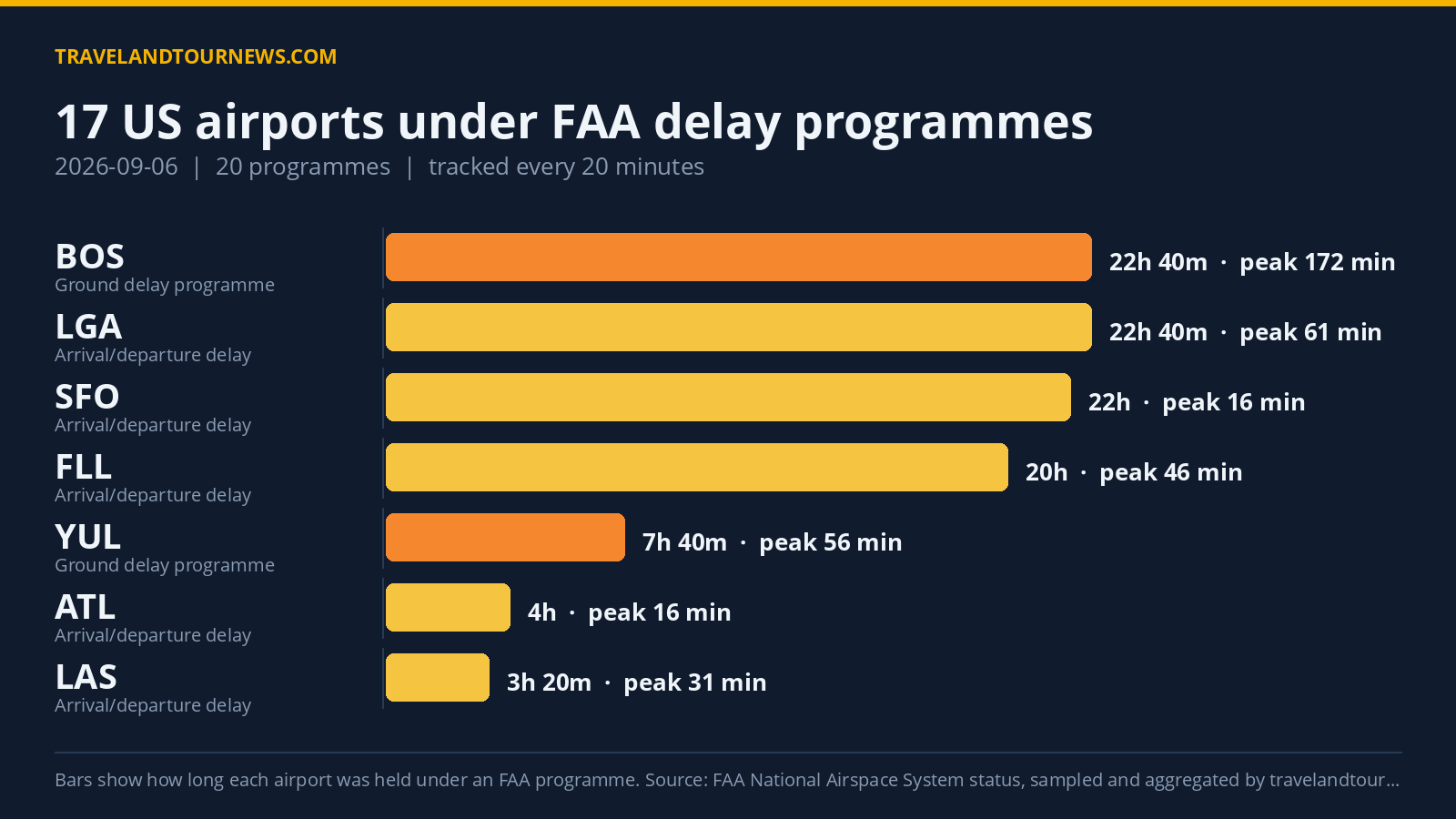

On September 6, 2026, the FAA held 17 United States airports under a total of 20 delay programmes, with Miami International Airport (MIA) experiencing the worst disruptions. The peak maximum delay recorded at MIA reached 1,137 minutes during ground delay programmes triggered by a disabled aircraft on the runway.
FAA Delay Programmes Across 17 Airports
Seventeen airports were affected by FAA delay programmes, which included 5 ground stop programmes, 4 ground delay programmes, and 11 general arrival/departure delay notifications. A ground stop holds departures bound for an airport on the ground at their origin, while a ground delay programme meters arrivals by assigning later departure times.
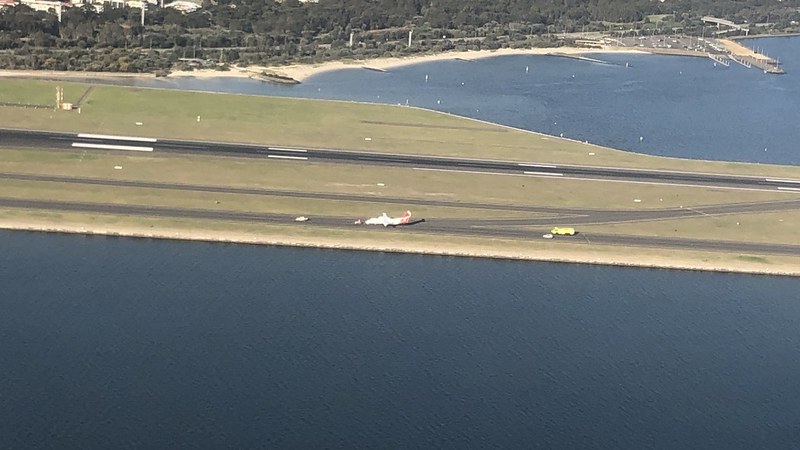
The longest programme observed was a ground delay at Boston Logan International (BOS), lasting 22 hours and 40 minutes with a peak average delay of 172 minutes and a peak maximum delay of 434 minutes. Miami International’s ground stop programme lasted 3 hours, from 18:00 to 21:00 UTC, caused
by a disabled aircraft blocking the runway and classified as “DISABLED.” This issue also instigated a ground delay programme at MIA lasting 1 hour and 20 minutes with a peak average delay of 384 minutes.
Other ground stop programmes included Toronto Pearson International (YYZ) for 1 hour due to airport volume, Boise (BOI) for 1 hour related to a fire, Westchester County Airport (HPN) for 20 minutes due to a disabled aircraft on the runway, and Burbank (BUR) for 20 minutes caused by thunderstorms. General arrival/departure delay programmes were widespread, with airports like LaGuardia (LGA), Fort Lauderdale-Hollywood (FLL), Las Vegas
(LAS), San Francisco (SFO), and others reporting delays primarily linked to weather and runway construction.
| Airport | FAA programme | Cause | Peak average delay | In force (UTC) |
|---|---|---|---|---|
| Miami International (MIA) | Ground Stop Programs | disabled aircraft on the runway; DISABLED | – | 18:00 to 21:00 (3 hours) |
| YYZ | Ground Stop Programs | airport volume | – | 17:00 to 18:00 (1 hour) |
| BOI | Ground Stop Programs | fire | – | 20:40 to 21:40 (1 hour) |
| HPN | Ground Stop Programs | disabled aircraft on the runway | – | 19:40 to 19:40 (20 minutes) |
| BUR | Ground Stop Programs | thunderstorms | – | 22:40 to 22:40 (20 minutes) |
| Miami International (MIA) | Ground Delay Programs | disabled aircraft on the runway | 384 min | 21:20 to 22:40 (1 hour 20 minutes) |
| Boston Logan International (BOS) | Ground Delay Programs | runway construction; other | 172 min | 00:00 to 22:40 (22 hours 40 minutes) |
| YUL | Ground Delay Programs | other | 56 min | 15:00 to 22:40 (7 hours 40 minutes) |
| Chicago O’Hare International (ORD) | Ground Delay Programs | other | 25 min | 21:20 to 22:40 (1 hour 20 minutes) |
| LaGuardia (LGA) | General Arrival/Departure Delay Info | TM Initiatives:SWAP:WX; RWY:Disabled Aircraft | 61 min | 00:00 to 22:40 (22 hours 40 minutes) |
| Fort Lauderdale-Hollywood International (FLL) | General Arrival/Departure Delay Info | TM Initiatives:MIT:WX; WX:Thunderstorms | 46 min | 00:40 to 20:40 (20 hours) |
| Harry Reid International (LAS) | General Arrival/Departure Delay Info | TM Initiatives:MIT:WX | 31 min | 17:00 to 20:20 (3 hours 20 minutes) |
| Miami International (MIA) | General Arrival/Departure Delay Info | TM Initiatives:MIT:WX | 31 min | 00:40 to 02:00 (1 hour 20 minutes) |
| Orlando International (MCO) | General Arrival/Departure Delay Info | WX:Thunderstorms | 31 min | 22:00 to 22:40 (40 minutes) |
Causes Behind the Delay Programmes
The FAA’s stated reasons for delay programmes on September 6 were led by “other” causes accounting for 54 instances across the country. Thunderstorms accounted for 28 occurrences, while traffic management initiatives related to weather contributed 18, and runway construction appeared in 17 cases. Disabled aircraft on the runway caused 15 delay instances, most notably affecting Miami International and Westchester County.
Specifically, disabled aircraft on the runway was the cause of Miami’s most severe ground stop and ground delay programmes, as well as a shorter ground
stop at Westchester County. Thunderstorms impacted several airports including Atlanta (ATL), Fort Lauderdale-Hollywood (FLL), Orlando (MCO), and Chicago O’Hare (ORD). Construction work slowed operations at Boston Logan and San Francisco International.
Delay Trend Compared With Previous Days
Compared with September 5, 2026, the number of airports affected increased by 8, from 9 to 17, and delay programmes rose from 11 to 20. When compared to the recent seven-day average of 18.9 airports affected, the day’s 17 airports were slightly below average. The total number of programmes remained elevated but did not surpass the highest level within the tracking window.
Methodology. travelandtournews.com samples the FAA’s National Airspace
System status feed every 20 minutes throughout the US operating day and aggregates the result. This report is built from 56 samples taken between 00:00 and 22:40 UTC on 2026-09-06. Durations are the observed window between the first and last sample in which a programme was in force, so a programme’s true length may be slightly longer than shown. Ground stops, ground delay programmes, airport closures and general delays are all published by the FAA in real time; the daily aggregation is ours.