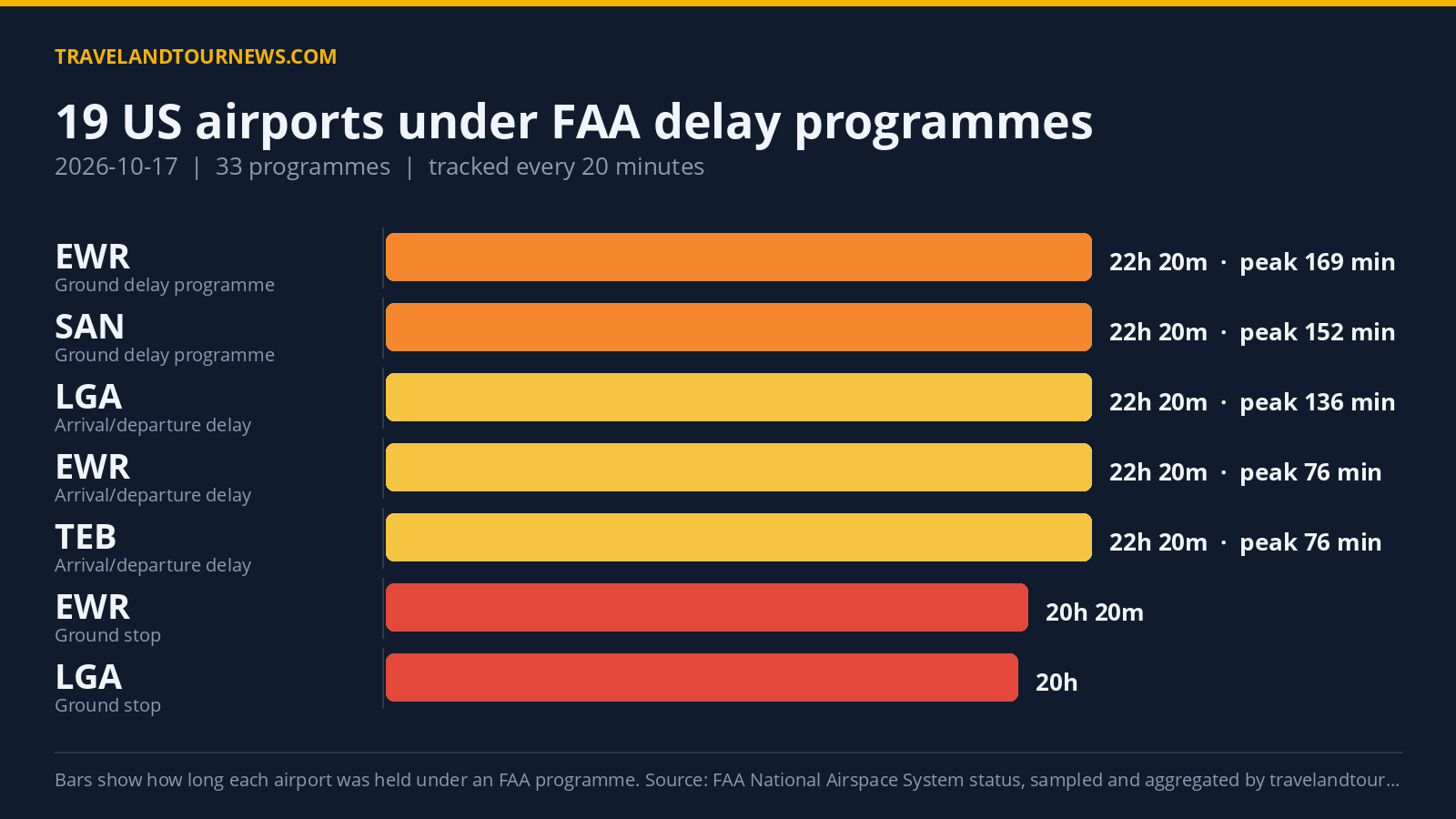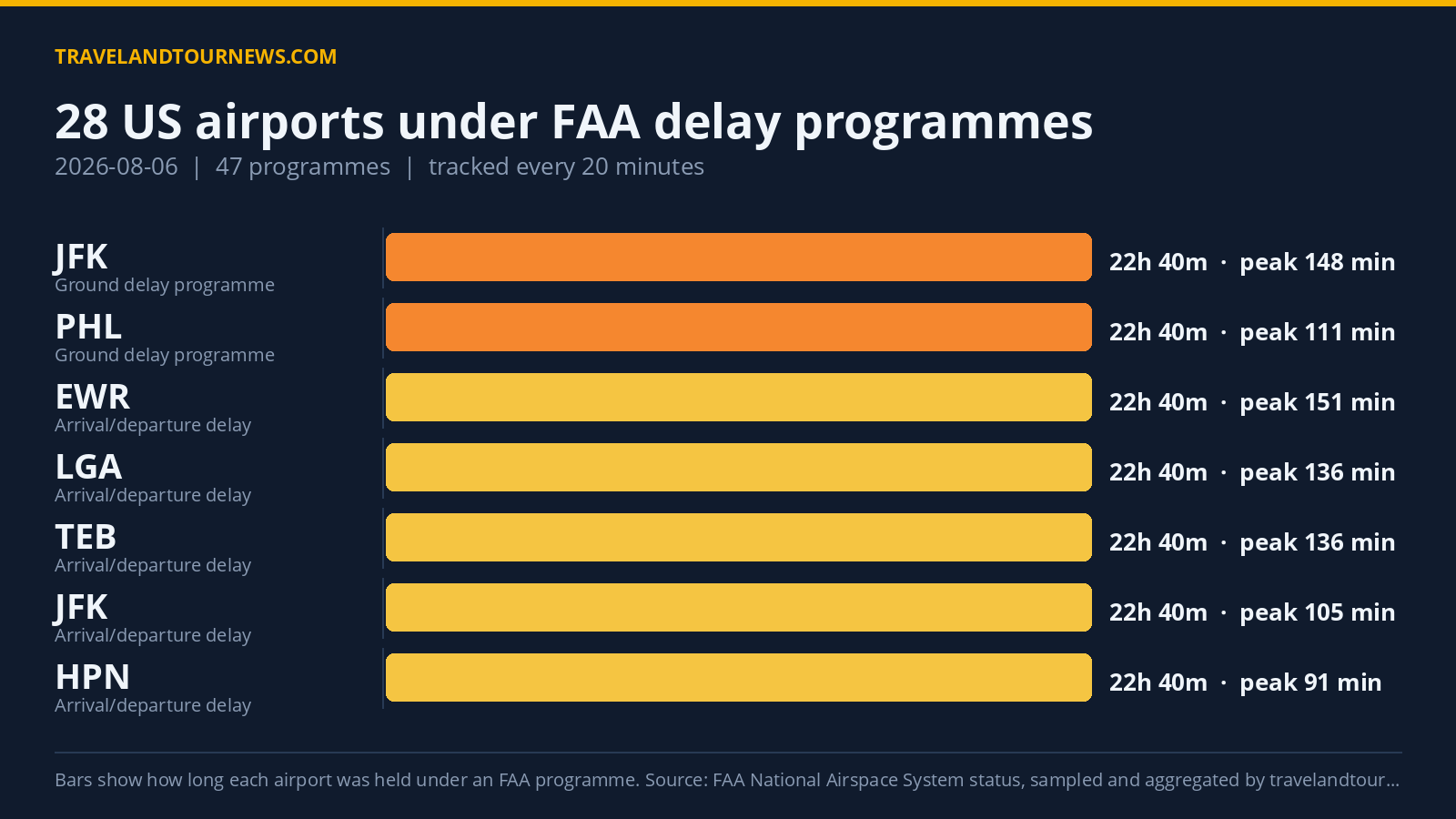

On August 6, 2026, 28 airports across the United States were impacted by a total of 47 FAA delay programs. The worst-hit airport was Orlando International (MCO), which experienced a ground stop program lasting 5 hours due to thunderstorms.
Delay Programs Varied Widely in Scope and Duration
The FAA implemented three types of delay programs during the day: 13 Ground Stop Programs, 11 Ground Delay Programs, and 23 instances of general arrival or departure delay information. A ground stop holds departures bound for an airport on the ground at their origin, while a ground delay program meters arrivals by assigning later departure times.
Orlando International (MCO) had the longest ground stop program, observed between 17:40 and 22:40 UTC, lasting 5 hours. Other ground stops with similar causes included LaGuardia (LGA) for over 4 hours and Ronald Reagan Washington National (DCA) and Washington Dulles International (IAD) for nearly
4 hours each. Newark Liberty International (EWR) had a ground delay program lasting 22 hours and 20 minutes, with a peak average delay of 273 minutes and a maximum delay reaching 505 minutes.
Boston Logan International (BOS) had a ground delay program focused on low ceilings lasting over 5 hours, with peak average delays of 85 minutes. Seattle-Tacoma International (SEA) experienced a ground delay program for low visibility for 18 hours, peaking at an average delay of 57 minutes.
| Airport | FAA programme | Cause | Peak average delay | In force (UTC) |
|---|---|---|---|---|
| Orlando International (MCO) | Ground Stop Programs | thunderstorms | – | 17:40 to 22:40 (5 hours) |
| LaGuardia (LGA) | Ground Stop Programs | thunderstorms | – | 18:20 to 22:40 (4 hours 20 minutes) |
| Ronald Reagan Washington National (DCA) | Ground Stop Programs | thunderstorms | – | 19:00 to 22:40 (3 hours 40 minutes) |
| Washington Dulles International (IAD) | Ground Stop Programs | thunderstorms | – | 19:00 to 22:40 (3 hours 40 minutes) |
| YUL | Ground Stop Programs | thunderstorms; other | – | 18:40 to 22:00 (3 hours 20 minutes) |
| Newark Liberty International (EWR) | Ground Stop Programs | thunderstorms | – | 19:20 to 22:40 (3 hours 20 minutes) |
| Boston Logan International (BOS) | Ground Stop Programs | thunderstorms | – | 20:00 to 22:40 (2 hours 40 minutes) |
| Minneapolis-Saint Paul International (MSP) | Ground Stop Programs | OCL: | – | 19:20 to 21:20 (2 hours) |
| YYZ | Ground Stop Programs | thunderstorms | – | 20:40 to 22:40 (2 hours) |
| Baltimore/Washington International (BWI) | Ground Stop Programs | thunderstorms | – | 20:40 to 22:40 (2 hours) |
| Harry Reid International (LAS) | Ground Stop Programs | WIND; wind | – | 20:40 to 22:00 (1 hour 20 minutes) |
| Tampa International (TPA) | Ground Stop Programs | thunderstorms | – | 21:40 to 22:40 (1 hour) |
| Hartsfield-Jackson Atlanta International (ATL) | Ground Stop Programs | thunderstorms | – | 22:20 to 22:40 (20 minutes) |
| Newark Liberty International (EWR) | Ground Delay Programs | thunderstorms; other | 273 min | 00:20 to 22:40 (22 hours 20 minutes) |
Several other airports such as San Diego (SAN) faced delays related to airport volume for almost 9 hours, and San Francisco International (SFO) reported delays over 22 hours due to other causes and low ceilings.
Thunderstorms Drove the Majority of Delay Programs
The FAA’s official reasons for delay programs were led by “TM Initiatives:SWAP:WX” with 183 instances, closely followed by thunderstorms with 165
instances. Other frequent causes included low ceilings (44 instances), “TM Initiatives:MIT:WX” (42), and additional mentions of thunderstorms under the label “WX:Thunderstorms” (39).
Thunderstorms were the direct cause cited for major ground stop programs at Orlando (MCO), LaGuardia (LGA), Ronald Reagan Washington National (DCA), Washington Dulles (IAD), Newark Liberty (EWR), Tampa (TPA), and Baltimore/Washington International (BWI). Wind and other weather-related factors appeared at Harry Reid International (LAS) and Minneapolis-Saint Paul (MSP).
Other significant causes included low visibility at Seattle (SEA) and low ceilings at Boston Logan (BOS) and San Francisco (SFO). Airport volume was specifically mentioned at San Diego (SAN).
Delay Activity Higher Than Previous Days at More Airports
Compared
with August 5, 2026, when 21 airports were affected by 28 programs, August 6 saw an increase of 7 airports and 19 more programs. The seven-day average prior to August 6 showed 20.3 airports affected, confirming that August 6 had the highest airport count in the recent tracking window. This indicates a notable rise in FAA delay program activity for the United States on this date.
Methodology. travelandtournews.com samples the FAA’s National Airspace System status feed every 20 minutes throughout the US operating day and aggregates the result. This report is built from 68 samples taken between 00:00 and 22:40
UTC on 2026-08-06. Durations are the observed window between the first and last sample in which a programme was in force, so a programme’s true length may be slightly longer than shown. Ground stops, ground delay programmes, airport closures and general delays are all published by the FAA in real time; the daily aggregation is ours.