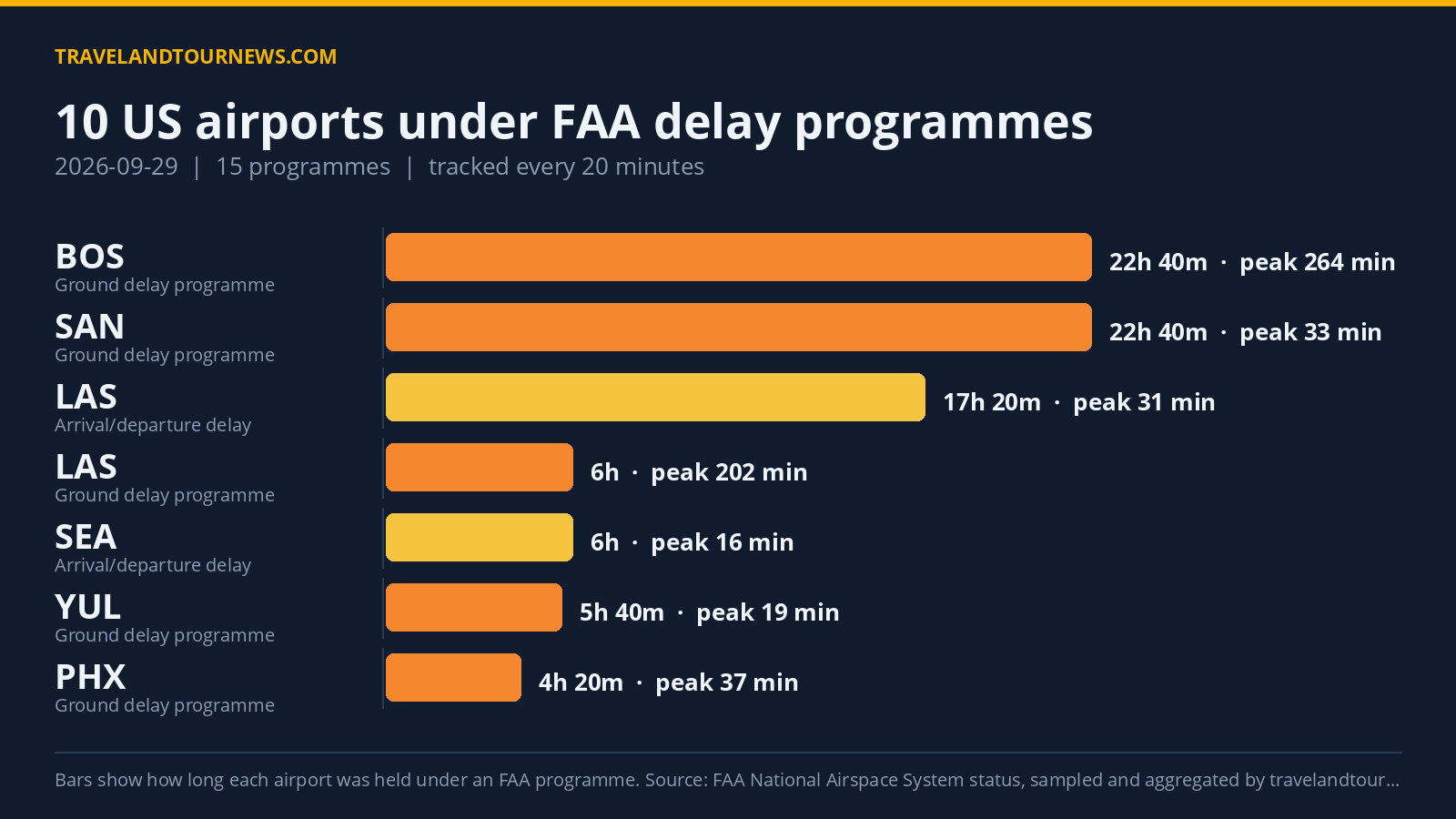

On September 29, 2026, the FAA held 10 United States airports under 15 delay programmes according to data tracked by travelandtournews.com from the FAA National Airspace System status feed. Boston Logan International Airport (BOS) experienced the highest peak maximum delay of 1,461 minutes under a Ground Delay Program.
Ten U.S. Airports Faced Delays Across Three Programme Types
The 10 airports affected on this day were Boston Logan (BOS), Miami International (MIA), Harry Reid International (LAS), Phoenix Sky Harbor International (PHX), Seattle-Tacoma International (SEA), San Diego International (SAN), LaGuardia (LGA), BHM, Teterboro (TEB), and Montreal–Pierre Elliott Trudeau (YUL).
There were 15 total programmes in force: 2 Ground Stop Programs, 7 Ground Delay Programs, and 6 instances of General Arrival/Departure Delay Information. A ground stop holds departures bound for an airport on the ground at their origin, while a ground delay programme meters arrivals by assigning later departure times.
Boston Logan’s Ground Delay Program due to runway construction lasted
1,360 minutes (22 hours 40 minutes) from midnight to 22:40 UTC, peaking with an average delay of 264 minutes and a maximum delay of 1,461 minutes. Miami International had a 40-minute Ground Stop Program caused by thunderstorms starting at 14:40 UTC. Harry Reid International’s Ground Delay Program for thunderstorms ran 6 hours from midnight to 06:00 UTC with a peak average delay of 202 minutes. Phoenix Sky Harbor recorded a nearly 4 hour and 20 minute thunderstorm-related Ground Delay Program starting at 12:40 UTC.
Seattle-Tacoma operated a 3-hour runway construction Ground Delay Program from midnight to 03:00 UTC. San Diego
International’s Ground Delay Program caused by airport volume lasted 22 hours 40 minutes. Teterboro had a 20-minute Ground Stop Program due to airport volume starting at 20:20 UTC. BHM had a 20-minute Ground Delay Program caused by an equipment outage at 07:40 UTC, while Montreal’s Ground Delay Program related to runway construction ran 5 hours and 40 minutes.
| Airport | FAA programme | Cause | Peak average delay | In force (UTC) |
|---|---|---|---|---|
| Miami International (MIA) | Ground Stop Programs | thunderstorms | – | 14:40 to 15:20 (40 minutes) |
| TEB | Ground Stop Programs | airport volume | – | 20:20 to 20:40 (20 minutes) |
| Boston Logan International (BOS) | Ground Delay Programs | runway construction | 264 min | 00:00 to 22:40 (22 hours 40 minutes) |
| Harry Reid International (LAS) | Ground Delay Programs | thunderstorms | 202 min | 00:00 to 06:00 (6 hours) |
| Phoenix Sky Harbor International (PHX) | Ground Delay Programs | thunderstorms | 37 min | 12:40 to 17:00 (4 hours 20 minutes) |
| Seattle-Tacoma International (SEA) | Ground Delay Programs | runway construction | 37 min | 00:00 to 03:00 (3 hours) |
| San Diego International (SAN) | Ground Delay Programs | airport volume | 33 min | 00:00 to 22:40 (22 hours 40 minutes) |
| BHM | Ground Delay Programs | equipment outage | 31 min | 07:40 to 07:40 (20 minutes) |
| YUL | Ground Delay Programs | runway construction | 19 min | 17:00 to 22:40 (5 hours 40 minutes) |
| Miami International (MIA) | General Arrival/Departure Delay Info | WX:Thunderstorms | 46 min | 14:40 to 16:20 (1 hour 40 minutes) |
| TEB | General Arrival/Departure Delay Info | VOL:Volume | 46 min | 19:40 to 21:20 (1 hour 40 minutes) |
| Harry Reid International (LAS) | General Arrival/Departure Delay Info | TM Initiatives:STOP:WX; WX:Thunderstorms | 31 min | 00:00 to 17:20 (17 hours 20 minutes) |
| LaGuardia (LGA) | General Arrival/Departure Delay Info | WX:Low Ceilings | 30 min | 01:00 to 02:40 (1 hour 40 minutes) |
| Seattle-Tacoma International (SEA) | General Arrival/Departure Delay Info | RWY:Construction | 16 min | 16:20 to 22:20 (6 hours) |
Runway Construction and Thunderstorms Led Delay Causes
The FAA’s own stated reasons show runway construction caused the most programmes, with 74 samples citing this cause primarily affecting BOS, SEA, and YUL. Thunderstorms were the second most cited cause, appearing 36 times and driving delays at LAS, PHX, and MIA.
Airport volume accounted for 20 samples of programme causes, spreading delays at SAN and TEB. Other causes included TM weather initiatives labeled as “TM Initiatives:STOP:WX” and equipment outages, which were less prevalent.
Delay Programmes Decreased From Yesterday but Remain Near Weekly Average
The 10 airports affected on September 29 represent a decrease of 5 airports compared to the 15 affected the previous day. Similarly, the total number of programmes dropped from 27 yesterday to 15, indicating a significant decline in delay activity.
Despite the drop, the number of affected airports remains close to the weekly average of 14.7 across the previous seven days. The peak delays today were high but
did not represent the worst in the recent tracking window.
Methodology. travelandtournews.com samples the FAA’s National Airspace System status feed every 20 minutes throughout the US operating day and aggregates the result. This report is built from 69 samples taken between 00:00 and 22:40 UTC on 2026-09-29. Durations are the observed window between the first and last sample in which a programme was in force, so a programme’s true length may be slightly longer than shown. Ground stops, ground delay programmes, airport closures and general delays are all published by the FAA in real time; the daily aggregation is ours.