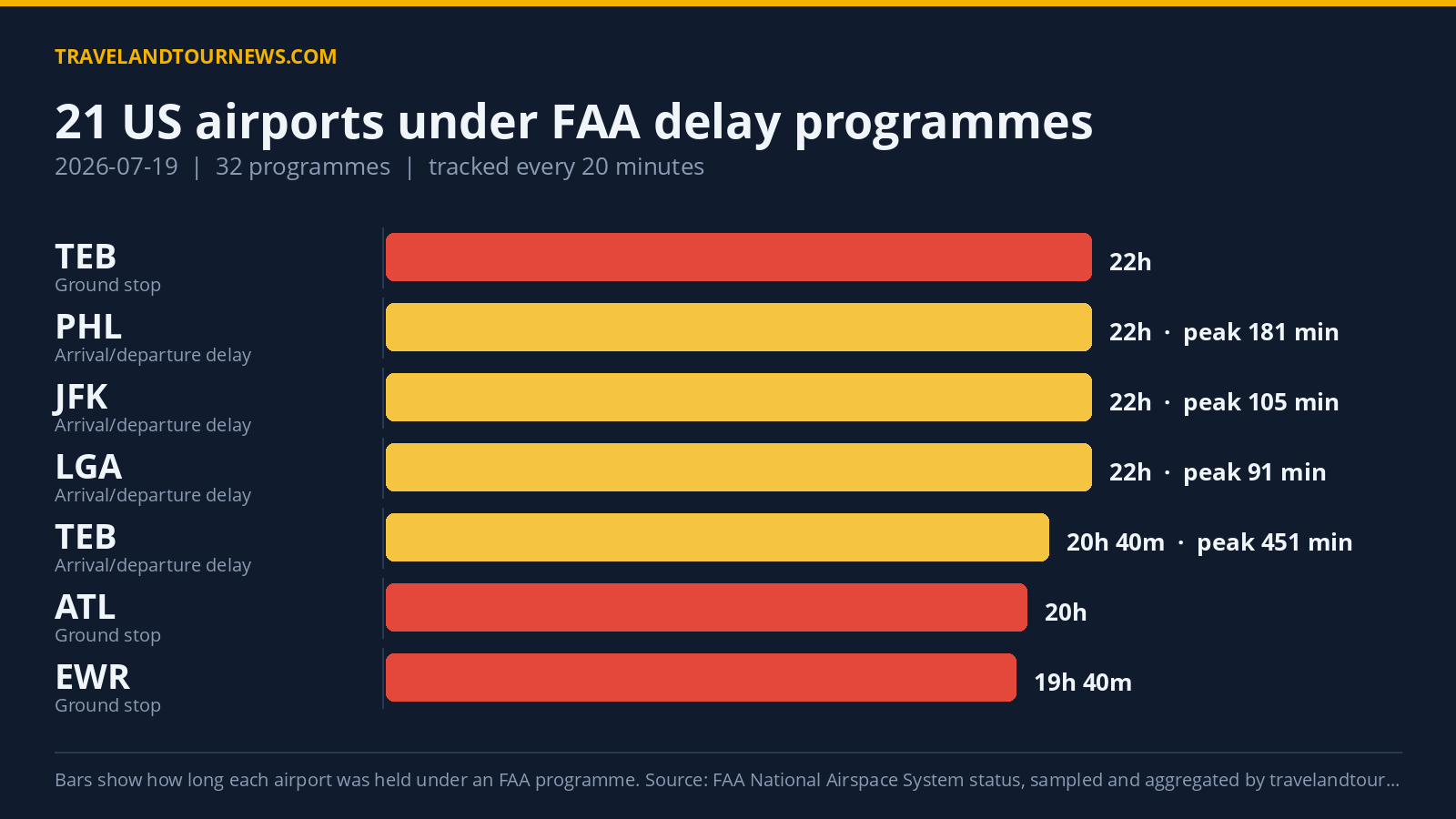

On July 19, 2026, 21 US airports were affected by a total of 32 FAA delay programmes, with Teterboro Airport (TEB) being the worst hit. TEB experienced the longest ground stop lasting 22 hours, involving multiple causes including thunderstorms and airport volume.
Airport Delay Programmes and Duration
The FAA implemented 13 ground stop programmes, which hold departures at their origin airports for flights bound to a specific airport; 5 ground delay programmes, which meter arrivals by assigning later departure times; 1 airport closure; and 13 general arrival/departure delay information releases across the country.
Teterboro Airport (TEB) had a ground stop programme active for 22 hours, from 00:00 to 22:00 UTC, accumulating 25 samples without peak average or maximum delay minutes but with significant observed minutes stretched across the day. Hartsfield-Jackson Atlanta International (ATL) recorded 20 hours of ground stop programmes caused by thunderstorms. Newark Liberty International (EWR)
had 19 hours and 40 minutes of ground stops including reasons like thunderstorms and VIP movement. LaGuardia (LGA) faced 18 hours and 40 minutes under a ground stop due to thunderstorms and airport volume.
Other airports with ground stop programmes lasting several hours include CDW for 16 hours and 40 minutes, MMU for 16 hours and 20 minutes, John F. Kennedy International (JFK) and HPN for 4 hours and 40 minutes each, Philadelphia International (PHL), BDL, and Boston Logan International (BOS) for up to 3 hours. Baltimore/Washington International (BWI) and Ronald Reagan Washington National (DCA) had ground stops lasting 2
hours.
Chicago O’Hare International (ORD) was active under a ground delay programme for 4 hours and 40 minutes, showing peak average delay minutes of 192 and maximum of 721. San Diego International (SAN) was closed for 3 hours and 20 minutes. Several airports had general arrival/departure delay information programmes with TEB’s lasting 20 hours and 40 minutes showing peak average delay minutes of 451.
| Airport | FAA programme | Cause | Peak average delay | In force (UTC) |
|---|---|---|---|---|
| TEB | Ground Stop Programs | thunderstorms; airport volume; OCL: | – | 00:00 to 22:00 (22 hours) |
| Hartsfield-Jackson Atlanta International (ATL) | Ground Stop Programs | thunderstorms; THUNDERSTORMS | – | 00:00 to 20:00 (20 hours) |
| Newark Liberty International (EWR) | Ground Stop Programs | thunderstorms; VIP | – | 00:00 to 19:40 (19 hours 40 minutes) |
| LaGuardia (LGA) | Ground Stop Programs | thunderstorms; airport volume | – | 00:00 to 18:40 (18 hours 40 minutes) |
| CDW | Ground Stop Programs | thunderstorms; airport volume; VOLUME | – | 00:00 to 16:40 (16 hours 40 minutes) |
| MMU | Ground Stop Programs | thunderstorms; airport volume | – | 00:20 to 16:40 (16 hours 20 minutes) |
| John F. Kennedy International (JFK) | Ground Stop Programs | thunderstorms | – | 00:00 to 04:40 (4 hours 40 minutes) |
| HPN | Ground Stop Programs | thunderstorms | – | 00:00 to 04:40 (4 hours 40 minutes) |
| Philadelphia International (PHL) | Ground Stop Programs | thunderstorms | – | 00:00 to 03:00 (3 hours) |
| BDL | Ground Stop Programs | thunderstorms | – | 00:00 to 03:00 (3 hours) |
| Boston Logan International (BOS) | Ground Stop Programs | thunderstorms | – | 00:00 to 03:00 (3 hours) |
| Baltimore/Washington International (BWI) | Ground Stop Programs | thunderstorms | – | 00:00 to 02:00 (2 hours) |
| Ronald Reagan Washington National (DCA) | Ground Stop Programs | thunderstorms | – | 00:00 to 02:00 (2 hours) |
| Chicago O’Hare International (ORD) | Ground Delay Programs | other | 192 min | 00:00 to 04:40 (4 hours 40 minutes) |
Thunderstorms and Traffic Volume Led Delay Causes
The most commonly cited reason for FAA delay programmes on July 19 was thunderstorms, appearing in 132 samples and associated with numerous ground stop and delay programmes at multiple airports including TEB, ATL, EWR, LGA, JFK,
and PHL. TM Initiatives related to weather swap operations ranked second with 90 occurrences, often linked to arrival and departure delay information programmes.
Other notable causes included general airport volume issues and VIP movements, each accounting for 19 programmes. Several airports reported compounded reasons such as airport volume, VIP movement, and other operational initiatives. For instance, TEB’s delay programmes involved thunderstorms, airport volume, and security concerns, while PHL combined weather swap systems with VIP movement in its general delay information programmes.
Decrease in Delay Programmes Compared to Previous Day
Compared to the previous day, July 19 showed a reduction in the number of FAA delay programmes by eight,
down from 40 yesterday to 32 today. Airports affected on July 19 numbered 21, slightly above the recent six-day average of 20.2 airports. July 19 was not the worst day in the recent tracking window.
This update uses FAA data tracked by travelandtournews.com.
Methodology. travelandtournews.com samples the FAA’s National Airspace System status feed every 20 minutes throughout the US operating day and aggregates the result. This report is built from 67 samples taken between 00:00 and 22:00 UTC on 2026-07-19. Durations are the observed window between the first and last sample in which a programme was in force, so a
programme’s true length may be slightly longer than shown. Ground stops, ground delay programmes, airport closures and general delays are all published by the FAA in real time; the daily aggregation is ours.