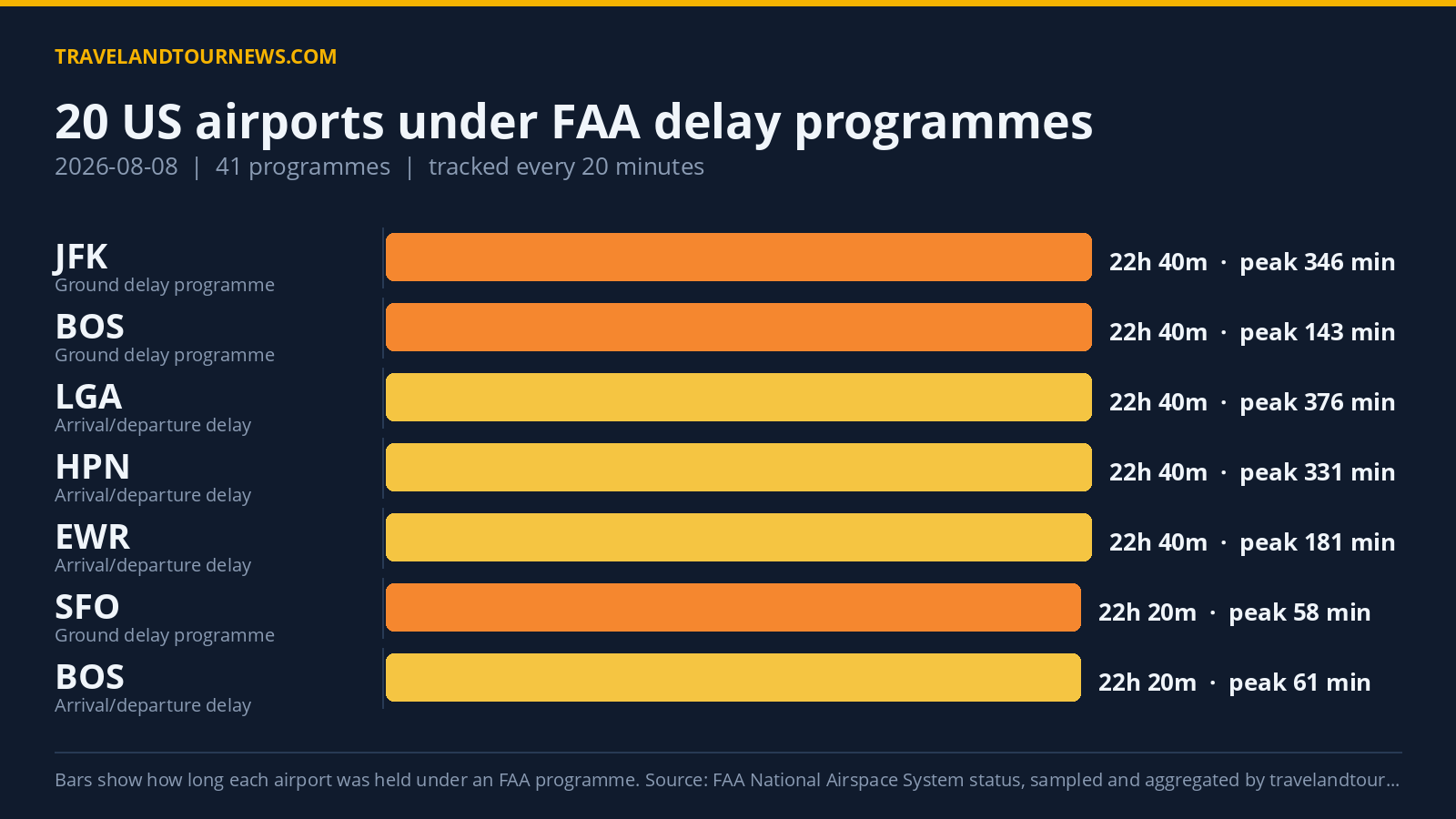

On August 8, 2026, the FAA held 20 airports in the United States under a total of 41 delay programmes, according to FAA data tracked by travelandtournews.com. Newark Liberty International (EWR) was the worst-hit airport, experiencing a peak maximum delay of 389 minutes under ground delay programmes caused primarily by thunderstorms.
Delays Concentrated at Major East Coast and National Airports
The FAA’s delay programmes on this day consisted of 14 ground stop programmes, 10 ground delay programmes, and 17 general arrival or departure delay reports across 20 airports. Ground stops hold departures bound for an airport on the ground at their origin, while ground delay programmes meter arrivals by assigning later departure times.
Newark Liberty International (EWR) experienced the longest ground stop programme lasting 21 hours attributed to thunderstorms and other unspecified reasons. It also held a ground delay programme for 21 hours and 40 minutes with a peak average delay of 175 minutes and a peak maximum delay of
389 minutes related to thunderstorms. John F. Kennedy International (JFK) ran a 20-hour 40-minute ground stop for thunderstorms plus a 22-hour 40-minute ground delay programme with peak delays reaching 346 minutes average and 658 minutes maximum.
LaGuardia (LGA) had a 20-hour ground stop and a 22-hour ground delay programme both due to thunderstorms, with peak delays on the ground delay programme of 79 minutes average and 317 minutes maximum. Philadelphia International (PHL) saw an 8-sample ground stop plus a 5-hour 20-minute ground delay programme, both due to thunderstorms, with delays reaching 76 minutes average and 144 minutes maximum.
Boston Logan
International (BOS) carried a 40-minute ground stop due to wind and a long 22-hour 40-minute ground delay programme caused by thunderstorms, which reached a peak maximum delay of 910 minutes—the highest recorded maximum delay for the day across all airports and programmes. Other airports with ground delay programmes included San Francisco International (SFO), Seattle International (SAN), Denver International (DEN), and Toronto Pearson (YYZ), with SFO delays caused by low ceilings and other factors.
| Airport | FAA programme | Cause | Peak average delay | In force (UTC) |
|---|---|---|---|---|
| Newark Liberty International (EWR) | Ground Stop Programs | thunderstorms; other | – | 00:00 to 21:00 (21 hours) |
| John F. Kennedy International (JFK) | Ground Stop Programs | thunderstorms | – | 00:00 to 20:40 (20 hours 40 minutes) |
| LaGuardia (LGA) | Ground Stop Programs | thunderstorms | – | 00:00 to 20:00 (20 hours) |
| Philadelphia International (PHL) | Ground Stop Programs | thunderstorms | – | 00:00 to 19:40 (19 hours 40 minutes) |
| Denver International (DEN) | Ground Stop Programs | STAFFING; wind | – | 21:20 to 22:40 (1 hour 20 minutes) |
| TEB | Ground Stop Programs | thunderstorms | – | 00:00 to 00:40 (40 minutes) |
| Boston Logan International (BOS) | Ground Stop Programs | wind | – | 19:00 to 19:40 (40 minutes) |
| YYZ | Ground Stop Programs | thunderstorms | – | 19:20 to 20:00 (40 minutes) |
| Washington Dulles International (IAD) | Ground Stop Programs | thunderstorms | – | 00:00 to 00:00 (20 minutes) |
| Baltimore/Washington International (BWI) | Ground Stop Programs | thunderstorms | – | 00:00 to 00:00 (20 minutes) |
| Ronald Reagan Washington National (DCA) | Ground Stop Programs | thunderstorms | – | 00:00 to 00:00 (20 minutes) |
| Dallas/Fort Worth International (DFW) | Ground Stop Programs | thunderstorms | – | 00:20 to 00:40 (20 minutes) |
| San Francisco International (SFO) | Ground Stop Programs | other | – | 04:40 to 05:00 (20 minutes) |
| AGS | Ground Stop Programs | equipment outage | – | 14:20 to 14:40 (20 minutes) |
Thunderstorms Drive Majority of Delay Programmes
Thunderstorms were the leading cause of FAA delay programmes on August 8, 2026, driving 132 delay incidents directly and featuring as a reason in multiple programmes at
major airports including EWR, JFK, LGA, PHL, and BOS. The FAA’s categorization included related labels such as “TM Initiatives:SWAP:WX” accounting for 175 mentions, and “WX:Thunderstorms” with 19 mentions, underscoring weather as the dominant factor.
Low ceilings contributed to 31 delay programmes, predominantly at airports like San Francisco (SFO). Other causes included airport volume at San Diego (SAN), staffing shortages and wind conditions at Denver (DEN), and equipment outage at AGS. The “other” category, applied by the FAA to a range of unspecified issues, appeared 28 times across multiple airports.
Delay Programmes Slightly Reduced From Previous Day, Near Weekly Average
Compared to the previous day, August 7, 2026, the number of
airports affected declined from 24 to 20 and total delay programmes dropped from 44 to 41. These figures align closely with the recent week’s average of 22.1 airports affected, with no indication of an extreme spike or drop in delay activity. August 8 did not register as the worst in the recent tracking window.
Peak average delay on this day reached 376 minutes, with a maximum delay peak of 910 minutes, recorded at Boston Logan. The longest single programme observed lasted 1,360 minutes (22 hours 40 minutes), notably the JFK ground delay programme for thunderstorms.
Methodology. travelandtournews.com samples the FAA’s
National Airspace System status feed every 20 minutes throughout the US operating day and aggregates the result. This report is built from 69 samples taken between 00:00 and 22:40 UTC on 2026-08-08. Durations are the observed window between the first and last sample in which a programme was in force, so a programme’s true length may be slightly longer than shown. Ground stops, ground delay programmes, airport closures and general delays are all published by the FAA in real time; the daily aggregation is ours.