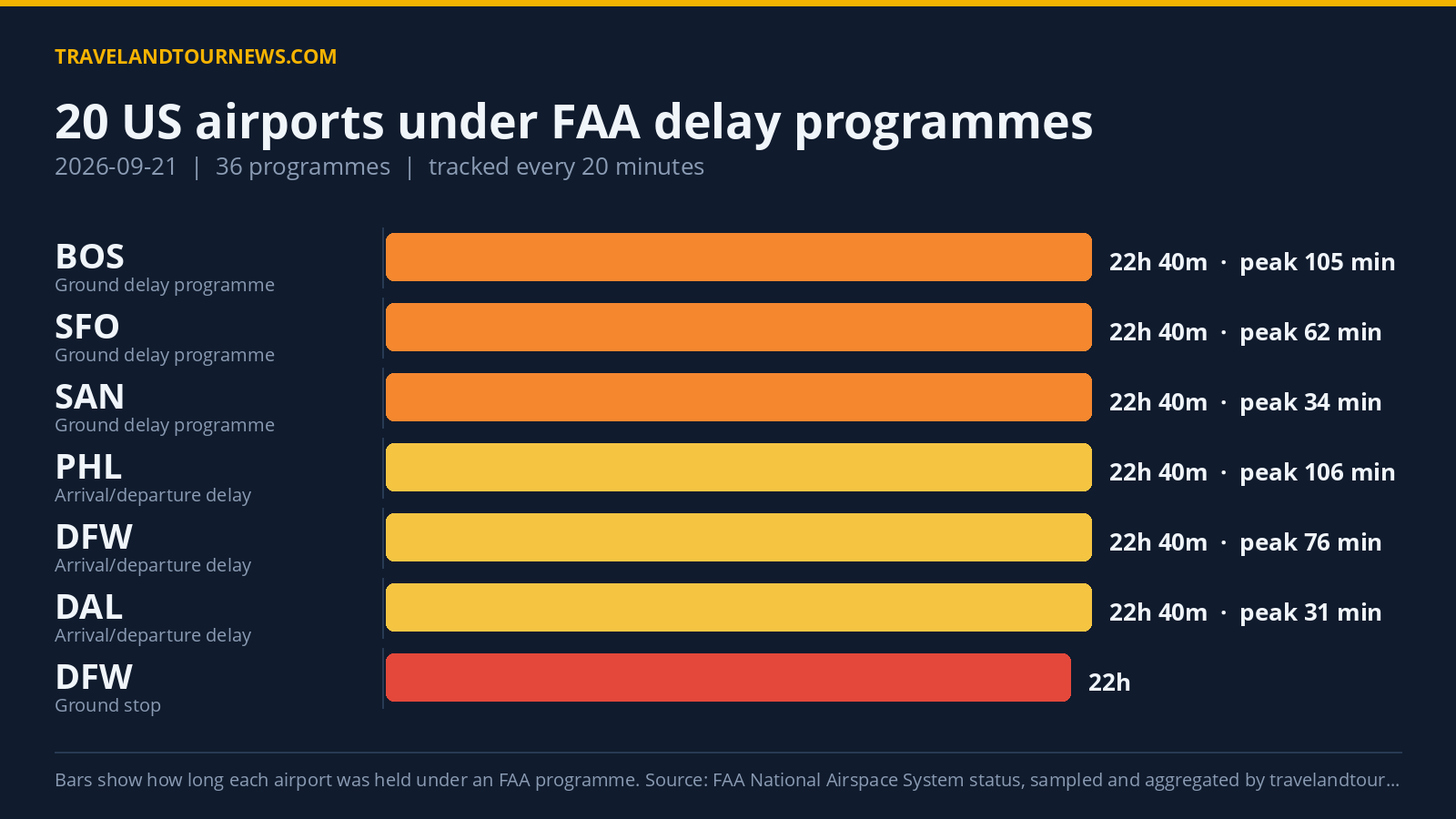

On September 21, 2026, 20 airports across the United States were subject to 36 FAA delay programmes, with Dallas/Fort Worth International (DFW) proving the worst hit. The airport experienced ground stop programmes due to thunderstorms lasting 22 hours, though recorded peak delays during these were zero minutes. DFW also had a ground delay programme caused by thunderstorms with peak delays reaching 194 minutes.
Delay Programmes by Airport and Type
Delay programmes took multiple forms: 10 were ground stop programmes, which hold departures on the ground at their origin airport bound for the affected destination; 11 were ground delay programmes, which assign later departure times to meter arrivals; one airport closure; and 14 related to general arrival/departure delay information.
The longest programmes were the ground stops at DFW (22 hours) and TEB (21 hours 20 minutes), while Boston Logan International (BOS) and San Francisco International (SFO) had ground delay programmes running for 22 hours 40 minutes each. The peak average delay across all airports reached 421 minutes, with the highest
single recorded delay at Newark Liberty International (EWR) topping 1,268 minutes during a ground delay programme caused by equipment issues.
Key airports with sustained ground stop programmes included DFW, TEB, EWR, Philadelphia (PHL), John F. Kennedy (JFK), LaGuardia (LGA), and others. For instance, EWR faced a 21-hour ground stop programme caused by staffing and equipment outages. Philadelphia International had both ground stop and ground delay programmes for several hours, driven primarily by equipment outages. Teterboro (TEB) displayed multiple programmes due to staffing shortages and equipment failures, including a ground delay programme with delays up to 500 minutes recorded.
Additional airports
such as HPN and DCA faced shorter ground stops related to volume or equipment issues. William P. Hobby Airport (HOU) experienced a 20-minute ground stop for runway maintenance. San Diego International (SAN) reported a 4-hour 20-minute airport closure in addition to ground delay programmes linked to airport volume.
| Airport | FAA programme | Cause | Peak average delay | In force (UTC) |
|---|---|---|---|---|
| Dallas/Fort Worth International (DFW) | Ground Stop Programs | THUNDERSTORMS; thunderstorms | – | 00:40 to 22:40 (22 hours) |
| TEB | Ground Stop Programs | STAFFING; equipment outage | – | 00:20 to 21:40 (21 hours 20 minutes) |
| Newark Liberty International (EWR) | Ground Stop Programs | STAFFING; equipment outage; EQUIPMENT | – | 00:20 to 21:20 (21 hours) |
| Philadelphia International (PHL) | Ground Stop Programs | equipment outage | – | 14:20 to 20:40 (6 hours 20 minutes) |
| John F. Kennedy International (JFK) | Ground Stop Programs | equipment outage | – | 17:00 to 22:20 (5 hours 20 minutes) |
| LaGuardia (LGA) | Ground Stop Programs | equipment outage; EQUIPMENT | – | 17:00 to 22:00 (5 hours) |
| HPN | Ground Stop Programs | equipment outage; airport volume | – | 17:00 to 20:00 (3 hours) |
| Ronald Reagan Washington National (DCA) | Ground Stop Programs | airport volume | – | 19:00 to 20:00 (1 hour) |
| Boston Logan International (BOS) | Ground Stop Programs | airport volume | – | 17:00 to 17:40 (40 minutes) |
| William P. Hobby (HOU) | Ground Stop Programs | runway maintenance | – | 20:00 to 20:20 (20 minutes) |
| Newark Liberty International (EWR) | Ground Delay Programs | EQUIPMENT; equipment outage | 306 min | 21:40 to 22:40 (1 hour) |
| Philadelphia International (PHL) | Ground Delay Programs | equipment outage | 212 min | 16:40 to 22:40 (6 hours) |
| TEB | Ground Delay Programs | equipment outage | 159 min | 22:00 to 22:40 (40 minutes) |
| Dallas/Fort Worth International (DFW) | Ground Delay Programs | thunderstorms | 107 min | 02:20 to 04:20 (2 hours) |
Causes of Delay Programmes
The FAA’s official reasons for delay programmes on this date centered mostly on equipment-related outages, which drove 135 of the programs sampled. Low ceilings contributed to 66 programmes, and high airport volume appeared as the cause in 48 cases. Thunderstorms, referenced specifically for DFW and other airports, were attributed to 39 programmes.
FAA equipment issues, highlighted separately, accounted for 37 programmes.
Equipment outages were the primary cited cause behind many ground stop and ground delay programmes, notably at EWR, PHL, JFK, LGA, and TEB. Weather factors, including thunderstorms mainly at DFW, and low ceilings especially impacting BOS and SFO, represented major operational challenges. Volume-related delays impacted Boston Logan, Philadelphia, HPN, and several others.
Non-weather grounds such as staffing shortages affected TEB and Newark’s ground stops. Runway maintenance delayed William P. Hobby (HOU), and runway construction also contributed delays at Boston Logan and Seattle-Tacoma International (SEA).
Comparison with Previous Day and Recent Average
The number of airports affected on September
21 dropped slightly to 20 from 21 on the previous day. Total delay programmes increased marginally by one compared to 31 programmes the day before. The 20 airports impacted exceeded the recent seven-day average of 16.3.
Despite the high number of affected airports, September 21, 2026, was not the worst day in the FAA data aggregation’s tracking window.
Methodology. travelandtournews.com samples the FAA’s National Airspace System status feed every 20 minutes throughout the US operating day and aggregates the result. This report is built from 69 samples taken between 00:00 and 22:40 UTC on 2026-09-21. Durations are the observed window
between the first and last sample in which a programme was in force, so a programme’s true length may be slightly longer than shown. Ground stops, ground delay programmes, airport closures and general delays are all published by the FAA in real time; the daily aggregation is ours.