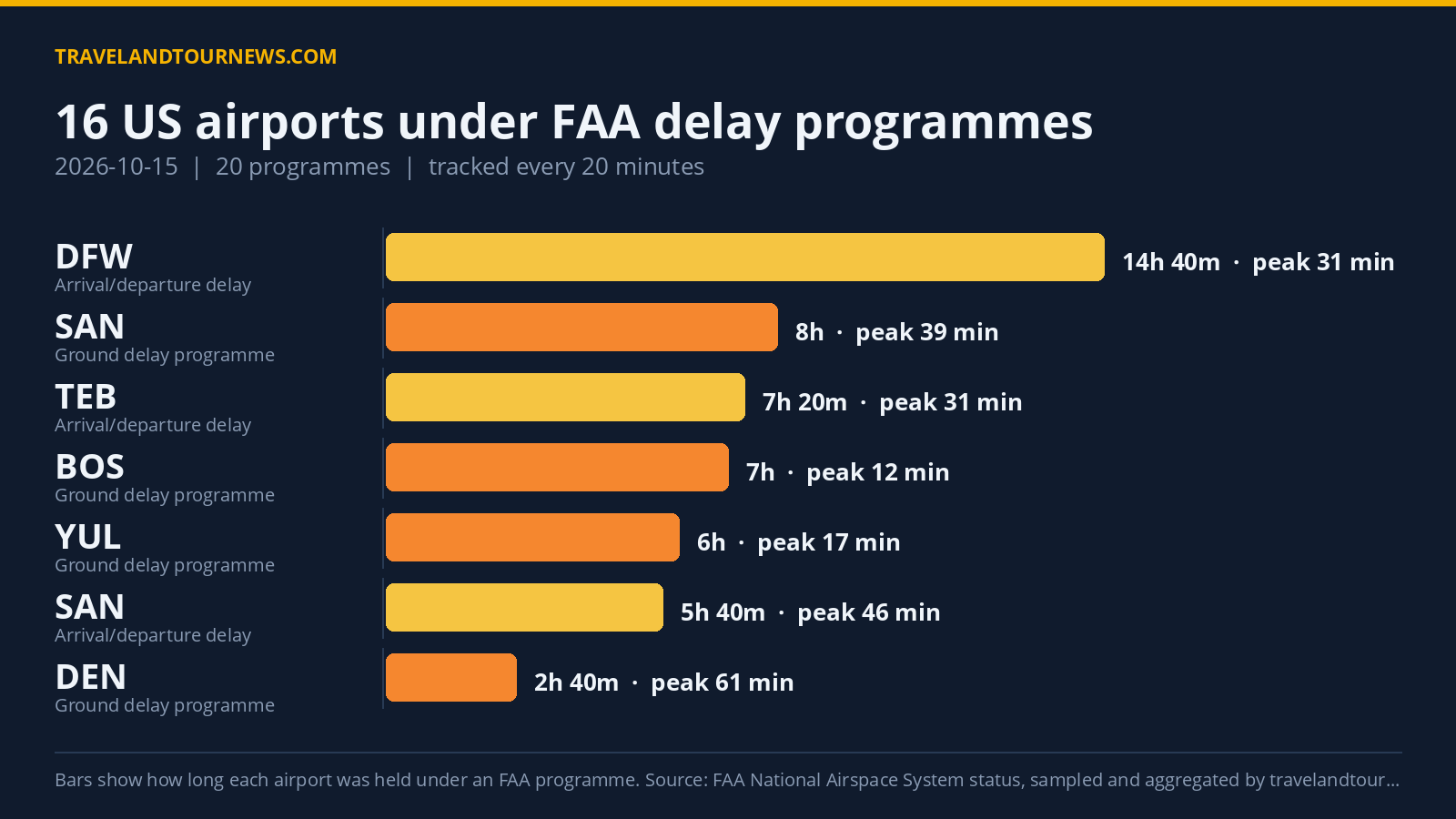
The Federal Aviation Administration (FAA) maintained ground stops at Newark Liberty International Airport (EWR), John F. Kennedy International Airport (JFK), and LaGuardia Airport (LGA) on August 11, 2026, resulting in over 930 flights being canceled or delayed. These three major New York City area airports were among 13 nationwide airports subject to ground stops by the FAA on that day.
Weather and Delays at Chicago O’Hare
Chicago O’Hare International Airport (ORD) faced potentially similar disruptions following severe weather forecasts. The National Weather Service (NWS) issued Hazardous Weather Outlook alerts for ORD on July 31 and August 1, 2026, warning of thunderstorms and heavy rainfall with flooding
risks. These conditions contributed to significant flight delays and cancellations at ORD in late July.
On July 27, ORD recorded the highest number of flight cancellations in the U.S. with more than 1,000 flights canceled. The FAA reported that ground delays led to an average delay time of 438 minutes at the airport during that day. Forecasts for July 31 indicated a 100% chance of precipitation after 4 p.m. local time, with rainfall between three-quarters and one inch expected, and an 80% chance of precipitation continuing into August 1.
Nationwide Delay and Cancellation Statistics
The FAA’s ground stops in early August contributed to more than
2,500 flight cancellations and over 8,400 delays across several U.S. airports. The New York City area airports, including Newark, JFK, and LaGuardia, consistently experience the highest volume of weather-related delays nationwide. In 2022 alone, these airports reported 30,000 delays exceeding 15 minutes.
Other major hubs such as Las Vegas McCarran International Airport, Boston Logan International Airport, and Chicago O’Hare also endure thousands of weather-related delays annually. Recent FAA ground stops have underscored the operational challenges at these congested hubs during adverse weather periods and high demand.
Causes of Delays and Ground Stops
Severe weather conditions, including thunderstorms and flooding threats, combined with high operational capacity, have
led to sustained delays and ground stops at the nation’s busiest airports. The FAA notes that airports operating near full capacity experience cascading delays when adverse weather restricts flight movements, causing delayed arrivals and departures to wait for extended periods.
Staffing shortages at major hubs have also compounded these disruptions. The FAA implemented ground stops at 13 airports on August 11, including Newark, JFK, and LaGuardia, to manage air traffic amid these complications.
Passenger Impact and Advisory Information
Passengers at Newark, JFK, and LaGuardia airports faced significant travel interruptions on August 11, 2026, with over 930 flights canceled or delayed. The FAA cautioned travelers about
possible prolonged delays due to continuing ground stops.
At Chicago O’Hare, travelers were warned to monitor updates for possible schedule changes amid thunderstorm threats forecasted for the end of July and early August. The NWS forecasts indicated thunderstorms with potential to approach severe limits and heavy rainfall capable of causing localized flooding near ORD.
Official Statements and Weather Alerts
The FAA highlighted that airports most affected by weather delays operate near or at full capacity for much of the day, intensifying the impact of adverse conditions on flight schedules. The combination of weather and demand means delayed flights at hubs like Newark, JFK, LaGuardia, and
ORD can face hours-long waits.
The National Weather Service issued alerts stating a chance of thunderstorms with some storms possibly reaching severe limits in areas near Chicago O’Hare. Heavy rainfall accompanying these storms increased flooding risks, further complicating airport operations during the forecast period.