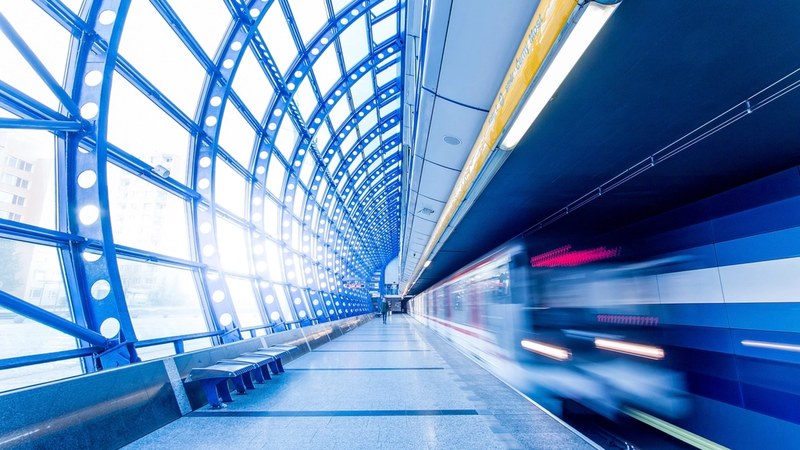
Siemens has delivered the first driverless Inspiro HC trainset for the Western Sydney Airport rail line, marking a key step towards commissioning the new metro service. The three-car train, manufactured at Siemens Mobility’s Vienna facility, is undergoing static testing at the Orchard Hills Stabling and Maintenance Facility in Greater Western Sydney.
Individual carriages of the train traveled by sea from Vienna to Port Kembla, New South Wales, a 23,000-kilometer journey taking 45 to 61 days. From Port Kembla, the carriages were transported overland by heavy-haul trucks to Orchard Hills for final assembly and testing preparation.
Metro Service Launch Delayed Past Airport Opening
Western Sydney International Airport is
scheduled to open to commercial flights on October 25, 2026, with Jetstar operating the first passenger flight to the Gold Coast that morning. Air New Zealand begins flights to Auckland on October 26, 2026, followed by Singapore Airlines launching daily services to Changi Airport on November 23, 2026.
The Western Sydney Airport rail line will not carry passengers at airport opening. Rail service is projected to commence in mid-to-late 2027, creating an eight to twelve-month gap without direct metro access. A free interim bus service connects St Marys station to the airport terminal every 30 minutes between 4:30 a.m. and
midnight Sunday through Thursday, and until 1 a.m. on Fridays and Saturdays. The bus journey takes approximately 30 minutes, compared to the 15-minute metro trip planned upon rail service launch.
Advanced Driverless Technology and Safety Systems
The Western Sydney Airport Line will operate under Grade of Automation 4 (GoA4), representing full driverless operation without onboard attendants. This is the highest automation standard internationally, used on metros like Copenhagen, Singapore, and Paris.
The system utilizes Communications-Based Train Control (CBTC) for continuous train-to-trackside communication and moving-block signaling, allowing precise positioning and increased capacity. Automatic Train Operation (ATO) manages driving functions, stops trains within 30 centimeters of platform markers,
and controls door operations and departure timings.
Platform Screen Doors (PSDs) are installed at all six stations to enable safe unattended train operation; 50 percent of the 108 PSDs are in place as of August 2026. Additionally, over half of the line’s 40 escalators have been installed.
Siemens Inspiro HC Train Specifications and Passenger Features
The three-car Inspiro HC trainset is 67.63 meters long and 3.19 meters wide, with a top speed of 100 kilometers per hour. It can carry up to 645 passengers with 194 seats. The design prioritizes airport travelers with aisles about 30 centimeters wider than those on Sydney Metro’s existing M1 Line trains and
under-seat luggage bays to reduce congestion.
The train offers live flight information displays linked in real-time to airport operational systems, eight bicycle storage spaces, multiple wheelchair-accessible areas, and hearing loops in every carriage. Seating upholstery features culturally commissioned artwork by Dharug artists representing local landscape themes.
The Inspiro HC operates on 25 kV 50 Hz AC overhead catenary electrification, suitable for the line’s surface and viaduct sections, a first for this model in the Asia-Pacific region.
Predictive maintenance using Siemens Mobility’s Railigent X platform continuously monitors train components through onboard sensors, aiming to optimize availability and reduce maintenance-related delays.
Project Funding, Route Details, and Construction Progress
The
AU$11-billion Western Sydney Airport Line is jointly funded by the Australian federal government, contributing approximately AU$5.25 billion, and the New South Wales government. The 23-kilometer metro route includes six stations: St Marys, Orchard Hills, Luddenham, Airport Business Park, Airport Terminal, and Bradfield.
All station platforms are complete as of August 2026, with more than half of the 40 escalators installed and half of the 108 platform screen doors in place. Parklife Metro holds the 15-year operations and maintenance contract, supported by advanced technology platforms and a fleet of 12 trainsets to be delivered progressively through 2026 and 2027.