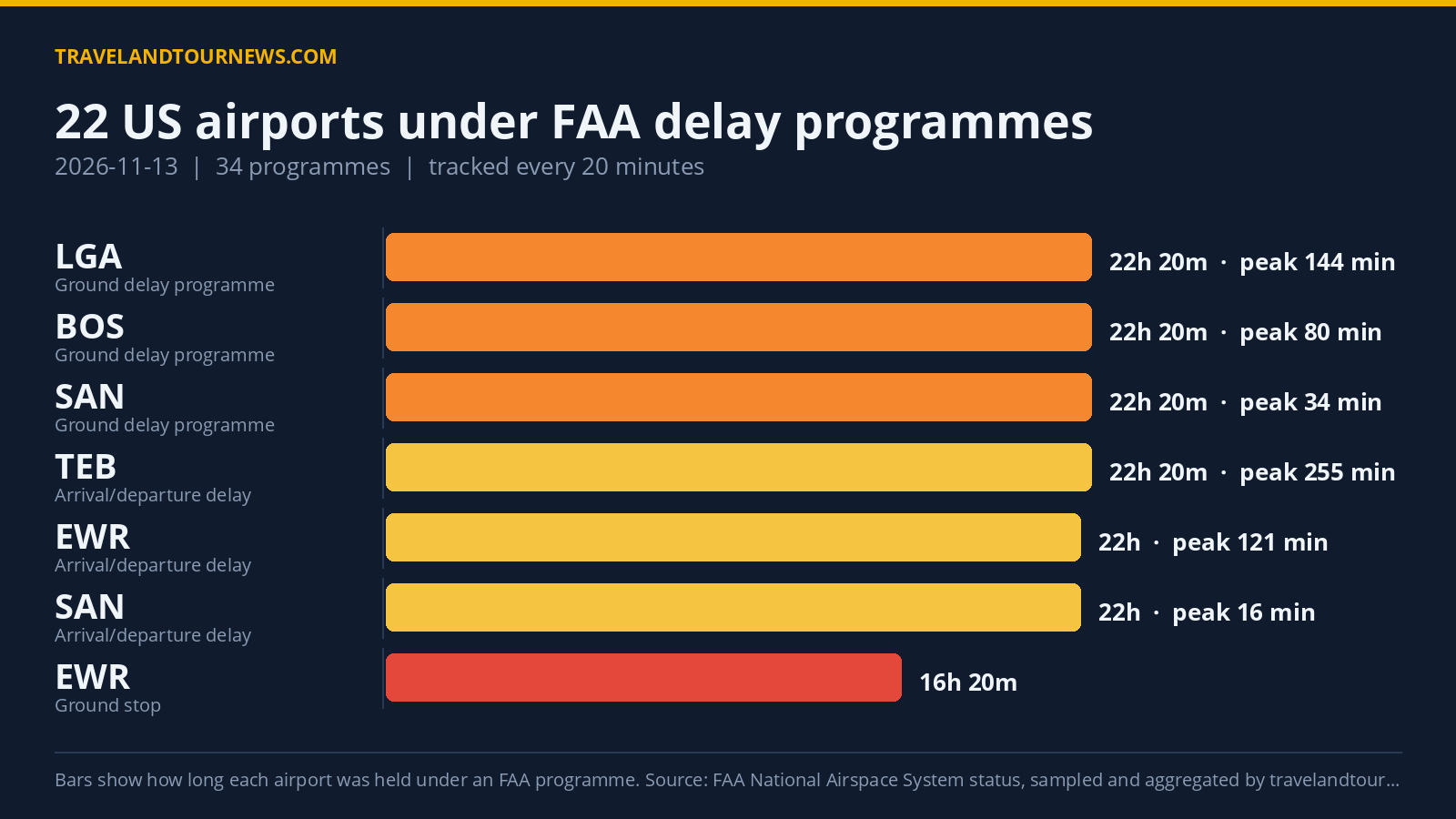
On November 13, 2026, the Federal Aviation Administration (FAA) implemented ground stops and ground delay programs at five major Northeast U.S. airports—John F. Kennedy International Airport (JFK), LaGuardia Airport, Newark Liberty International Airport, Boston Logan International Airport, and Philadelphia International Airport—due to severe thunderstorms and heavy rain affecting the region.
Flight Restrictions and Delay Program Details
The FAA initiated a ground stop at LaGuardia Airport starting at 1:27 p.m. ET, initially scheduled until 3:45 p.m., with a 30% to 60% chance of extension. Concurrently, LaGuardia is under a ground delay program from 1 p.m. to 11:59 p.m. Flights arriving under this program are averaging delays of
63 minutes. Newark Liberty International Airport began a ground delay program at 2:37 p.m., where arriving flights are delayed on average by 137 minutes. John F. Kennedy International Airport entered a ground stop at 2:49 p.m., also planned to last until 3:45 p.m. with the same extension probability. Boston Logan and Philadelphia International airports also experienced FAA-imposed ground stops during the same day as part of the congestion management measures.
Delay and Cancellation Statistics Across Key Airports
FlightAware data from early to mid-afternoon snapshots reported 215 delayed flights and 10 cancellations at LaGuardia, 131 delays and six cancellations at Newark, and 239 delays and 24 cancellations at
JFK. These figures represent the ongoing operational challenges at the New York metropolitan area airports. In total, combined data for the day among the three New York airports reflected over 1,300 flight delays and 40 cancellations. Additional flood advisory measures were active until 1:45 p.m. for Newark and nearby low-lying areas, adding to airport operational difficulties due to minor flooding.
Operational Impact of FAA Flow Controls and Weather Conditions
The FAA employs two main traffic management tools amid these weather disruptions: ground stops and ground delay programs. Ground stops hold flights on the ground until the restriction lifts, blocking departures to avoid congestion. Ground delay programs meter departures, assigning
controlled departure times to maintain manageable arrival flows. The severe thunderstorms and flooding in low-lying areas, including Newark, are the primary causes of these disruptions, forcing the FAA to apply layered flow restrictions at congested hubs. This approach helps to reduce cascading delays but causes longer wait times for flights, particularly at Newark, where average delays more than double those at LaGuardia.
Travelers Face Significant Delays and Widespread Cancellation Effects
These disruptions have led to more than 1,000 flight cancellations across the five Northeast airports today. Thousands of additional flights experienced delays, averaging 63 minutes at LaGuardia and 137 minutes at Newark. The high level of disruption originating
from New York area’s major airports has ripple effects that extend beyond the Northeast, affecting flights departing from airports nationwide due to interconnected scheduling and airspace constraints. The cascading delays emphasize challenges for operators in scheduling arrival slots and managing alternate planning effectively in congested regions under multiple simultaneous restrictions.
FAA Monitoring and Potential for Additional Restrictions
The FAA continues to monitor the weather and traffic conditions intensively across the Northeast, stating that further air traffic restrictions may be necessary as the storm system progresses. The flood advisory that affected Newark and adjacent areas ended at 1:45 p.m., but the National Weather Service forecasts rainfall to persist
into Friday, potentially causing minor coastal flooding and prolonged aviation delays. The FAA’s decisions on extending ground stops at JFK and LaGuardia beyond 3:45 p.m. will be key to future operational flow management in the region.