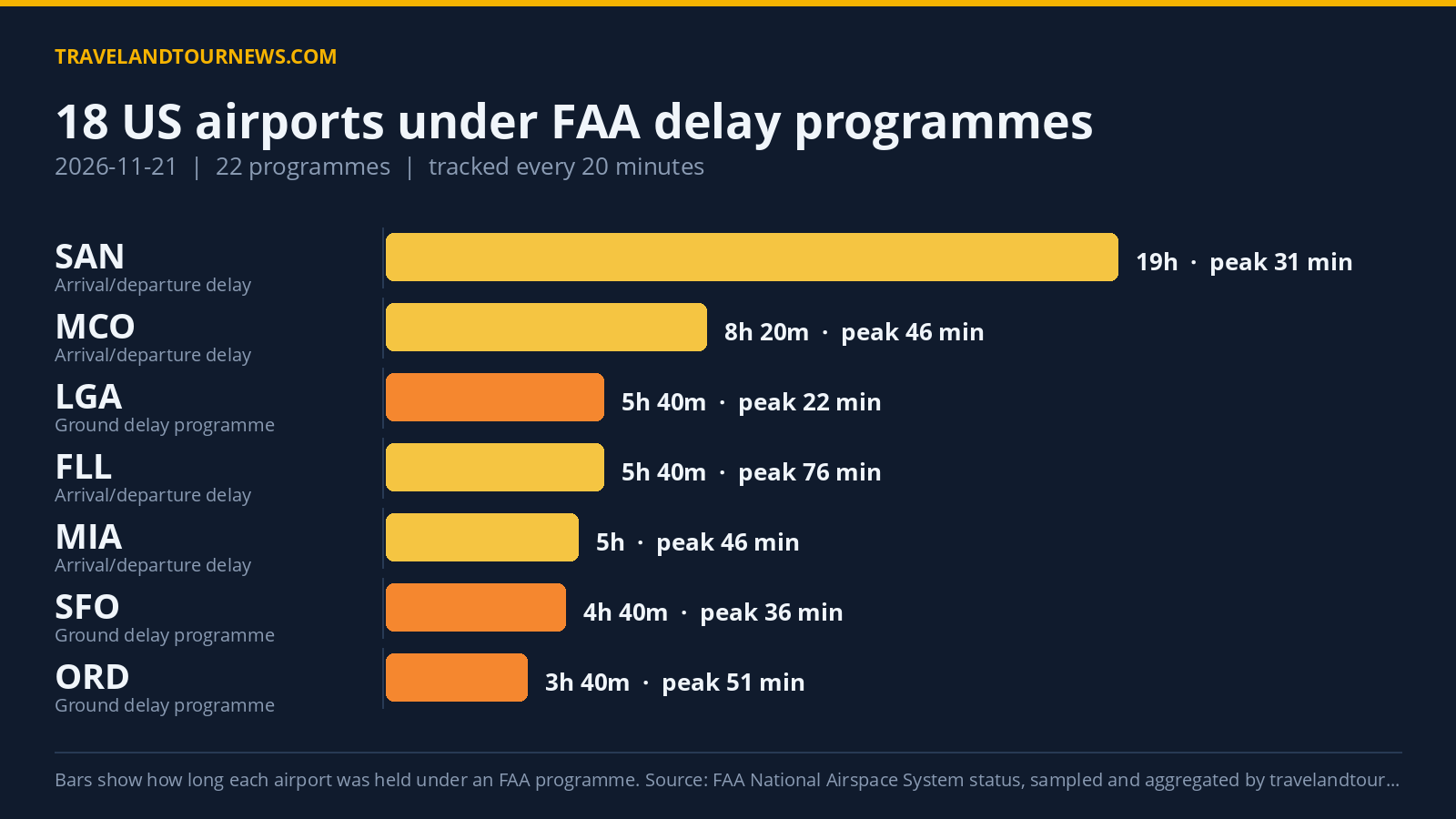
The Federal Aviation Administration (FAA) issued a ground stop on November 19, 2026, at San Francisco International Airport, halting all departing flights amid severe wind and storm conditions affecting the Bay Area. Downtown San Francisco recorded 1.85 inches of rainfall that day, nearing the 1918 daily record of 2.24 inches, while major flooding impacted infrastructure including southbound Interstate 280 near Geneva Avenue.
The ground stop led to average departure delays of 3 hours and 6 minutes, with the FAA assigning a “medium” probability of extension. On congested single-runway airports like San Francisco International, such interruptions cause cascading delays due to
queued departures, displaced aircraft, and crew duty time restrictions. Business aviation flights, which lack hub rebooking options, faced delayed departures or diversions to other Bay Area airports.
Concurrently, Hollywood Burbank Airport experienced two periods of “ATC Zero” status on the evening of November 19, 2026. During these roughly 30-minute intervals, the control tower was non-operational, forcing Southwest Airlines and Alaska Airlines pilots to self-coordinate arrivals and departures over the Common Traffic Advisory Frequency (CTAF). The FAA did not disclose the cause of the outages.
The FAA attributed the San Francisco ground stop to wind and weather conditions disrupting airport operations
and noted the medium chance the ground stop might be extended. Regarding the Hollywood Burbank ATC Zero events, the FAA withheld explanations for the control tower status changes.
Travelers faced extended delays beyond the ground stop lift due to backlog clearance complexities. Business aviation operators confronted logistical challenges as charter and fractional flights required schedule adjustments or airport changes, while flooding near I-280 potentially affected surface access to San Francisco International Airport.
Ground stops at busy, single-runway airports impose significant operational challenges, amplifying delay impacts across all flight operators. These disruptions extend beyond weather relief due to the intricate sequencing
and crew scheduling constraints that arise, increasing both delay durations and rerouting costs for affected carriers.