
On October 24, 2026, seven airports across the United States were under FAA delay programs, with a total of seven distinct operational restrictions issued. The airport experiencing the highest peak delay was Denver International Airport (DEN) with a maximum delay of 146 minutes during a runway construction-related ground delay program.
Delay Program Types and Airport Impacts
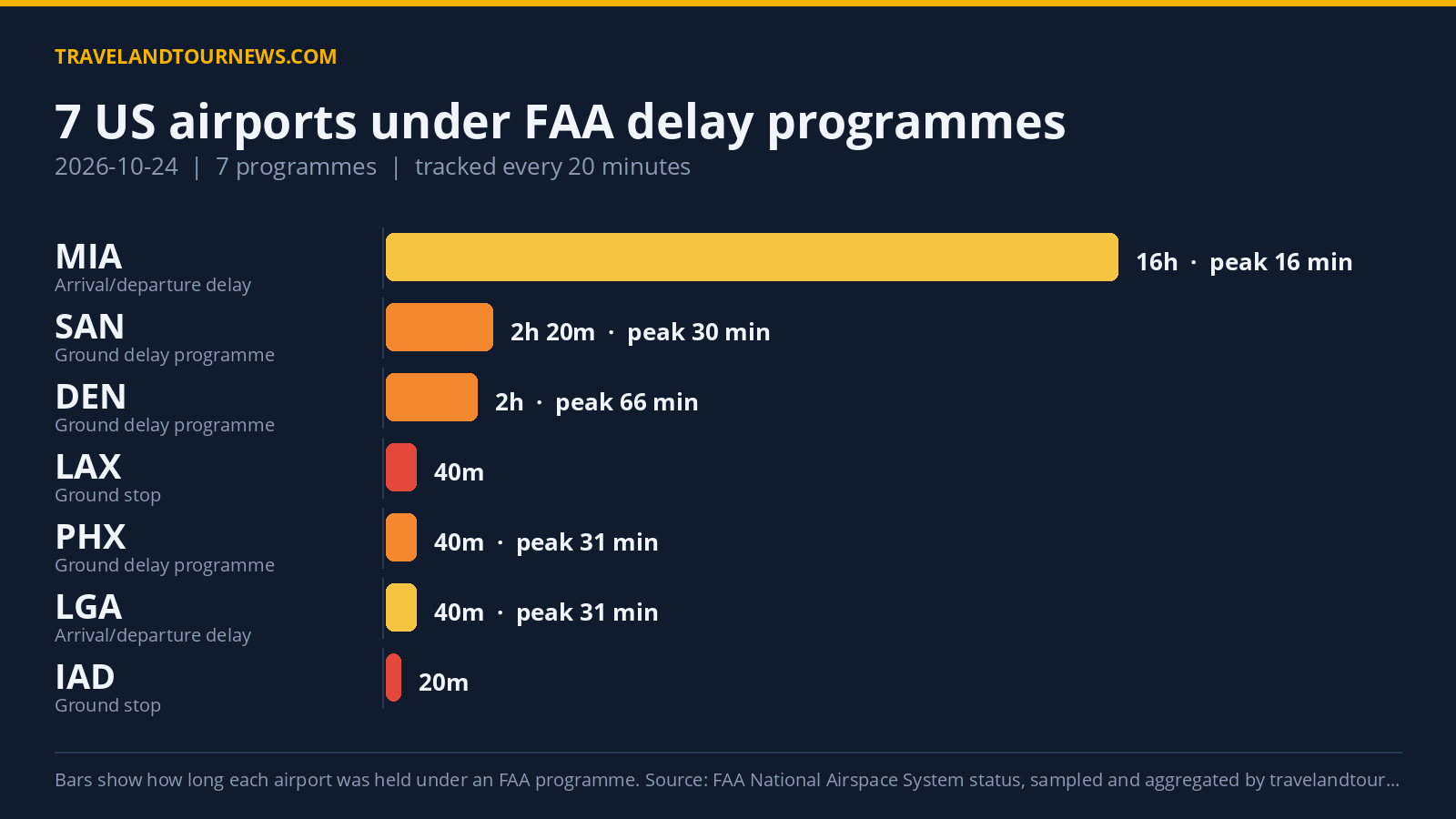
The FAA implemented two ground stop programs on the day, which hold departures bound for affected airports at their origin. Los Angeles International (LAX) experienced a ground stop due to thunderstorms lasting 40 minutes from 02:40 to 03:20 UTC. Washington Dulles International (IAD) also had a 20-minute ground stop for VIP reasons starting at 19:40 UTC.
Three ground delay programs, which meter arrivals by assigning later departure times, were active. Denver International’s runway construction program lasted two hours from midnight to 02:00 UTC and recorded the highest average delay of 66 minutes. San Diego International (SAN) had a ground delay
program due to airport volume lasting 2 hours and 20 minutes starting at 00:00 UTC, with a peak average delay of 30 minutes. Phoenix Sky Harbor International (PHX) also had a ground delay program, categorized as “other,” from 20:00 to 20:40 UTC, with a 31-minute average delay.
Two airports reported general arrival and departure delay information. LaGuardia Airport (LGA) experienced runway construction delays for 40 minutes beginning at 20:00 UTC, with average delays up to 31 minutes. Miami International Airport (MIA) had the longest duration of delay information dissemination, lasting 16 hours from midnight to 16:00 UTC, encompassing runway construction,
bird strike, and traffic management initiatives, with peak average delays of 16 minutes.
| Airport | FAA programme | Cause | Peak average delay | In force (UTC) |
|---|---|---|---|---|
| Los Angeles International (LAX) | Ground Stop Programs | thunderstorms | – | 02:40 to 03:20 (40 minutes) |
| Washington Dulles International (IAD) | Ground Stop Programs | VIP | – | 19:40 to 20:00 (20 minutes) |
| Denver International (DEN) | Ground Delay Programs | runway construction | 66 min | 00:00 to 02:00 (2 hours) |
| Phoenix Sky Harbor International (PHX) | Ground Delay Programs | other | 31 min | 20:00 to 20:40 (40 minutes) |
| San Diego International (SAN) | Ground Delay Programs | airport volume | 30 min | 00:00 to 02:20 (2 hours 20 minutes) |
| LaGuardia (LGA) | General Arrival/Departure Delay Info | RWY:Construction | 31 min | 20:00 to 20:40 (40 minutes) |
| Miami International (MIA) | General Arrival/Departure Delay Info | RWY:Construction; OTHER:Bird Strike; TM Initiatives:MIT:VOL | 16 min | 00:00 to 16:00 (16 hours) |
Runway Construction and Other Causes Lead Delay Programs
Runway construction was the leading cause of delay programs on this date, cited in 19 samples across affected airports. Airport volume contributed to eight samples, particularly influencing the San Diego ground delay. Other causes included thunderstorms, noted exclusively at LAX with ground stop orders, and miscellaneous reasons categorized as “other” in Phoenix’s program. Additional rare causes included VIP activities at Washington Dulles and bird strikes affecting Miami.
Delay Program Trends Show Reduced Activity Compared to Previous Day
Compared to October 23, 2026, when 16 airports were affected by 22 delay programs, the count on October 24 dropped
significantly to seven airports and seven programs. This represents a reduction of nine programs from the previous day. The seven-airport figure is also lower than the seven-day average of 14.7 airports affected, indicating a day with fewer FAA delay programs than usual in this tracking window. October 24 is not the worst day within the current seven-day window.
Methodology. travelandtournews.com samples the FAA’s National Airspace System status feed every 20 minutes throughout the US operating day and aggregates the result. This report is built from 68 samples taken between 00:00 and 22:20 UTC on 2026-10-24. Durations are the observed window
between the first and last sample in which a programme was in force, so a programme’s true length may be slightly longer than shown. Ground stops, ground delay programmes, airport closures and general delays are all published by the FAA in real time; the daily aggregation is ours.