
On July 30, 2026, the FAA held delay programmes affecting 23 airports across the United States, with a total of 37 programmes in force. Tampa International Airport (TPA) was the worst-hit, enduring a ground stop programme lasting 7 hours and 40 minutes due to thunderstorms.
Delay Programmes at 23 Airports Varied in Type and Duration
The FAA tracked 14 ground stop programmes, 6 ground delay programmes, and 17 general arrival/departure delay info programmes throughout the day. Ground stops hold departures bound for an airport on the ground at their origin, while ground delay programmes meter arrivals by assigning later departure times.
Tampa International (TPA) experienced the longest ground stop, beginning at 14:00 UTC and lasting until 21:40 UTC, totaling 460 minutes. Miami International (MIA) had an extensive ground stop lasting 3 hours and 20 minutes also due to thunderstorms, as did Fort Lauderdale-Hollywood International (FLL) for 3 hours. Orlando International (MCO), DJT, Salt Lake City
International (SLC), and other airports also faced ground stops because of thunderstorms or specific runway incidents.
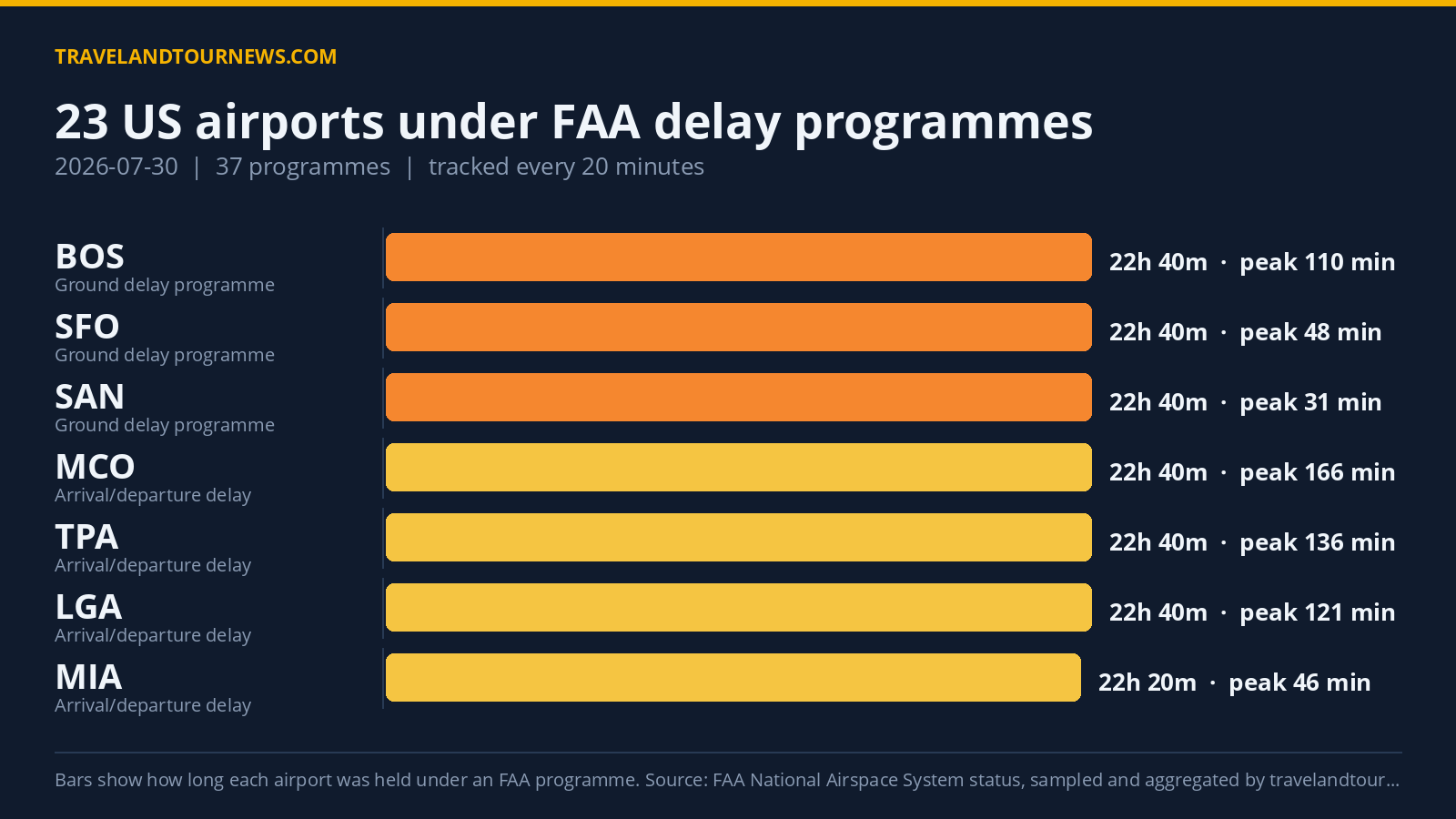
Ground delay programmes showed significant activity as well. Boston Logan International (BOS) ran a single ground delay programme continuously from 00:00 to 22:40 UTC (22 hours 40 minutes) caused by low ceilings, with peak average delays reaching 110 minutes and peak maximum delays of 319 minutes. San Francisco International (SFO) also operated a ground delay programme the entire day, attributed to “other” causes, with peak average delay of 48 minutes and peak max delay of 142 minutes.
Denver International (DEN) had a short 1
hour 40 minute ground delay programme due to thunderstorms, with peak delays up to 325 minutes, the highest observed max delay overall. San Diego International (SAN) simultaneously ran a prolonged ground delay programme attributed to airport volume for more than 22 hours with peak average delay of 31 minutes and max delay of 160 minutes.
| Airport | FAA programme | Cause | Peak average delay | In force (UTC) |
|---|---|---|---|---|
| Tampa International (TPA) | Ground Stop Programs | thunderstorms | – | 14:00 to 21:40 (7 hours 40 minutes) |
| Miami International (MIA) | Ground Stop Programs | thunderstorms | – | 14:20 to 17:40 (3 hours 20 minutes) |
| Fort Lauderdale-Hollywood International (FLL) | Ground Stop Programs | thunderstorms | – | 14:40 to 17:40 (3 hours) |
| Orlando International (MCO) | Ground Stop Programs | thunderstorms | – | 13:40 to 16:20 (2 hours 40 minutes) |
| DJT | Ground Stop Programs | thunderstorms | – | 15:40 to 18:00 (2 hours 20 minutes) |
| Salt Lake City International (SLC) | Ground Stop Programs | thunderstorms | – | 01:00 to 02:00 (1 hour) |
| FMY | Ground Stop Programs | thunderstorms | – | 15:40 to 16:40 (1 hour) |
| SRQ | Ground Stop Programs | thunderstorms | – | 17:00 to 18:00 (1 hour) |
| ASE | Ground Stop Programs | airport volume | – | 16:00 to 16:40 (40 minutes) |
| RSW | Ground Stop Programs | thunderstorms | – | 17:00 to 17:40 (40 minutes) |
| VNY | Ground Stop Programs | disabled aircraft on the runway | – | 00:00 to 00:20 (20 minutes) |
| Newark Liberty International (EWR) | Ground Stop Programs | airspace volume | – | 21:20 to 21:40 (20 minutes) |
| Denver International (DEN) | Ground Stop Programs | thunderstorms | – | 22:20 to 22:40 (20 minutes) |
| San Diego International (SAN) | Ground Stop Programs | airport volume | – | 22:40 to 22:40 (20 minutes) |
Thunderstorms Drove the Majority of Delay Programmes on July 30
Thunderstorms were the leading cause behind delay programmes on July 30, cited in 80 instances across the FAA’s programmes. TM Initiatives (traffic management actions related to weather) also played a significant role, with 59 programmes related to stop directives and 39 to mitigate directives linked
to weather.
Other causes included compacted demand, accounting for 35 programmes, and miscellaneous or “other” reasons involved in 57 cases. Specific operational issues included airport volume constraints, airspace congestion, and disabled aircraft on the runway as causing a smaller number of program activations.
Thunderstorm-related ground stops affected airports mainly in Florida, including Tampa, Miami, Fort Lauderdale, and Orlando, as well as airports such as Salt Lake City and Denver. Ground delay programmes were often linked to weather impacts and airport volume, with Boston’s delays driven primarily by low ceilings.
Delay Impact Trends Are Slightly Lower Than Previous Day but Above Weekly Average
The July 30 data shows 23 airports affected by delay programmes,
two fewer than the previous day when 25 airports were impacted. Total programmes decreased slightly from 40 the prior day to 37.
When compared with the average over the past seven days, which saw 17.7 airports affected daily, July 30 remained above average in terms of affected airports and programmes. However, it was not the worst day within the tracking window.
Methodology. travelandtournews.com samples the FAA’s National Airspace System status feed every 20 minutes throughout the US operating day and aggregates the result. This report is built from 67 samples taken between 00:00 and 22:40 UTC on 2026-07-30. Durations are
the observed window between the first and last sample in which a programme was in force, so a programme’s true length may be slightly longer than shown. Ground stops, ground delay programmes, airport closures and general delays are all published by the FAA in real time; the daily aggregation is ours.