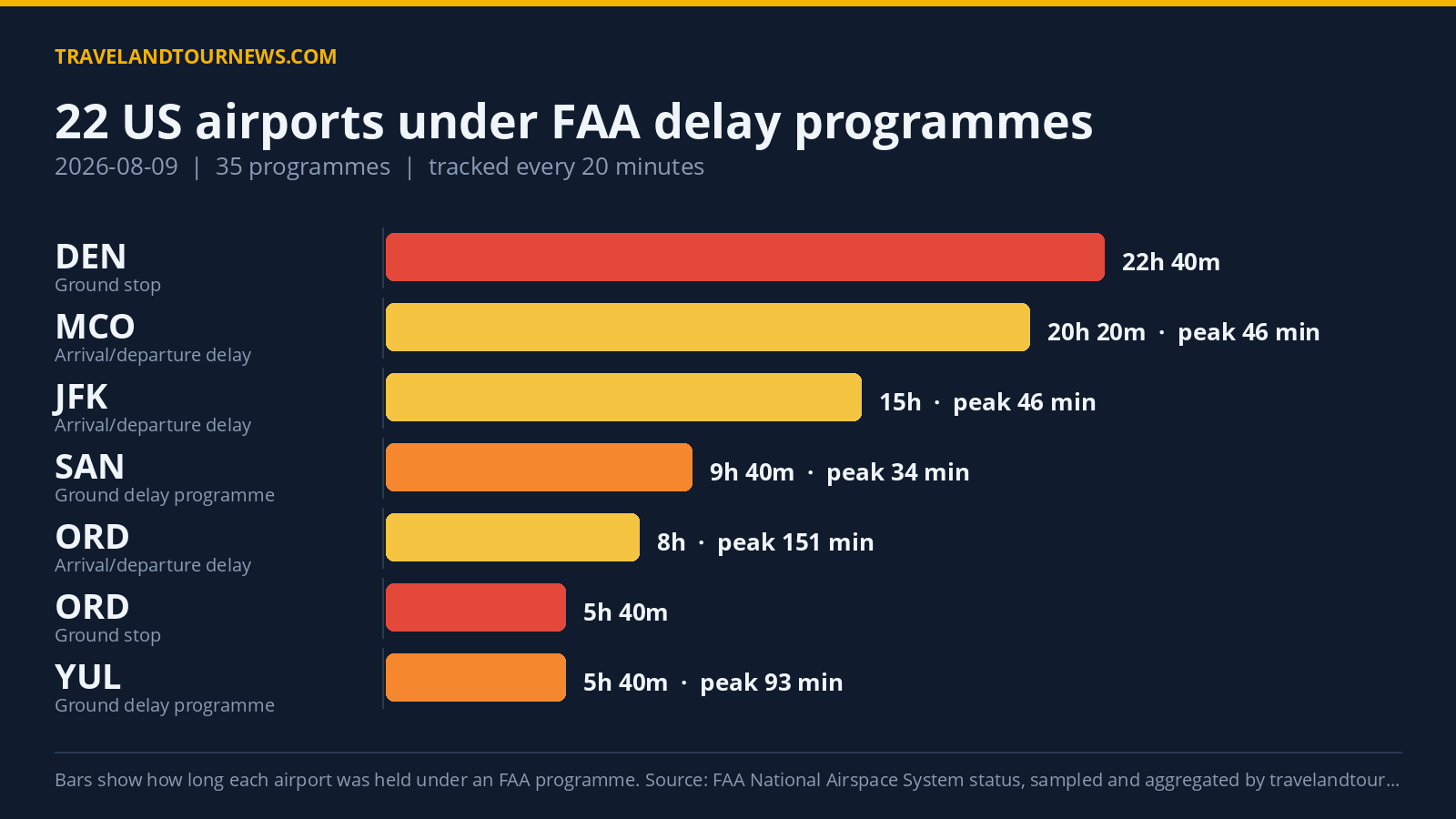

On August 9, 2026, the FAA implemented 35 delay programs at 22 airports across the United States, with Denver International Airport (DEN) experiencing the longest ground stop program lasting 22 hours and 40 minutes. Denver’s peak delay reached up to 0 minutes recorded during this lengthy program, indicating prolonged suspension rather than queued delays.
Overview of Airport Delay Programs on August 9
The 22 affected airports include major hubs such as Denver International (DEN), Chicago O’Hare (ORD), San Diego International (SAN), and John F. Kennedy International (JFK). The FAA recorded 7 ground stop programs, 9 ground delay programs, 1 airport closure, and 18 general arrival/departure delay information notices.
Ground stop programs prevent departures from origin airports toward the affected airport, stopping flights on the ground. Ground delay programs meter arrivals by assigning later departure times to reduce congestion.
Denver led with a ground stop running nearly the full day (from 00:00 to 22:40 UTC) due to wind and thunderstorms. Chicago O’Hare also
had multiple ground stops for thunderstorms lasting up to 5 hours 40 minutes and a ground delay program with peak average delay of 157 minutes and maximum delay reported as 642 minutes over 2 hours 40 minutes.
San Diego International had a 4 hour 20 minute airport closure and a concurrent 9 hour 40 minute ground delay program for airport volume issues, with peak average delay up to 34 minutes. Additional airports including Boston Logan, JFK, Philadelphia (PHL), Orlando International (MCO), and Las Vegas Harry Reid (LAS) had ground delay programs with delays ranging from 26 to 157 minutes caused
by thunderstorms, equipment outages, wind, and low ceilings.
| Airport | FAA programme | Cause | Peak average delay | In force (UTC) |
|---|---|---|---|---|
| Denver International (DEN) | Ground Stop Programs | wind; thunderstorms | – | 00:00 to 22:40 (22 hours 40 minutes) |
| Chicago O’Hare International (ORD) | Ground Stop Programs | thunderstorms | – | 17:00 to 22:40 (5 hours 40 minutes) |
| Chicago Midway International (MDW) | Ground Stop Programs | thunderstorms; THUNDERSTORMS | – | 18:20 to 21:00 (2 hours 40 minutes) |
| Harry Reid International (LAS) | Ground Stop Programs | wind | – | 21:40 to 22:20 (40 minutes) |
| LaGuardia (LGA) | Ground Stop Programs | airport volume | – | 18:00 to 18:20 (20 minutes) |
| SNA | Ground Stop Programs | airport volume | – | 20:00 to 20:00 (20 minutes) |
| Tampa International (TPA) | Ground Stop Programs | thunderstorms | – | 21:40 to 22:00 (20 minutes) |
| Chicago O’Hare International (ORD) | Ground Delay Programs | thunderstorms | 157 min | 20:00 to 22:40 (2 hours 40 minutes) |
| John F. Kennedy International (JFK) | Ground Delay Programs | thunderstorms | 157 min | 00:00 to 00:00 (20 minutes) |
| Denver International (DEN) | Ground Delay Programs | other | 143 min | 00:00 to 02:20 (2 hours 20 minutes) |
| Boston Logan International (BOS) | Ground Delay Programs | thunderstorms | 143 min | 00:00 to 00:00 (20 minutes) |
| YUL | Ground Delay Programs | other | 93 min | 17:00 to 22:40 (5 hours 40 minutes) |
| Harry Reid International (LAS) | Ground Delay Programs | wind | 63 min | 22:40 to 22:40 (20 minutes) |
| Philadelphia International (PHL) | Ground Delay Programs | EQUIPMENT; equipment outage | 47 min | 21:40 to 22:40 (1 hour) |
Thunderstorms and Airport Volume Led Delay Causes
FAA’s data lists thunderstorms as the top delay driver, cited in 35 programs. Airport volume was the second most common cause at 33 programs, followed closely by traffic management initiatives related to weather in 32 programs.
Other notable reasons from the dataset include equipment outages at PHI, low ceilings at San Francisco International, and wind primarily at Denver and Las Vegas airports. Weather-related issues dominated the delay drivers, with thunderstorm causes appearing frequently across different program types.
Comparison with Previous Day and Recent Trends
Compared to August 8, when 20 US airports were affected by 41 programs, August 9
had a slight increase of two airports affected but fewer programs overall, down to 35. The number of airports affected today matched the seven-day average of 22 airports, indicating a typical day in the monitoring window.
August 9 was not the worst day within the recent tracking period. Still, the extensive duration of Denver’s ground stop was notable for lasting over 22 hours, the longest observed program on this date.
Methodology. travelandtournews.com samples the FAA’s National Airspace System status feed every 20 minutes throughout the US operating day and aggregates the result. This report is built from 69 samples taken
between 00:00 and 22:40 UTC on 2026-08-09. Durations are the observed window between the first and last sample in which a programme was in force, so a programme’s true length may be slightly longer than shown. Ground stops, ground delay programmes, airport closures and general delays are all published by the FAA in real time; the daily aggregation is ours.