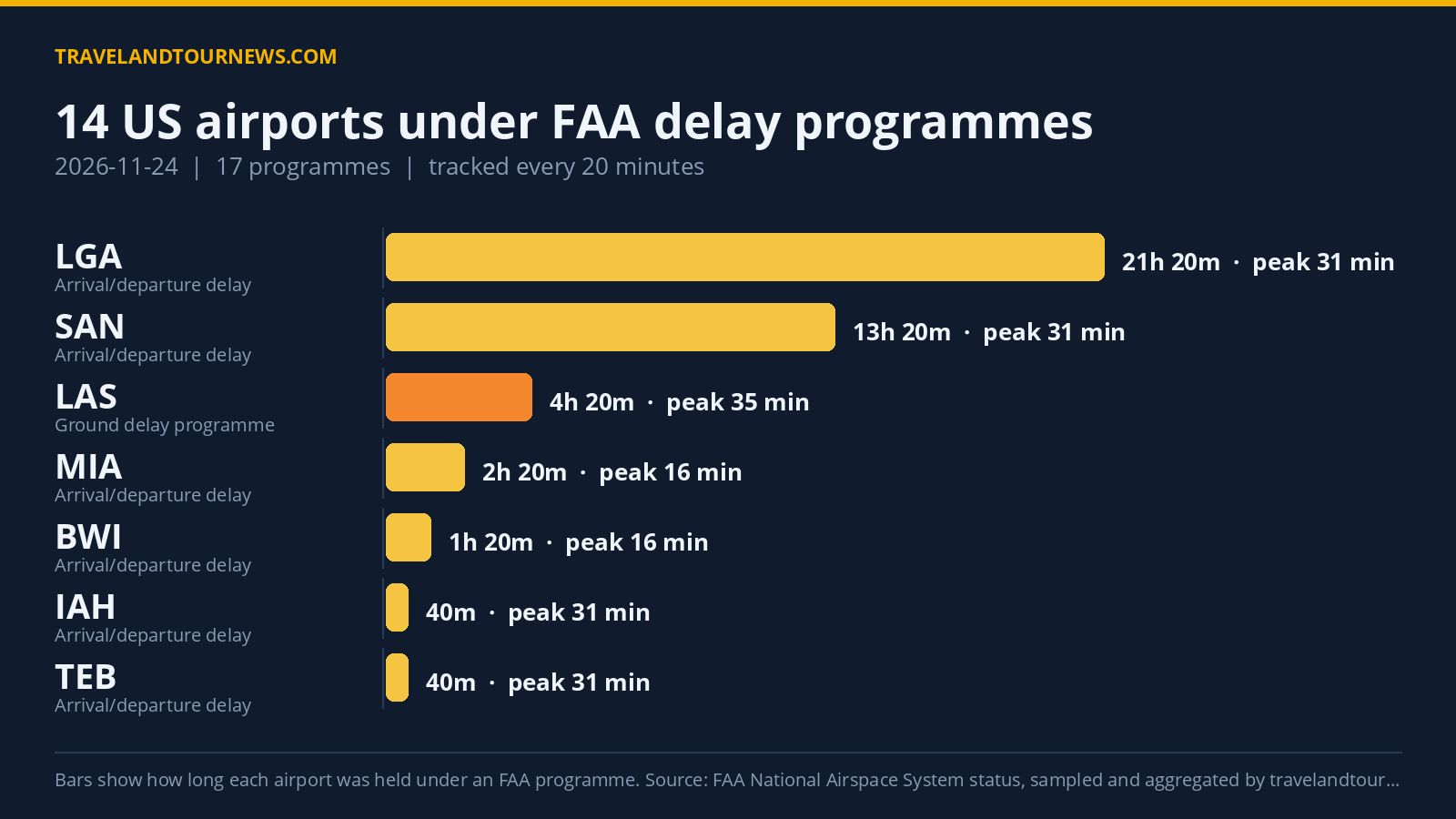

On November 24, 2026, 14 US airports were subject to 17 FAA delay programmes, according to FAA data tracked by travelandtournews.com. The worst-hit airport was Lexington (LEX), which experienced a ground stop due to a disabled aircraft on the runway.
Overview of Affected Airports and Delay Programme Types
Fourteen airports across the United States faced delay programmes throughout the day. The types of FAA programmes included 3 ground stop programmes, which hold departures bound for an airport on the ground at their origin; 2 ground delay programmes that meter arrivals by assigning later departure times; and 12 general arrival/departure delay information advisories.
Ground stops were active at Lexington (LEX) for 20 minutes starting at 00:20 UTC due to a disabled aircraft on the runway, at Harry Reid International (LAS) for a total of 40 minutes caused by staffing issues early in the morning, and at Chicago O’Hare International
(ORD) from 21:40 to 22:00 UTC due to an equipment outage. Ground delay programmes ran at LAS for 4 hours 20 minutes into the early morning with delays peaking at 90 minutes average and 35 minutes maximum, attributed to unspecified ‘other’ reasons, and at ORD starting at 22:20 UTC with a peak average delay of 47 minutes and a maximum of 99 minutes caused by an equipment outage.
| Airport | FAA programme | Cause | Peak average delay | In force (UTC) |
|---|---|---|---|---|
| LEX | Ground Stop Programs | disabled aircraft on the runway | – | 00:20 to 00:20 (20 minutes) |
| Harry Reid International (LAS) | Ground Stop Programs | STAFFING | – | 06:00 to 06:20 (20 minutes) |
| Chicago O’Hare International (ORD) | Ground Stop Programs | equipment outage | – | 21:40 to 22:00 (20 minutes) |
| Chicago O’Hare International (ORD) | Ground Delay Programs | equipment outage | 47 min | 22:20 to 22:20 (20 minutes) |
| Harry Reid International (LAS) | Ground Delay Programs | other | 35 min | 02:00 to 06:20 (4 hours 20 minutes) |
| LaGuardia (LGA) | General Arrival/Departure Delay Info | WX:Wind | 31 min | 00:00 to 21:20 (21 hours 20 minutes) |
| San Diego International (SAN) | General Arrival/Departure Delay Info | VOL:Compacted Demand | 31 min | 02:00 to 15:20 (13 hours 20 minutes) |
| George Bush Intercontinental (IAH) | General Arrival/Departure Delay Info | WX:Wind | 31 min | 16:20 to 17:00 (40 minutes) |
| TEB | General Arrival/Departure Delay Info | WX:Wind | 31 min | 20:00 to 20:40 (40 minutes) |
| Miami International (MIA) | General Arrival/Departure Delay Info | TM Initiatives:MIT:VOL | 16 min | 15:40 to 18:00 (2 hours 20 minutes) |
| Baltimore/Washington International (BWI) | General Arrival/Departure Delay Info | VOL:Compacted Demand | 16 min | 13:40 to 15:00 (1 hour 20 minutes) |
| Chicago O’Hare International (ORD) | General Arrival/Departure Delay Info | RWY:Obstruction | 16 min | 13:40 to 14:20 (40 minutes) |
| Dallas/Fort Worth International (DFW) | General Arrival/Departure Delay Info | RWY:Disabled Aircraft | 16 min | 02:20 to 02:40 (20 minutes) |
| Seattle-Tacoma International (SEA) | General Arrival/Departure Delay Info | VOL:Compacted Demand | 16 min | 16:00 to 16:20 (20 minutes) |
General arrival/departure delay programmes ranged in duration from 20 minutes to over 21 hours. LaGuardia (LGA) experienced such delays from midnight to 21:20 UTC with wind-related causes, showing peak average delays of 31 minutes. San Diego International (SAN) faced compacted demand delays lasting 13 hours 20 minutes from 02:00 to 15:20 UTC with similar peak delays. Miami International (MIA) and Fort Lauderdale-Hollywood International (FLL) encountered delays related to traffic management initiatives centered on volume control for periods of 2 hours 20 minutes and 20 minutes respectively.
Primary Causes Behind Delay Programmes
The FAA attributed the delays to a range of reasons, with wind (WX:Wind) being the most frequent cause, driving 20 delay instances overall. Other common reasons included compacted demand (VOL:Compacted Demand) and
the FAA’s traffic management initiatives related to volume (TM Initiatives:MIT:VOL). Less frequent but notable causes were runway obstructions, including disabled aircraft and physical runway obstructions.
Specifically, disabled aircraft on the runway caused delays at Lexington (LEX) within a ground stop and at Dallas/Fort Worth International (DFW) in general arrival/departure delays. Equipment outages factored into multiple ORD programmes, both for ground stops and ground delays, marking a critical infrastructure issue on the day.
Comparison With Previous Day and Recent Average
Compared to the previous day, the number of airports affected increased by seven, from 7 airports yesterday to 14 on November 24. The total delay programmes rose correspondingly
from 9 to 17. Against a seven-day average of 12.6 affected airports, this day showed elevated activity but is not the worst in the tracking window.
Methodology. travelandtournews.com samples the FAA’s National Airspace System status feed every 20 minutes throughout the US operating day and aggregates the result. This report is built from 67 samples taken between 00:00 and 22:20 UTC on 2026-11-24. Durations are the observed window between the first and last sample in which a programme was in force, so a programme’s true length may be slightly longer than shown. Ground stops, ground delay programmes, airport closures and
general delays are all published by the FAA in real time; the daily aggregation is ours.