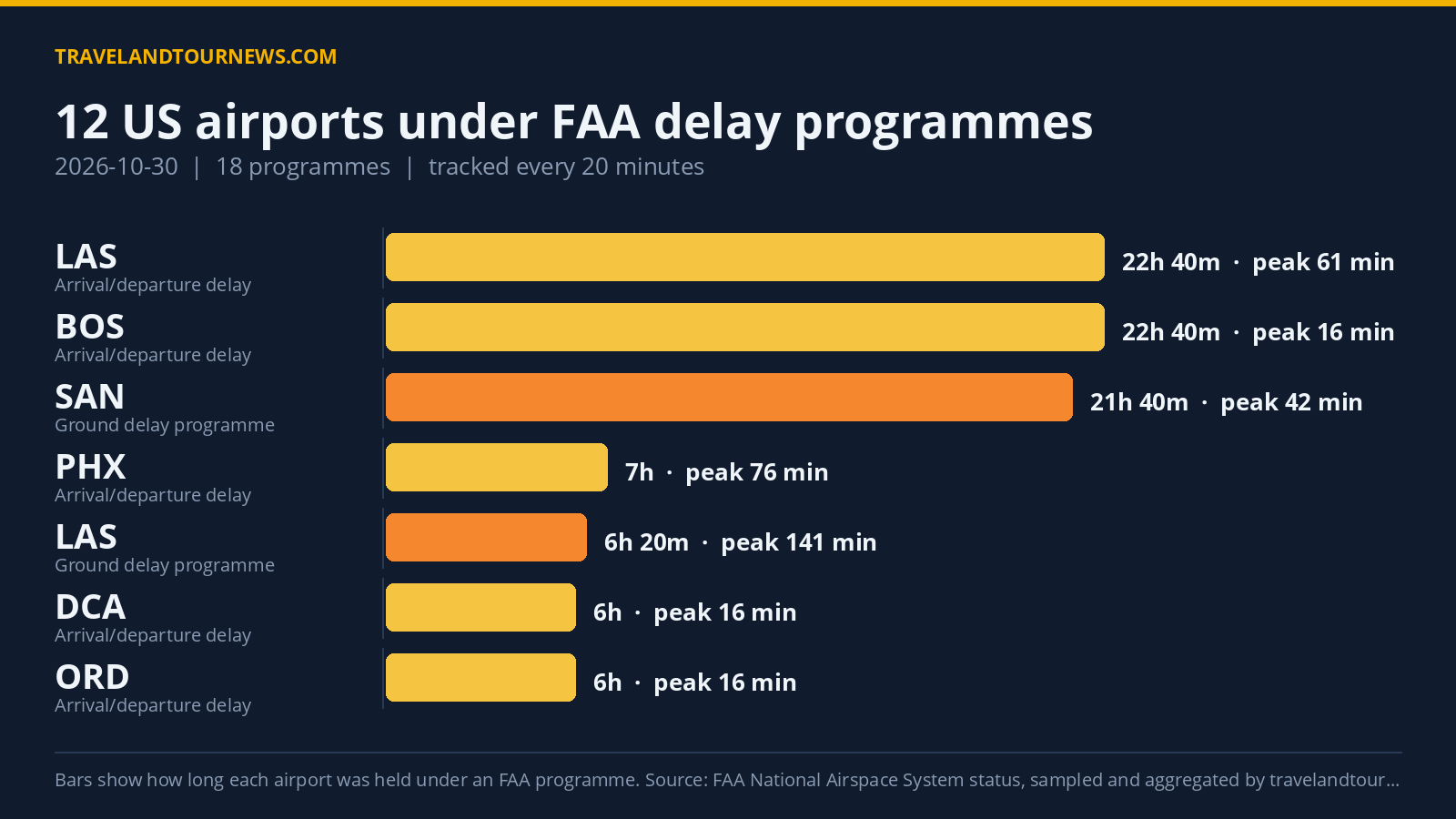

On October 30, 2026, the Federal Aviation Administration (FAA) held 12 airports in the United States under 18 delay programmes. The worst-hit airport was Harry Reid International (LAS) with ground delay programmes peaking at an average delay of 141 minutes and a maximum delay of 225 minutes.
FAA Delay Programmes and Airport Impact
The 12 airports affected on this day included AUS, BDL, BOS, DAL, DCA, DEN, HOU, LAS, LGA, ORD, PHX, and SAN. Among the 18 programmes, four were Ground Stop Programs, which hold departures bound for an airport on the ground at their origin, including LAS, DCA, AUS, and PHX. Three were Ground Delay Programs, which meter arrivals by assigning later departure times, active at LAS, SAN, and PHX. The remaining 11 programmes provided general arrival and departure delay information across multiple airports.
The longest-running programme was at San Diego International (SAN), where a Ground Delay Program related to airport volume
lasted 21 hours and 40 minutes. This programme peaked with an average delay of 42 minutes and a maximum delay of 80 minutes. Harry Reid International had the highest peak delay under a Ground Delay Program lasting 6 hours and 20 minutes due to staffing and other operational issues, with delays peaking at 141 minutes average and 225 minutes maximum. Other notable Ground Stop Programs due to thunderstorms were observed at LAS for 1 hour 40 minutes and PHX for 20 minutes.
| Airport | FAA programme | Cause | Peak average delay | In force (UTC) |
|---|---|---|---|---|
| Harry Reid International (LAS) | Ground Stop Programs | THUNDERSTORMS | – | 20:00 to 21:40 (1 hour 40 minutes) |
| Ronald Reagan Washington National (DCA) | Ground Stop Programs | security | – | 00:40 to 01:00 (20 minutes) |
| AUS | Ground Stop Programs | runway construction | – | 18:20 to 18:40 (20 minutes) |
| Phoenix Sky Harbor International (PHX) | Ground Stop Programs | THUNDERSTORMS | – | 18:20 to 18:40 (20 minutes) |
| Harry Reid International (LAS) | Ground Delay Programs | other; STAFFING | 141 min | 00:00 to 06:20 (6 hours 20 minutes) |
| San Diego International (SAN) | Ground Delay Programs | airport volume | 42 min | 00:00 to 21:40 (21 hours 40 minutes) |
| Phoenix Sky Harbor International (PHX) | Ground Delay Programs | THUNDERSTORMS | 40 min | 21:40 to 22:40 (1 hour) |
| Phoenix Sky Harbor International (PHX) | General Arrival/Departure Delay Info | TM Initiatives:MIT:WX | 76 min | 15:20 to 22:20 (7 hours) |
| Harry Reid International (LAS) | General Arrival/Departure Delay Info | WX:Wind; WX:Thunderstorms | 61 min | 00:00 to 22:40 (22 hours 40 minutes) |
| BDL | General Arrival/Departure Delay Info | VOL:Compacted Demand; VOL:ZDC VOL | 31 min | 20:20 to 21:00 (40 minutes) |
| William P. Hobby (HOU) | General Arrival/Departure Delay Info | OTHER: | 30 min | 00:00 to 02:20 (2 hours 20 minutes) |
| Boston Logan International (BOS) | General Arrival/Departure Delay Info | WX:Wind; ZBW / WX:Wind | 16 min | 00:00 to 22:40 (22 hours 40 minutes) |
| Ronald Reagan Washington National (DCA) | General Arrival/Departure Delay Info | VIPM:VIP Movement; VOL:Compacted Demand | 16 min | 00:00 to 06:00 (6 hours) |
| Chicago O’Hare International (ORD) | General Arrival/Departure Delay Info | VOL:Multi-taxi | 16 min | 00:00 to 06:00 (6 hours) |
Delay Causes: Thunderstorms, Volume, and Weather Measures
The FAA’s stated reasons for the delay programmes grouped into five top causes. The most frequent cause was
airport volume, cited 32 times, followed by compacted demand in volume-related factors appearing 23 times. Weather-related wind conditions accounted for 21 mentions, closely followed by Traffic Management (TM) Initiatives due to weather at 20 instances. Multi-taxi volume effects appeared 19 times. Thunderstorms specifically impacted LAS and PHX, triggering several Ground Stop and Ground Delay Programs.
Specific causes included runway construction at AUS, security concerns at DCA, and staffing issues at LAS and LGA. Several airports reported combined weather challenges, such as wind and thunderstorms affecting BOS and LAS. Denver International experienced a brief delay due to low visibility. General arrival
and departure delays were linked to a mix of these volume and weather causes across the affected airports.
Comparing Delay Activity: Slight Increase from Previous Day
Compared to October 29, 2026, the number of airports affected increased by one, rising from 11 to 12 on October 30. The total number of programmes increased from 16 to 18. The daily figures were above the recent seven-day average of 10.9 airports affected but did not mark the highest level observed in that period. This indicates a modest intensification of delays on this day relative to recent activity but not a peak in the last week.
Methodology. travelandtournews.com samples the FAA’s
National Airspace System status feed every 20 minutes throughout the US operating day and aggregates the result. This report is built from 66 samples taken between 00:00 and 22:40 UTC on 2026-10-30. Durations are the observed window between the first and last sample in which a programme was in force, so a programme’s true length may be slightly longer than shown. Ground stops, ground delay programmes, airport closures and general delays are all published by the FAA in real time; the daily aggregation is ours.