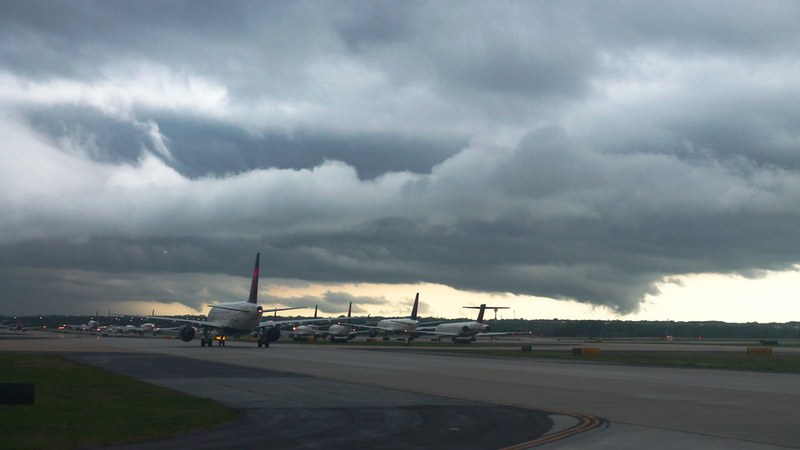
On August 15, 2026, the Federal Aviation Administration (FAA) issued a ground stop at Denver International Airport (DEN) as severe thunderstorms moved across the Colorado Front Range. The FAA halted all arrivals at 3:25 p.m. local time due to storms affecting the Denver metro area and Castle Rock, grounding inbound aircraft to avoid unsafe landing conditions.
By the end of the day, more than 700 flights were delayed or cancelled at DEN. FlightAware tracked 689 delayed flights and 22 cancellations on August 15. The average weather-related delay at the airport was one hour and 44 minutes. United Airlines experienced 216
delayed flights and four cancellations, while Southwest Airlines logged 249 delays and three cancellations. SkyWest reported 157 delays with 10 cancellations, and Frontier Airlines cancelled eight flights during the ground stop.
The ground stop was lifted at 4 p.m., but flight disruptions continued. By 4:30 p.m., FlightAware data showed 91 total cancellations and 708 delays at Denver International Airport. At that time, SkyWest had 38 cancellations and 121 delays, United Airlines had 34 cancellations and 265 delays, Southwest registered 14 cancellations and 211 delays, and Frontier recorded five cancellations and 49 delays. The National Weather Service issued a severe thunderstorm
watch for the Front Range until 9 p.m., signaling continued weather risks through the evening.
The weather disruption resulted from the North American Monsoon, which drives moist subtropical air into Colorado from mid-July through August. This pattern frequently causes rapidly developing afternoon thunderstorms near the foothills, creating strong outflow winds that disrupt runway operations at DEN. The airport’s high elevation and exposure to convective storm cells make it vulnerable to weather-driven ground stops and delays.
Denver International Airport is a major hub serving over 82.4 million passengers in 2025, ranking as the fourth-busiest airport in the United States. United Airlines
operates its second-largest hub at DEN, carrying a company-record 41.4 million passengers through the airport last year. United, Southwest, and Frontier Airlines together account for 88% of the seat capacity at DEN, amplifying the operational impact of weather disruptions.
The FAA defines a ground stop as the halting of incoming flights when an airport’s capacity drops sharply or reaches zero, typically due to severe weather. This prevents aircraft from holding overhead and having to circle before landing. The FAA implemented the ground stop on August 15 at 3:25 p.m. because thunderstorms interfered with final approach courses, rendering arrivals unsafe. The
ground stop was lifted at 4 p.m., but the FAA acknowledged that delays persisted due to ongoing severe weather. Concurrently, the National Weather Service maintained a severe thunderstorm watch for the region until 9 p.m.