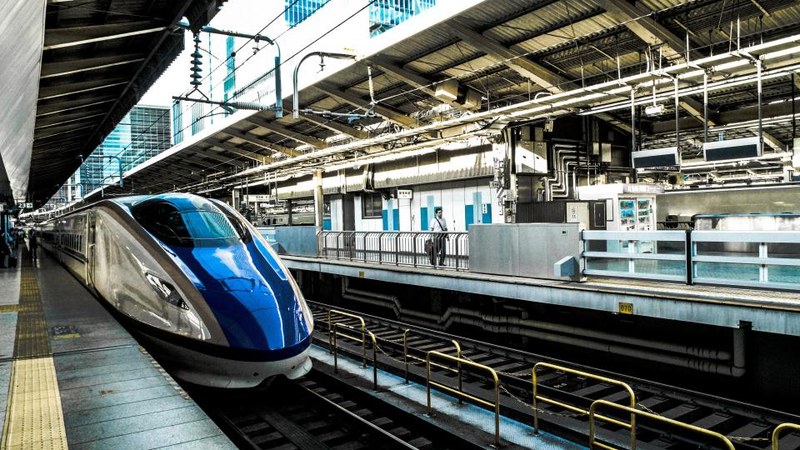
The Delhi-Mumbai bullet train project intends to connect two of India’s largest economic hubs, significantly reducing travel time between the capital and financial center. This initiative aims to strengthen the economic corridor linking Delhi and Mumbai, supporting faster business travel and regional integration over nearly 1,400 kilometers.
Mumbai-Ahmedabad High-Speed Rail Corridor Under Construction
The 508-kilometer Mumbai-Ahmedabad High-Speed Rail corridor is India’s first dedicated bullet train project, developed with Japanese technical and financial assistance. Designed for speeds up to 350 km/h and operating at 320 km/h, it includes 12 stations across Maharashtra, Dadra and Nagar Haveli, and Gujarat. Construction is ongoing despite delays and cost increases, with
the first service on the Surat-Vapi section expected by August 2027.
Delhi-Ahmedabad High-Speed Rail Corridor Planned But Not Yet Sanctioned
The Delhi-Ahmedabad corridor, approximately 886 km long, is planned with 15 stations spanning Delhi, Haryana, Rajasthan, and Gujarat. Key stops include Dwarka Sector 21 in Delhi; Manesar and Rewari in Haryana; Jaipur, Ajmer, Udaipur, and other cities in Rajasthan; and Ahmedabad in Gujarat. The route is fully elevated and planned to reduce current train journey times from 14 hours to under four hours. The detailed project report has been prepared by the National High Speed Rail Corporation Limited (NHSRCL), but the project remains in the planning stage without approval
or construction start.
Contrasting Progress and Strategic Importance
While the Mumbai-Ahmedabad corridor is under active construction as the only sanctioned high-speed rail project in India, the Delhi-Ahmedabad line lacks project sanction, funding decisions, and has not begun land acquisition. An NHSRCL official stated the alignment was chosen alongside existing rail and highway corridors to minimize land acquisition delays, though acquisition has yet to start. The corridor’s progression depends on overcoming these pre-construction hurdles.
Economic Benefits and Network Integration Potential
The Delhi-Ahmedabad corridor could become a critical northern link connecting Delhi and the National Capital Region with Rajasthan and Gujarat, potentially extending to Mumbai. This integration would facilitate same-day business travel across
major urban and industrial centers, enhancing market access and employment opportunities. The high-speed rail network would complement existing freight corridors and highway links, adding an efficient layer for passenger movement without replacing existing infrastructure.
Project Approval, Funding, and Political Context
The Railway Ministry emphasizes that project sanction depends on detailed reports, feasibility, and resource availability. The Delhi-Ahmedabad corridor was not included among the seven new high-speed rail corridors announced in the 2026-27 budget, limiting its current administrative and political momentum. The Gujarat Legislative Assembly election scheduled for December 2027 may increase focus on the corridor, given Gujarat’s central role in both the Delhi-Ahmedabad plan and the
ongoing Mumbai-Ahmedabad project.
Official Statements on Alignment and Land Acquisition
An NHSRCL official told The Times Of India, “We have chosen this alignment (along the rail line and highway) to ensure that land acquisition is minimal. In such mega projects, maximum time gets spent in acquiring privately owned land. While the alignment is final, acquiring land is yet to begin.” Preparatory work is expected to require significant time prior to any construction start on the Delhi-Ahmedabad corridor.