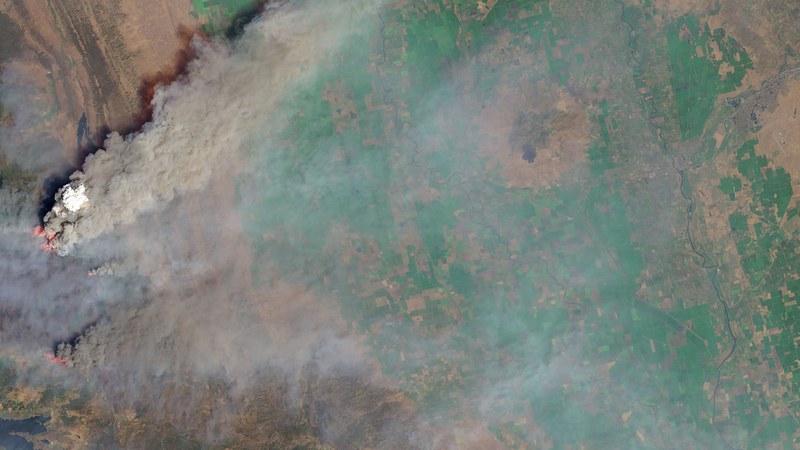
More than 10,700 U.S. flights were delayed on Friday, July 17, 2026, due to thick wildfire smoke drifting from over 900 active wildfires across Canada. The smoke affected airspace across the U.S. Midwest, Great Lakes, and East Coast regions, exposing over 100 million Americans in 18 states to hazardous PM2.5 pollution levels.
Airline Waivers and Travel Advisories Amidst Smoke Disruptions
United Airlines issued an air quality travel advisory on July 17 covering 17 airports across the U.S. and Canada, including Detroit, Toronto Pearson, Buffalo, Syracuse, Rochester, Duluth, and several airports in Michigan, Wisconsin, and New York. The airline allowed passengers with tickets purchased on or before July 16
to rebook July 17 or 18 flights between July 16 and July 20 without change fees or fare differences.
Delta Air Lines released a Midwest Air Quality Advisory from July 16 to 18 covering flights through Detroit, Minneapolis-St. Paul, Milwaukee, Green Bay, Grand Rapids, and Madison, with rebooking allowed through July 21. American Airlines extended waivers covering 29 airports after experiencing delays on 42% of its flights on July 17—more than double its 2026 average. However, American’s waiver deadline passed on July 18, though unused ticket values remain valid for one year after issuance.
Air Quality and Ongoing Smoke Waves in Key U.S. Cities
Air quality in affected regions reached
dangerous levels, with Detroit recording an Air Quality Index (AQI) near 600 on July 16, surpassing its previous records. Northern Minnesota exceeded 600 micrograms per cubic meter of PM2.5, far beyond the Environmental Protection Agency’s hazardous AQI ceiling of 500. Chicago’s AQI reached 153 early on July 19, ranking it among the world’s most polluted cities at that time.
The National Weather Service forecasted a third wave of smoke returning to the Great Lakes region by Sunday, July 19, with unhealthy air conditions expected in Chicago, Detroit, and parts of the Northeast through at least that day.
FAA Ground Delays and Airport Operations Impacted
The Federal Aviation
Administration (FAA) implemented a ground delay program to manage aircraft movements affected by reduced visibility due to smoke. Philadelphia International Airport recorded 365 flight delays and 12 cancellations on Thursday, July 16, followed by over 200 delays on Friday. Chicago O’Hare, Detroit, and other Great Lakes hubs also experienced significant delays, compounding travel disruptions.
Tariff Threat, Legal Constraints, and Canadian Government Response
On July 17, U.S. President Donald J. Trump threatened to increase tariffs on Canada, citing the “incalculable” financial impact of the smoke on the U.S., stating these costs “must of necessity be added to the TARIFFS Canada is currently paying.” However, legal experts point out that
a February 2026 Supreme Court ruling limits presidential tariff authority, making new levies on Canada unlikely before the scheduled Section 122 tariff expiration on July 24.
Canadian Prime Minister Mark Carney rejected the tariff threat, emphasizing that tackling climate change is “the responsibility of all countries, including the United States.” Emergency Management Minister Eleanor Olszewski detailed Canada’s $12 billion investment in forest management and fire prevention since 2020, while Ontario Premier Doug Ford criticized the U.S. administration’s accusations and challenged them to lift softwood lumber tariffs exceeding 45% if genuine cooperation is desired.
Scientific Links Between Wildfires and Climate Change
Climate scientists attribute the wildfires primarily to
a record-breaking heatwave rather than forestry management failures. The Ontario region experienced temperatures 25.2°F above average on July 13, facilitating forest drying and lightning-ignited fires, explained Shel Winkley, chief meteorologist at Climate Central. Daniel Swain, affiliated with the National Center for Atmospheric Research, noted that the heatwave created conditions for rapid fire spread.
The 2026 wildfire season has burned 134% of Canada’s 10-year average acreage and 5,740 square miles in the U.S.—31% above average. These figures illustrate the regional climate stress contributing to the extensive smoke impacting the U.S.
Traveler Precautions and Recommendations Amid Smoke and Delays
Passengers are advised to consult the FAA National Airspace System status
and airline-specific flight information before traveling. Additional connection time is recommended at major hubs including Philadelphia International, Chicago O’Hare, and Detroit due to ongoing delays. The Environmental Protection Agency advises limiting outdoor activities as AQI levels rise above 150, recommending N95 or KN95 masks for adequate particulate filtration.
Refunds for delays caused by wildfire smoke are generally unavailable unless flights are cancelled or schedules are significantly changed. Travelers utilizing airline waivers should note respective rebooking windows: United offers changes through July 20, Delta through July 21, and American waivers expired July 18.