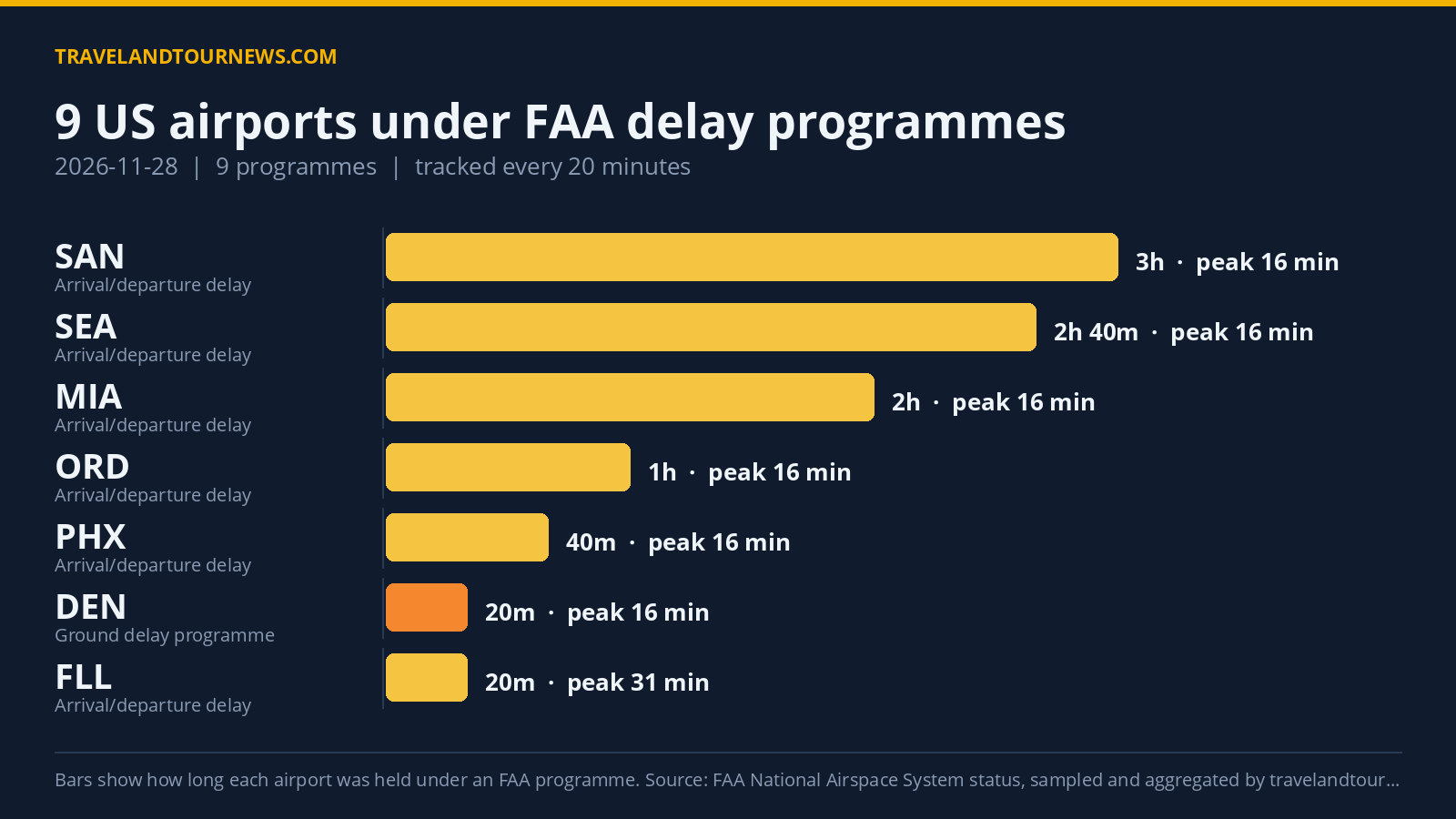

On November 28, 2026, the FAA held nine airports across the United States under delay programs, activating a total of nine programs. Denver International Airport (DEN) was the worst-hit, experiencing a peak delay of 97 minutes during a ground delay program.
Details on Delay Programs at Affected Airports
The FAA’s nine delay programs on November 28 covered airports in Denver (DEN), Dallas/Fort Worth (DFW), Fort Lauderdale-Hollywood (FLL), LaGuardia (LGA), Miami (MIA), Chicago O’Hare (ORD), Phoenix Sky Harbor (PHX), San Diego (SAN), and Seattle-Tacoma (SEA). Of the nine programs, one was a ground delay program at DEN, which meters arrivals by assigning later departure times. The remaining eight programs provided general arrival and departure delay information.
Denver’s ground delay program was observed for 20 minutes between 22:00 and 22:20 UTC, with a peak average delay of 16 minutes and a peak maximum of 97 minutes, attributed to wind. San
Diego operated a general arrival/departure delay program for the longest duration of three hours (15:00–18:00 UTC) driven by compacted demand, peaking at an average 16-minute delay and a maximum delay of 30 minutes. Seattle-Tacoma’s program lasted 2 hours 40 minutes with weather-related fog and compacted demand as causes, showing similar peak delays.
Miami and Fort Lauderdale-Hollywood had general delay programs lasting two hours and 20 minutes respectively, both influenced by traffic management initiatives related to volume. Chicago O’Hare and Phoenix Sky Harbor faced delays due to multi-taxi volume, while Dallas/Fort Worth encountered a delay program for 20 minutes caused by
runway obstruction. LaGuardia reported a short 20-minute delay linked to traffic management stopping volume.
| Airport | FAA programme | Cause | Peak average delay | In force (UTC) |
|---|---|---|---|---|
| Denver International (DEN) | Ground Delay Programs | wind | 16 min | 22:00 to 22:20 (20 minutes) |
| Fort Lauderdale-Hollywood International (FLL) | General Arrival/Departure Delay Info | TM Initiatives:MIT:VOL | 31 min | 18:20 to 18:40 (20 minutes) |
| San Diego International (SAN) | General Arrival/Departure Delay Info | VOL:Compacted Demand | 16 min | 15:00 to 18:00 (3 hours) |
| Seattle-Tacoma International (SEA) | General Arrival/Departure Delay Info | WX:Fog; VOL:Compacted Demand | 16 min | 18:00 to 20:40 (2 hours 40 minutes) |
| Miami International (MIA) | General Arrival/Departure Delay Info | TM Initiatives:MIT:VOL | 16 min | 16:00 to 18:00 (2 hours) |
| Chicago O’Hare International (ORD) | General Arrival/Departure Delay Info | VOL:Multi-taxi | 16 min | 00:40 to 01:40 (1 hour) |
| Phoenix Sky Harbor International (PHX) | General Arrival/Departure Delay Info | VOL:Multi-taxi | 16 min | 19:00 to 19:40 (40 minutes) |
| Dallas/Fort Worth International (DFW) | General Arrival/Departure Delay Info | RWY:Obstruction | 16 min | 14:00 to 14:00 (20 minutes) |
| LaGuardia (LGA) | General Arrival/Departure Delay Info | TM Initiatives:STOP:VOL | 16 min | 21:40 to 21:40 (20 minutes) |
Delay Causes: Volume and Weather Dominated
Volume-related factors dominated November 28’s delay causes. The most frequent cause was compacted demand, implicated in 11 instances, followed by traffic management initiatives addressing volume, referenced in nine programs. Multi-taxi volume delayed operations in seven cases. Weather factors contributed less frequently, with fog recorded twice and wind the cause for the ground delay program at Denver twice as well.
Specific FAA-labelled reasons included “TM Initiatives:MIT:VOL” (traffic management initiative), “VOL:Compacted Demand,” and “VOL:Multi-taxi,” indicating volume-related operational constraints as the primary delay factors. Weather conditions were isolated to
fog at Seattle-Tacoma and wind at Denver.
Comparing November 28 to Previous Days
The number of airports affected on November 28 (9) more than doubled compared to the previous day’s 4. The total delay programs also rose from 4 to 9. Despite this increase, the figure remains below the weekly average of 11.6 airports affected over the past seven days. Today’s highest average delays and peak delays did not surpass the highest levels recorded in the tracked week.
Methodology. travelandtournews.com samples the FAA’s National Airspace System status feed every 20 minutes throughout the US operating day and aggregates the result. This report is built from 68
samples taken between 00:00 and 22:20 UTC on 2026-11-28. Durations are the observed window between the first and last sample in which a programme was in force, so a programme’s true length may be slightly longer than shown. Ground stops, ground delay programmes, airport closures and general delays are all published by the FAA in real time; the daily aggregation is ours.