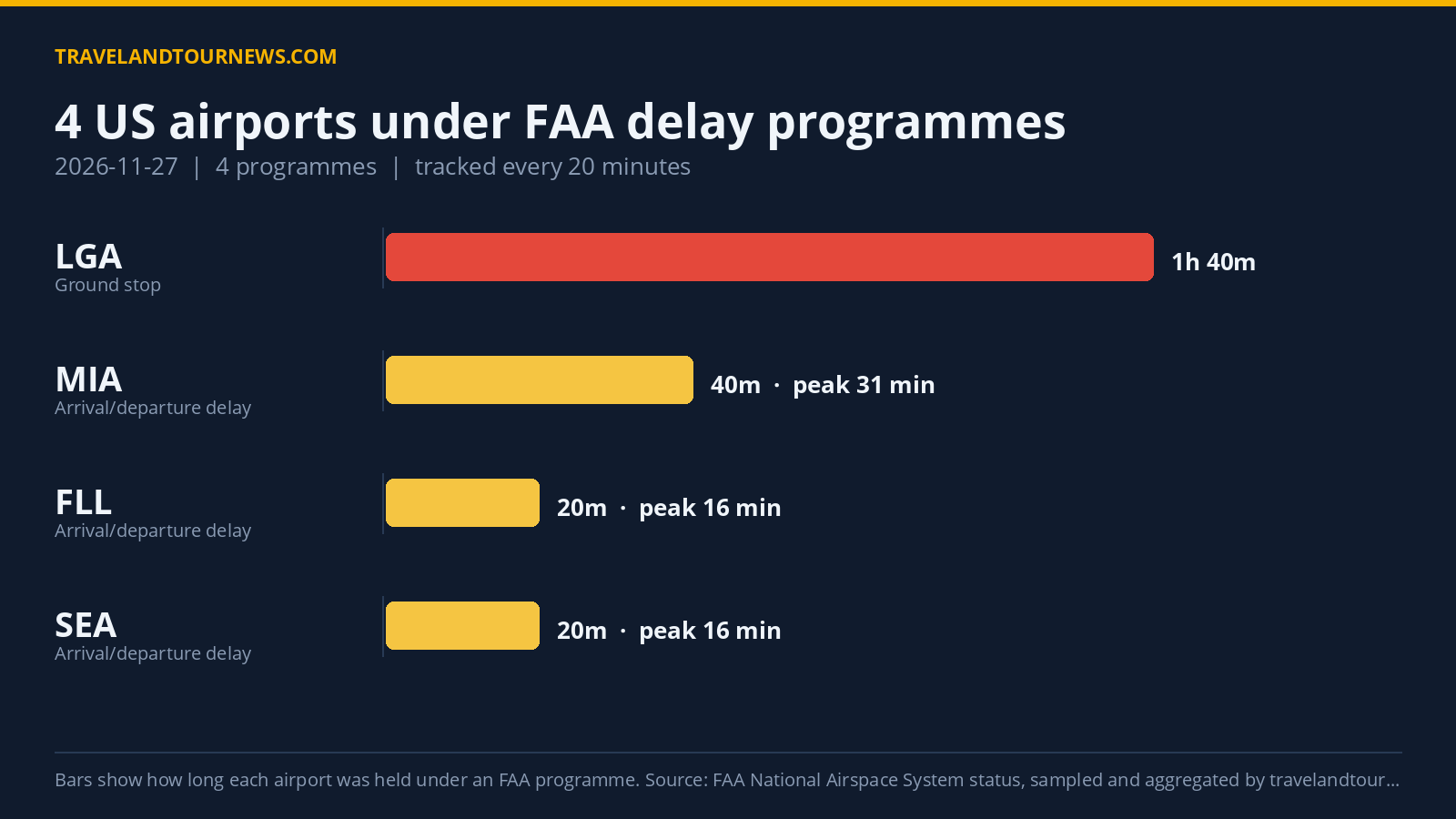

On November 27, 2026, the FAA held delay programs affecting four airports in the United States through a total of four programmes. Miami International Airport (MIA) experienced the longest peak arrival and departure delay of 45 minutes during this period.
FAA Delay Programs Active at Four Airports Including One Ground Stop
The delay programs were in place at LaGuardia (LGA), Miami International (MIA), Fort Lauderdale-Hollywood International (FLL), and Seattle-Tacoma International (SEA). Of these, LaGuardia operated a ground stop program, which halts departures destined for the airport on the ground at their originating airports. This ground stop lasted 1 hour and 40 minutes, from midnight to 1:40 a.m. UTC but reported no measurable peak delays at the airport itself.
The other three airports each had general arrival and departure delay programs, which meter arrivals by assigning later departure times. Miami International’s delay program lasted 40 minutes between 16:20 and 17:00 UTC. It
recorded the highest peak average delay of 31 minutes and a peak maximum delay reaching 45 minutes during this time.
Fort Lauderdale-Hollywood International’s program was active for 20 minutes, from 16:20 to 16:40 UTC, with a peak average delay of 16 minutes and a maximum delay of 30 minutes. Seattle-Tacoma International had a general delay program from 20:20 to 20:40 UTC, also lasting 20 minutes, with the same peak average and maximum delays of 16 and 30 minutes respectively.
| Airport | FAA programme | Cause | Peak average delay | In force (UTC) |
|---|---|---|---|---|
| LaGuardia (LGA) | Ground Stop Programs | other | – | 00:00 to 01:40 (1 hour 40 minutes) |
| Miami International (MIA) | General Arrival/Departure Delay Info | TM Initiatives:MIT:VOL | 31 min | 16:20 to 17:00 (40 minutes) |
| Fort Lauderdale-Hollywood International (FLL) | General Arrival/Departure Delay Info | TM Initiatives:MIT:VOL | 16 min | 16:20 to 16:40 (20 minutes) |
| Seattle-Tacoma International (SEA) | General Arrival/Departure Delay Info | VOL:Compacted Demand | 16 min | 20:20 to 20:40 (20 minutes) |
Causes Behind Delay Programs: Traffic Management Initiatives and Others
The FAA’s stated causes for the delay programs were grouped mainly under three categories. The most frequent cause listed was categorized
as “other,” accounting for six program samples and notably affecting LaGuardia during the ground stop.
Next were traffic management initiatives labeled as “TM Initiatives:MIT:VOL,” which drove five program samples. These initiatives caused delays at Miami International and Fort Lauderdale-Hollywood International, indicating efforts to manage volume-induced demand at those airports.
A smaller number of program samples, two in total, were attributed to “VOL:Compacted Demand,” creating delays at Seattle-Tacoma International. This cause reflects situations of condensed demand affecting the airport’s operational flow.
Delay Program Trends: Fewer Airports and Programs Compared to Yesterday and Weekly Average
Compared to the previous day, November 26, 2026, when nine delay programs at five airports were recorded, today’s numbers show
a decline to four programs across four airports. This represents a reduction of one airport affected and five fewer programs in total.
This day’s activity remains below the seven-day average, which typically sees 13 airports impacted by delay programs. The current day is not the highest in peak delay or number of programs within the recent tracking window.
Methodology. travelandtournews.com samples the FAA’s National Airspace System status feed every 20 minutes throughout the US operating day and aggregates the result. This report is built from 68 samples taken between 00:00 and 22:20 UTC on 2026-11-27. Durations are the observed window
between the first and last sample in which a programme was in force, so a programme’s true length may be slightly longer than shown. Ground stops, ground delay programmes, airport closures and general delays are all published by the FAA in real time; the daily aggregation is ours.