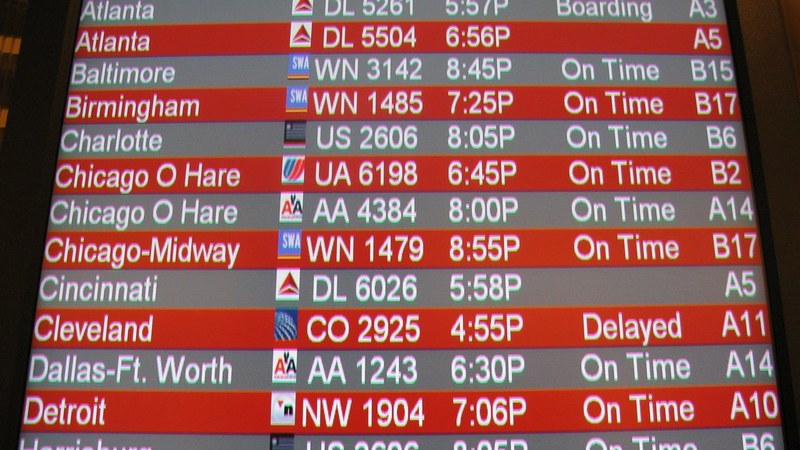
The Federal Aviation Administration (FAA) issued a ground stop at Chicago O’Hare International Airport on November 24, 2026, beginning between 3:20 and 3:25 p.m. Central Standard Time (CST) due to an equipment outage affecting air traffic operations. The ground stop lasted approximately 40 to 45 minutes before being downgraded to a ground delay program as technicians worked on repairs.
Operational Impact of Ground Stop
During the ground stop, flights bound for O’Hare that had not yet departed were held at their origin airports, while inbound flights already airborne were allowed to continue. The FAA did not close the airport fully, and there were no official
reports of diverted arrivals caused solely by the outage. Average flight delays for departures and arrivals at O’Hare during the disruption were between 40 and 50 minutes. Although the ground stop ended around 4:00 p.m. CST, residual delays and schedule disruptions persisted into the evening.
Passenger Disruptions and Flight Cancellations
The FAA’s ground stop and subsequent ground delay period resulted in flight cancellations and significant delays on some routes to O’Hare, affecting crew schedules and aircraft rotations. Passengers traveling to or through O’Hare faced missed connections or were required to be rebooked on later flights. Reports from travelers on outbound flights indicated delays on taxiways
or gate holds while waiting for clearance. Arriving passengers at O’Hare also encountered longer waiting times for arriving aircraft to reach gates.
Background on Recent FAA Disruptions
This equipment outage follows earlier November 2026 events that impacted O’Hare’s operations. On November 13, a nationwide FAA ground stop halted departures at all U.S. airports for several hours due to telecommunications equipment failure. Additionally, on November 23, Chicago Terminal Radar Approach Control imposed a ground stop at O’Hare caused by controller staffing constraints, lifted after about 1.5 hours. These incidents collectively added pressure on the airport’s already strained operating environment during the busy Thanksgiving travel period.
Equipment Issue and Official Responses
The
FAA has not disclosed detailed information on the specific air traffic control equipment that failed but has indicated the problem was isolated to O’Hare. Local reports suggest the affected system may have involved ground-based surface radar or ground movement monitoring equipment. FAA officials emphasized ongoing repair work and confirmed the outage was unrelated to cyber activity or the telecommunications failure from the November 13 nationwide ground stop.
An FAA statement read: “The FAA is no longer under a ground stop at Chicago O’Hare International Airport but is temporarily delaying some flights while technicians work to repair a piece of air
traffic equipment.” The agency also noted, “The issue is specific to O’Hare, and it does not impact all flights nor affect any other airports or FAA systems.”
U.S. Department of Transportation Secretary Sean Duffy said, “As millions of Americans prepare to hit the road or take to the skies to spend the holiday season with their loved ones, the Trump Administration’s message is clear: your safety is our number one priority. We’ve taken unprecedented action to limit flight delays and cancellations. We will be on the clock 24/7 to get families to their destinations safely and on time.”
Holiday Travel Context and Traveler Guidance
The ground
stop occurred during the peak Thanksgiving holiday travel period, during which AAA forecasted 5.96 million U.S. domestic air travelers, and the U.S. Department of Transportation anticipated over 417,000 flights nationwide in a nine-day span starting November 24. The disruption limited airline flexibility to adjust schedules rapidly due to heavy demand and close-to-capacity operations at O’Hare.
Travelers using Chicago O’Hare in the days following the outage should account for potential residual delays. Airlines have not issued special change waivers but are operating standard rebooking and same-day change policies. The FAA’s delay map no longer shows active ground stop or ground delay
programs at O’Hare as of November 25, 2026. The incident adds to data on the resilience challenges faced by U.S. air traffic control infrastructure during periods of peak demand, informing ongoing FAA modernization discussions.