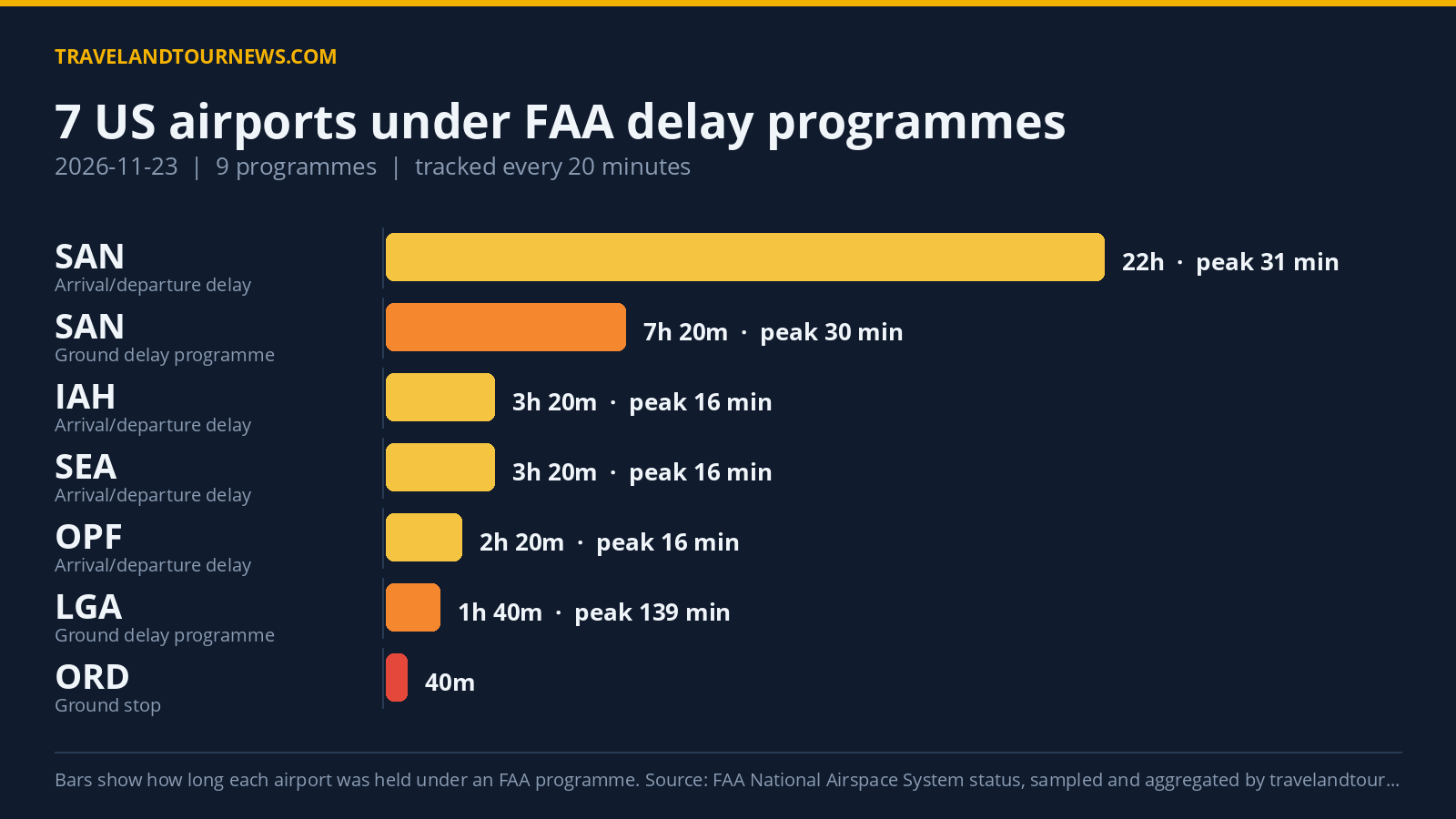

On November 23, 2026, the FAA held delay programmes across seven U.S. airports with a total of nine programmes active throughout the day. The worst-hit airport was Chicago O’Hare International (ORD), which experienced a ground stop program due to staffing shortages.
FAA Delay Programmes Spread Across Seven Key Airports
The seven affected airports on November 23 were Chicago O’Hare International (ORD), LaGuardia (LGA), San Diego International (SAN), George Bush Intercontinental (IAH), Seattle-Tacoma International (SEA), Philadelphia International (PHL), and OPF. Program types included one ground stop, two ground delay programmes, and six general arrival/departure delay information advisories.
A ground stop holds departures bound for an airport on the ground at their origin, while a ground delay programme meters arrivals by assigning later departure times.
ORD’s ground stop occurred between 17:20 and 18:00 UTC lasting 40 minutes and was caused by staffing issues. It did not register average or maximum delay
minutes due to the halt on departures.
LaGuardia’s ground delay programme, triggered by low visibility, lasted 1 hour 40 minutes from midnight to 01:40 UTC. This programme had the highest peak average delay of 139 minutes and a maximum delay reaching 361 minutes.
San Diego International ran a ground delay programme caused by airport volume from 14:40 to 22:00 UTC lasting 7 hours 20 minutes. Peak average delay was 30 minutes with a maximum delay of 80 minutes.
San Diego also reported a general arrival/departure delay program under compacted demand volume lasting a full 22 hours between midnight and 22:00
UTC with average delays around 31 minutes and maximum delays of 45 minutes.
| Airport | FAA programme | Cause | Peak average delay | In force (UTC) |
|---|---|---|---|---|
| Chicago O’Hare International (ORD) | Ground Stop Programs | STAFFING | – | 17:20 to 18:00 (40 minutes) |
| LaGuardia (LGA) | Ground Delay Programs | low visibility | 139 min | 00:00 to 01:40 (1 hour 40 minutes) |
| San Diego International (SAN) | Ground Delay Programs | airport volume | 30 min | 14:40 to 22:00 (7 hours 20 minutes) |
| San Diego International (SAN) | General Arrival/Departure Delay Info | VOL:Compacted Demand | 31 min | 00:00 to 22:00 (22 hours) |
| George Bush Intercontinental (IAH) | General Arrival/Departure Delay Info | WX:Wind | 16 min | 16:40 to 20:00 (3 hours 20 minutes) |
| Seattle-Tacoma International (SEA) | General Arrival/Departure Delay Info | VOL:Compacted Demand; RWY:Obstruction | 16 min | 17:00 to 20:20 (3 hours 20 minutes) |
| OPF | General Arrival/Departure Delay Info | WX:Low Ceilings | 16 min | 13:40 to 16:00 (2 hours 20 minutes) |
| Philadelphia International (PHL) | General Arrival/Departure Delay Info | WX:Low Ceilings | 16 min | 14:40 to 15:00 (20 minutes) |
| Chicago O’Hare International (ORD) | General Arrival/Departure Delay Info | STAFF:Staffing | 16 min | 17:40 to 18:00 (20 minutes) |
General delay advisories at other airports included weather-related issues like low ceilings at OPF and PHL, wind conditions at IAH, and runway obstruction coupled with compacted demand at SEA. These programmes measured delays between 16 and 30 minutes on average and lasted from 20 minutes to over 3 hours.
Airport Volume and Weather Drive Most Delays
FAA’s stated causes for these programmes were varied. The leading cause was airport volume, cited in 23 programmes, followed by compacted demand volume with 11 cases. Weather-related delays were also prominent with low ceilings and wind each affecting 10 and 6 programmes respectively, and low visibility cited in 6 programmes. Other specific causes included runway obstruction and staffing shortages.
Delay Activity Down Compared to Yesterday and Weekly Average
Compared to the previous day, November 23 showed a significant reduction in delay activity. Yesterday had 20 airports affected by 26 programmes, while November 23 had only 7
airports with 9 programmes, a decline of 13 programmes. The seven-day average before November 23 noted 13.1 airports affected per day, marking this day below the recent weekly norm. This day was not the peak in the tracking window.
Methodology. travelandtournews.com samples the FAA’s National Airspace System status feed every 20 minutes throughout the US operating day and aggregates the result. This report is built from 67 samples taken between 00:00 and 22:00 UTC on 2026-11-23. Durations are the observed window between the first and last sample in which a programme was in force, so a programme’s true length may
be slightly longer than shown. Ground stops, ground delay programmes, airport closures and general delays are all published by the FAA in real time; the daily aggregation is ours.