Spain is advancing its upgrade of railway telecommunications by preparing field trials for the Future Railway Mobile Communication System (FRMCS). The effort is part of the FP2-MORANE-2 research initiative managed by Europe’s Rail Joint Undertaking and led by the International Union of Railways (UIC).
The FP2-MORANE-2 consortium includes 11 railway operators and infrastructure managers, suppliers such as Alstom, CAF, Ericsson, and Siemens, mobile network operators KPN and Telia, and technology firms including Teltronic and Viavi Solutions. The project seeks to validate FRMCS, which will replace the increasingly obsolete GSM-R system with a 5G-based platform.
Laboratory and Demonstration Activities Pave Way for Field Trials
Initial laboratory tests of FRMCS technology
have been conducted to integrate components and evaluate risks before deployment. In December 2024, Teltronic demonstrated broadband networks and Mission Critical Services (MCX) communicating with an Urbos tram in Zaragoza, using TETRA, 4G, and 5G technologies at the Rail Live! trade show in Madrid. The demonstration connected Zaragoza tram communications simultaneously with control rooms in Madrid and elsewhere.
In June 2025, the MoySEST consortium, led by Teltronic and including Kenmei and S2Grupo, began overnight test trials deploying a CAF-built Class 900 electric multiple unit on the metre-gauge network near Durango in the Basque region. Supported by Euskotren and Eusko Trenbide
Sarea under the EU Recovery & Resilience Plan, the trials validated broadband 5G and advanced cybersecurity performance for FRMCS use, confirming coverage and latency suitable for future testing.
Private 5G Network Deployed on High-Speed Line
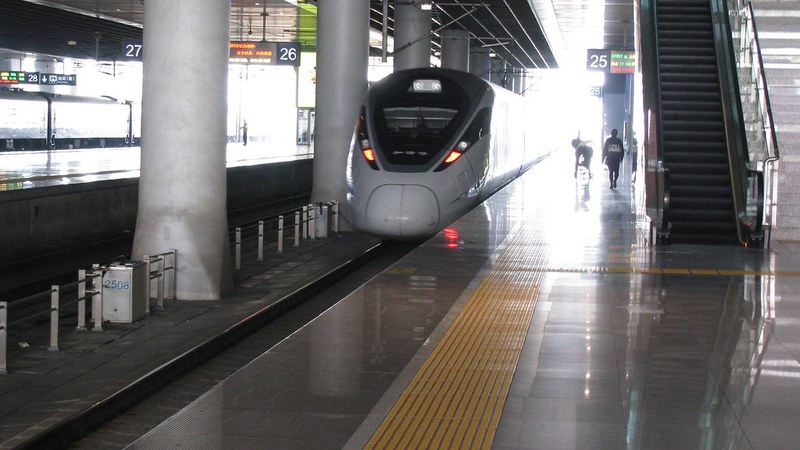
In early 2026, Teltronic installed a private 5G network operating at 24 GHz along a 37-kilometer section of the Albacete–Alacant high-speed railway line to support FRMCS communications. The network was engineered specifically to handle communication requirements at speeds exceeding 200 kilometers per hour while mitigating Doppler effects.
An ADIF laboratory train equipped with onboard units transmitted voice, data, and video communications over the network during over 900 kilometers of test runs, simulating
operational conditions at up to 200 km/h. The tests demonstrated stable coverage, satisfactory transmission rates, and robust cybersecurity on the high-speed line.
Deployment and Testing Plans on Spanish Rail Lines
ADIF, the Spanish rail infrastructure manager, is preparing a FRMCS demonstrator deployment on a 60-kilometer segment of the Albacete–Alacant line. Infrastructure works are completed, and fiber optic installations for dedicated radio site connections are underway. Installation of FRMCS radio equipment is planned to commence in November 2026, followed by system integration and commissioning.
Field testing on this high-speed corridor is scheduled between April and June 2027. Tests will assess FRMCS performance regarding mobility, handover, communication continuity, and mission-critical
service support under real operating conditions.
Separately, a second trial site on the metre-gauge Asunción Universidad–Matallana section near León is advancing. Infrastructure preparation is approximately 85% complete as of November 2026, with radio equipment installation expected between late September and early October. The field campaign there is planned from January to March 2027, offering operational conditions distinct from high-speed lines due to regional traffic density and topography.
FRMCS as a Future-Proof Railway Communication Platform
FRMCS is designed not only to replace GSM-R but to establish a scalable digital communications platform capable of evolving with future railway applications and telecom standards. It supports increased data capacity and a
range of mission-critical services such as ETCS, Automatic Train Operation, operational voice communications, emergency calls, and train diagnostics.
ADIF’s R&D Project Manager emphasized that the transition to FRMCS is about creating a flexible system adaptable to evolving telecommunications technologies, rather than a direct system replacement. The platform’s bandwidth, reliability, and cybersecurity features are intended to underpin the next era of railway digitalization and automation.
The Spanish field trials remain pre-commercial validations focusing on specification verification and operational performance rather than a commercial rollout. Laboratory validation and component integration continue under FP2-MORANE-2 to reduce risks before the real-world tests begin.