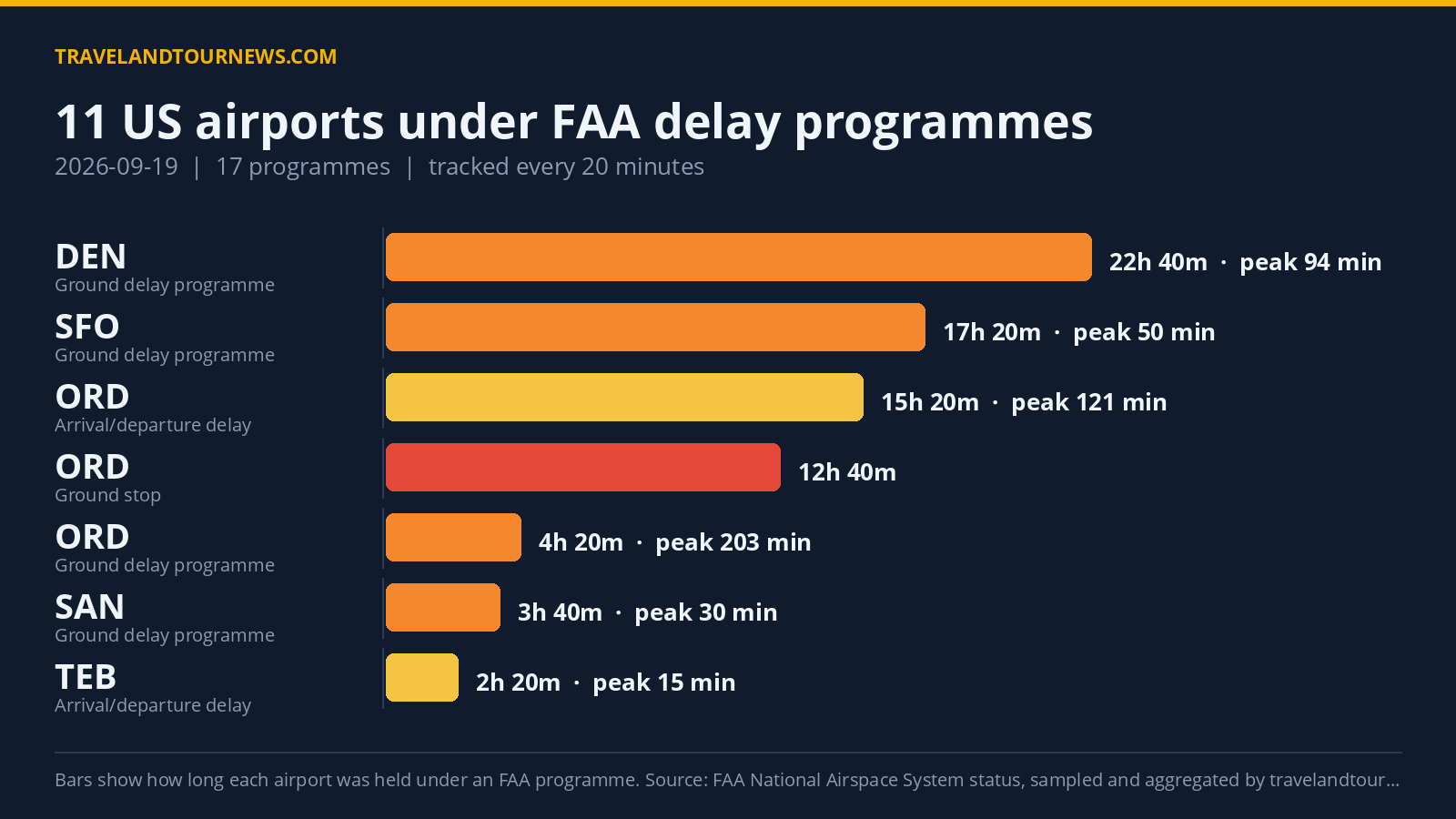

On September 19, 2026, the FAA held 11 U.S. airports under a total of 17 delay programmes, according to FAA data tracked by travelandtournews.com. The worst-affected airport was Chicago O’Hare International (ORD), which experienced ground stop and ground delay programmes with peak maximum delays reaching 312 minutes.
Overview of Affected Airports and Programmes
The 11 airports affected included Atlanta (ATL), Boston (BOS), Denver (DEN), Eagle County (EGE), Orlando (MCO), Chicago Midway (MDW), Chicago O’Hare (ORD), San Diego (SAN), Seattle-Tacoma (SEA), San Francisco (SFO), and Teterboro (TEB).
There were six Ground Stop Programs, which hold departures bound for an airport on the ground at their origin, and four Ground Delay Programs, which meter arrivals by assigning later departure times. The remaining seven were general arrival/departure delay information notices issued by the FAA.
Chicago O’Hare’s ground stop was active from 10:00 to 22:40 UTC, lasting 12 hours and 40 minutes. Its longest-standing ground delay programme
ran for 4 hours and 20 minutes from 12:00 to 16:20 UTC, hitting peak average delays of 203 minutes and maximum delays of 312 minutes. Denver International had the longest programme duration at 22 hours and 40 minutes with a Ground Delay Program operating continuously from 00:00 to 22:40 UTC.
San Francisco International saw multiple programmes including a 20-minute ground stop early in the day for low ceilings and a ground delay programme due to airport volume and low ceilings lasting 17 hours and 20 minutes with peak average delays of 50 minutes. San Diego’s ground delay programme lasted 3
hours and 40 minutes for airport volume reasons and peaked at 30 minutes average delays.
Smaller duration ground stops affected Midway, Seattle-Tacoma, and Atlanta with durations of 1 hour 40 minutes, 20 minutes, and 20 minutes respectively.
| Airport | FAA programme | Cause | Peak average delay | In force (UTC) |
|---|---|---|---|---|
| Chicago O’Hare International (ORD) | Ground Stop Programs | thunderstorms | – | 10:00 to 22:40 (12 hours 40 minutes) |
| Chicago Midway International (MDW) | Ground Stop Programs | thunderstorms | – | 11:00 to 12:40 (1 hour 40 minutes) |
| San Francisco International (SFO) | Ground Stop Programs | low ceilings | – | 03:20 to 03:40 (20 minutes) |
| Denver International (DEN) | Ground Stop Programs | STAFFING | – | 13:20 to 13:40 (20 minutes) |
| Seattle-Tacoma International (SEA) | Ground Stop Programs | runway construction | – | 15:40 to 16:00 (20 minutes) |
| Hartsfield-Jackson Atlanta International (ATL) | Ground Stop Programs | thunderstorms | – | 22:20 to 22:40 (20 minutes) |
| Chicago O’Hare International (ORD) | Ground Delay Programs | thunderstorms | 203 min | 12:00 to 16:20 (4 hours 20 minutes) |
| Denver International (DEN) | Ground Delay Programs | thunderstorms | 94 min | 00:00 to 22:40 (22 hours 40 minutes) |
| San Francisco International (SFO) | Ground Delay Programs | airport volume; low ceilings | 50 min | 00:40 to 18:00 (17 hours 20 minutes) |
| San Diego International (SAN) | Ground Delay Programs | airport volume | 30 min | 00:00 to 03:40 (3 hours 40 minutes) |
| Chicago O’Hare International (ORD) | General Arrival/Departure Delay Info | TM Initiatives:MIT:WX; WX:Thunderstorms | 121 min | 00:00 to 15:20 (15 hours 20 minutes) |
| Denver International (DEN) | General Arrival/Departure Delay Info | ZDV / WX:Thunderstorms | 46 min | 00:00 to 00:20 (20 minutes) |
| Boston Logan International (BOS) | General Arrival/Departure Delay Info | RWY:Construction | 31 min | 00:20 to 01:00 (40 minutes) |
| San Francisco International (SFO) | General Arrival/Departure Delay Info | RWY:Construction | 16 min | 00:00 to 00:20 (20 minutes) |
Thunderstorms Were the Primary Cause of Delay Programmes
Thunderstorms were the leading cause, cited 48 times across multiple programmes including all ground stop programmes at ORD, MDW, ATL, and ground delays at ORD and DEN. The next most frequent causes were airport volume with 22 citations and low ceilings with 18.
Other causes included weather-related runway construction delays (BOS and SFO), staffing issues at Denver, runway construction at Seattle-Tacoma, and individual
release procedures at Teterboro.
Thunderstorm-related weather (including FAA classifications WX:Thunderstorms and ZDV / WX:Thunderstorms) accounted for the majority of the longest and most impactful programmes on the day.
Comparison to Previous Day and Weekly Averages
Compared to the previous day, September 19 saw 7 fewer airports affected (11 vs. 18) and 9 fewer programmes (17 vs. 26). The day was below the seven-day rolling average of 16.3 airports affected. The data does not indicate this day as the worst in the recent tracking window.
Methodology. travelandtournews.com samples the FAA’s National Airspace System status feed every 20 minutes throughout the US operating day and aggregates the result. This
report is built from 69 samples taken between 00:00 and 22:40 UTC on 2026-09-19. Durations are the observed window between the first and last sample in which a programme was in force, so a programme’s true length may be slightly longer than shown. Ground stops, ground delay programmes, airport closures and general delays are all published by the FAA in real time; the daily aggregation is ours.