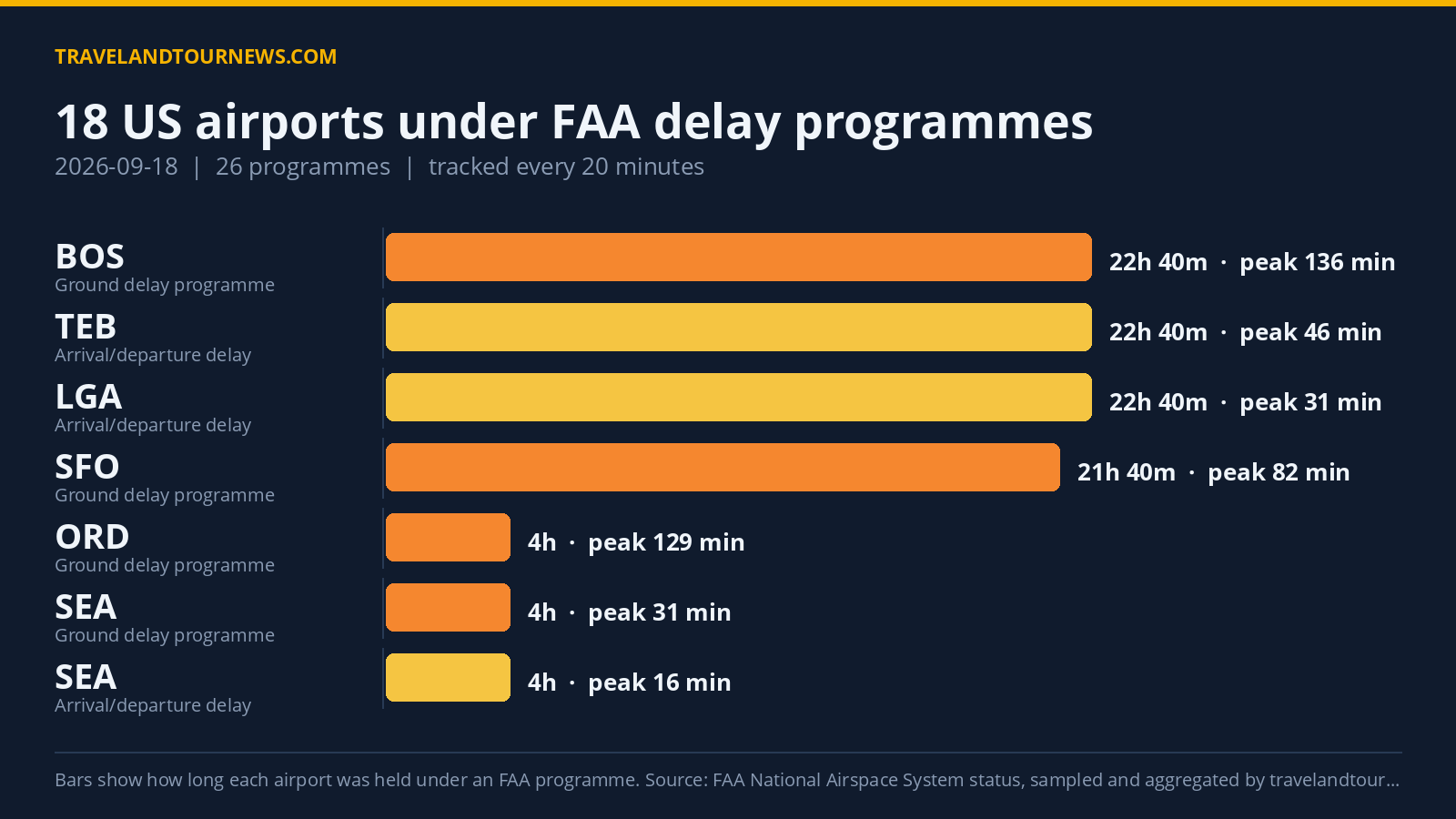
On September 18, 2026, the Federal Aviation Administration implemented a ground delay program at Nashville International Airport (BNA) due to staffing shortages at the airport’s air traffic control tower. The program was active from 5 p.m. to 10:59 p.m. local time with staffing constraints expected to continue into the overnight hours.
The ground delay program led to average arrival and departure delays of approximately 46 minutes for flights destined for Nashville. Some arrivals experienced delays as long as 97 minutes. Once airborne, general arrival delays at BNA were limited to 15 minutes or less, indicating that most delay time occurred
while aircraft remained on the ground at their origin airports.
Operational impacts and FAA authority
This traffic management effort slowed the flow of inbound flights to maintain safe airport operations amid the reduced hourly arrival capacity caused by the staffing limitations. The FAA alone holds the authority to issue ground stops or ground delay programs, while airlines manage specific decisions regarding cancellations, reroutings, or reassignments of aircraft and crews.
The reduced arrival capacity and slowed traffic at Nashville also create ripple effects on airline schedules, particularly during the busy evening period. Delays arriving into Nashville can disrupt tight turnaround times and connecting flights at BNA
and major US hub airports feeding Nashville service.
Passenger impacts during the delay program
Travelers encountered delayed boarding, gate changes, and revised departure times at origin airports as flights were held pending available arrival slots at Nashville. Since the program held flights before departure, passengers traveling to BNA on September 18 faced extended waits on the ground rather than in-flight holding patterns.
Passengers with tight connections through Nashville should anticipate potential missed connections or late departures due to the cascading delay effects. Airlines may proactively change itineraries by rerouting flights or adjusting departure times to accommodate the constrained arrival capacity.
Staffing constraints and national network effects
Staff shortages at Nashville International Airport’s
air traffic control tower lowered the airport’s arrival acceptance rate, forcing the FAA to implement this ground delay program. Unlike weather-related delays, this disruption stemmed solely from staffing limits rather than visibility or meteorological conditions.
Such staffing-related capacity reductions can lead to wider network disruptions because Nashville is connected to multiple major US airports including Chicago O’Hare, JFK, LaGuardia, Newark, and Atlanta. The slowed arrival flow into BNA during peak evening periods complicates airline scheduling and aircraft utilization, increasing the risk of delays beyond Nashville’s airspace.