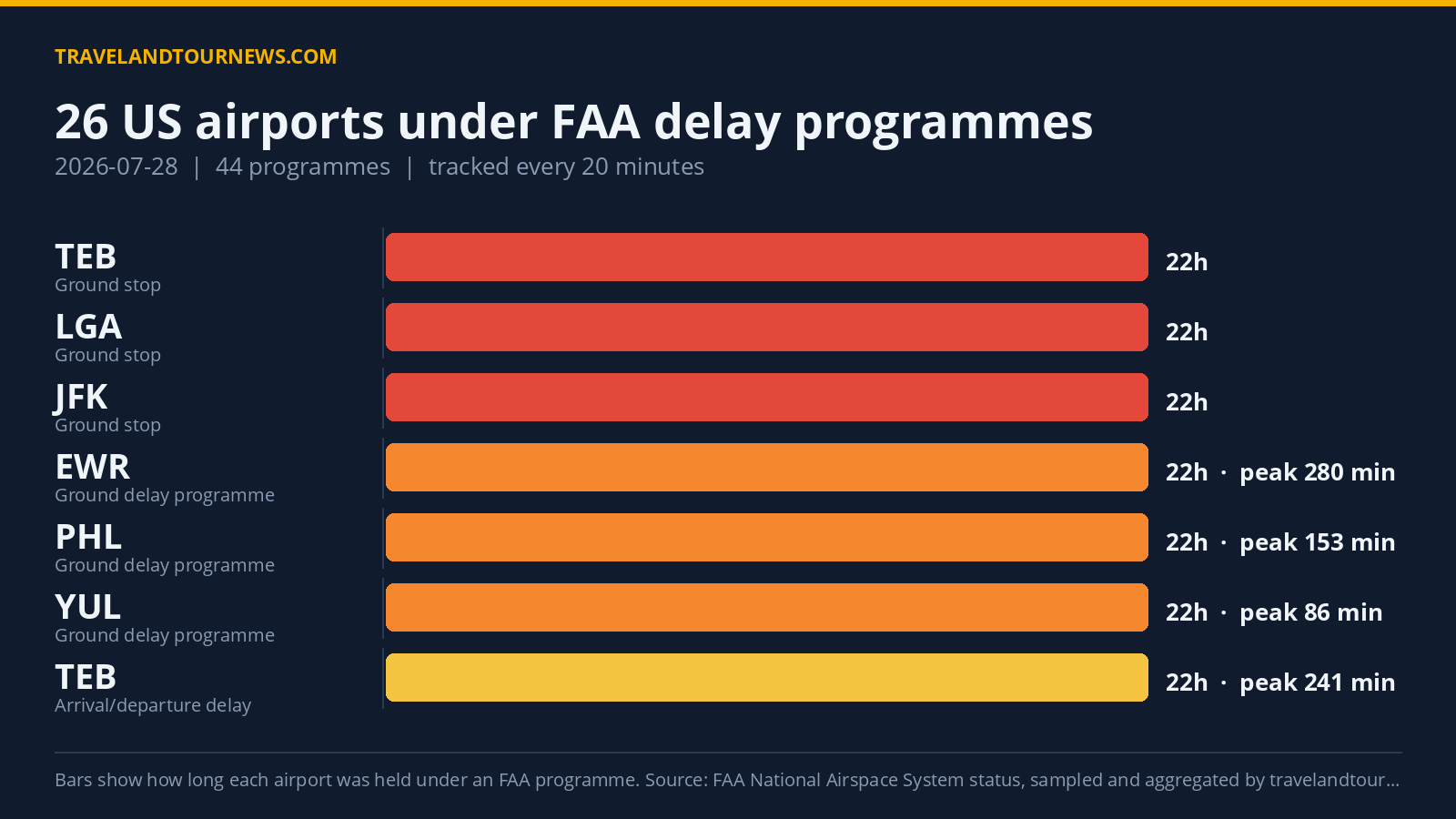

On July 28, 2026, the FAA held 26 airports across the United States under 44 separate delay programmes. Teterboro Airport (TEB) endured the longest and most sustained disruption, with a ground stop programme in effect for 22 hours due to thunderstorms.
Overview of Airports and Delay Programmes
The FAA’s delay programmes on July 28 fell into three categories: 14 Ground Stop Programs, 11 Ground Delay Programs, and 19 instances of General Arrival or Departure Delay Information. Ground stops hold departures bound for the affected airport on the ground at their origin, while ground delay programmes meter arrivals by assigning later departure times.
TEB was the worst affected airport, with a ground stop programme lasting 22 hours (from 00:00 to 22:00 UTC), solely due to thunderstorms. Although it reported a peak average and maximum delay of zero minutes, the duration of the ground stop signal significant operational impact.
Other airports with ground stop programmes lasting several hours included LaGuardia (LGA) and John F. Kennedy International (JFK), both from midnight to 22:00 UTC. JFK’s ground stop cited both staffing and thunderstorms as causes. Newark Liberty International (EWR) also had a 10 hour and 20 minute ground stop starting late morning.
Ground delay programmes were primarily active at Newark (EWR) for 22 hours and Philadelphia International (PHL) also for 22 hours, with peak average delays of 280 and 153 minutes respectively. Chicago O’Hare (ORD) saw a shorter ground delay programme of four hours but with the highest peak average delay
of 419 minutes and maximum delay reaching 1287 minutes.
| Airport | FAA programme | Cause | Peak average delay | In force (UTC) |
|---|---|---|---|---|
| TEB | Ground Stop Programs | thunderstorms | – | 00:00 to 22:00 (22 hours) |
| LaGuardia (LGA) | Ground Stop Programs | thunderstorms | – | 00:00 to 22:00 (22 hours) |
| John F. Kennedy International (JFK) | Ground Stop Programs | STAFFING; thunderstorms | – | 00:00 to 22:00 (22 hours) |
| Newark Liberty International (EWR) | Ground Stop Programs | thunderstorms; THUNDERSTORMS | – | 11:40 to 22:00 (10 hours 20 minutes) |
| YUL | Ground Stop Programs | thunderstorms | – | 19:00 to 22:00 (3 hours) |
| Washington Dulles International (IAD) | Ground Stop Programs | thunderstorms | – | 20:00 to 22:00 (2 hours) |
| Baltimore/Washington International (BWI) | Ground Stop Programs | thunderstorms | – | 20:00 to 22:00 (2 hours) |
| Ronald Reagan Washington National (DCA) | Ground Stop Programs | thunderstorms | – | 20:00 to 22:00 (2 hours) |
| Denver International (DEN) | Ground Stop Programs | thunderstorms | – | 21:00 to 22:00 (1 hour) |
| MMU | Ground Stop Programs | thunderstorms | – | 21:20 to 22:00 (40 minutes) |
| Hartsfield-Jackson Atlanta International (ATL) | Ground Stop Programs | other | – | 00:20 to 00:40 (20 minutes) |
| BDL | Ground Stop Programs | thunderstorms | – | 17:00 to 17:20 (20 minutes) |
| CDW | Ground Stop Programs | thunderstorms | – | 21:40 to 22:00 (20 minutes) |
| Philadelphia International (PHL) | Ground Stop Programs | thunderstorms | – | 21:40 to 22:00 (20 minutes) |
Thunderstorms Drove the Majority of Delay Programmes
Thunderstorms were the FAA’s most cited cause, appearing 259 times under various capitalizations. They were a factor in both Ground Stop and Ground Delay Programmes at multiple airports, including TEB, LGA, JFK, EWR, and ORD.
Traffic Management Initiatives related to weather (noted as TM Initiatives:SWAP:WX and TM Initiatives:MIT:WX) accounted for 178 instances, highlighting ongoing weather-related operational adjustments. The category “other” reasons appeared 54 times, and airport volume was specifically cited once at San Diego International (SAN).
Other notable causes included staffing issues at JFK, and multiple airports reporting different thunderstorm-related delays
emphasizing the disruptive effect of severe weather across the country on July 28.
Comparison with Previous Day and Weekly Averages
The 26 airports affected and 44 delay programmes on July 28 represent an increase from the 19 airports and 34 programmes the previous day. This day’s figures also exceed the seven-day average of 16.3 airports affected, marking the highest airport count in the week-long tracking window.
The longer and more numerous delay programmes reflect heavier operational constraints on July 28 compared to recent days.
Methodology. travelandtournews.com samples the FAA’s National Airspace System status feed every 20 minutes throughout the US operating day and aggregates the result. This
report is built from 67 samples taken between 00:00 and 22:00 UTC on 2026-07-28. Durations are the observed window between the first and last sample in which a programme was in force, so a programme’s true length may be slightly longer than shown. Ground stops, ground delay programmes, airport closures and general delays are all published by the FAA in real time; the daily aggregation is ours.