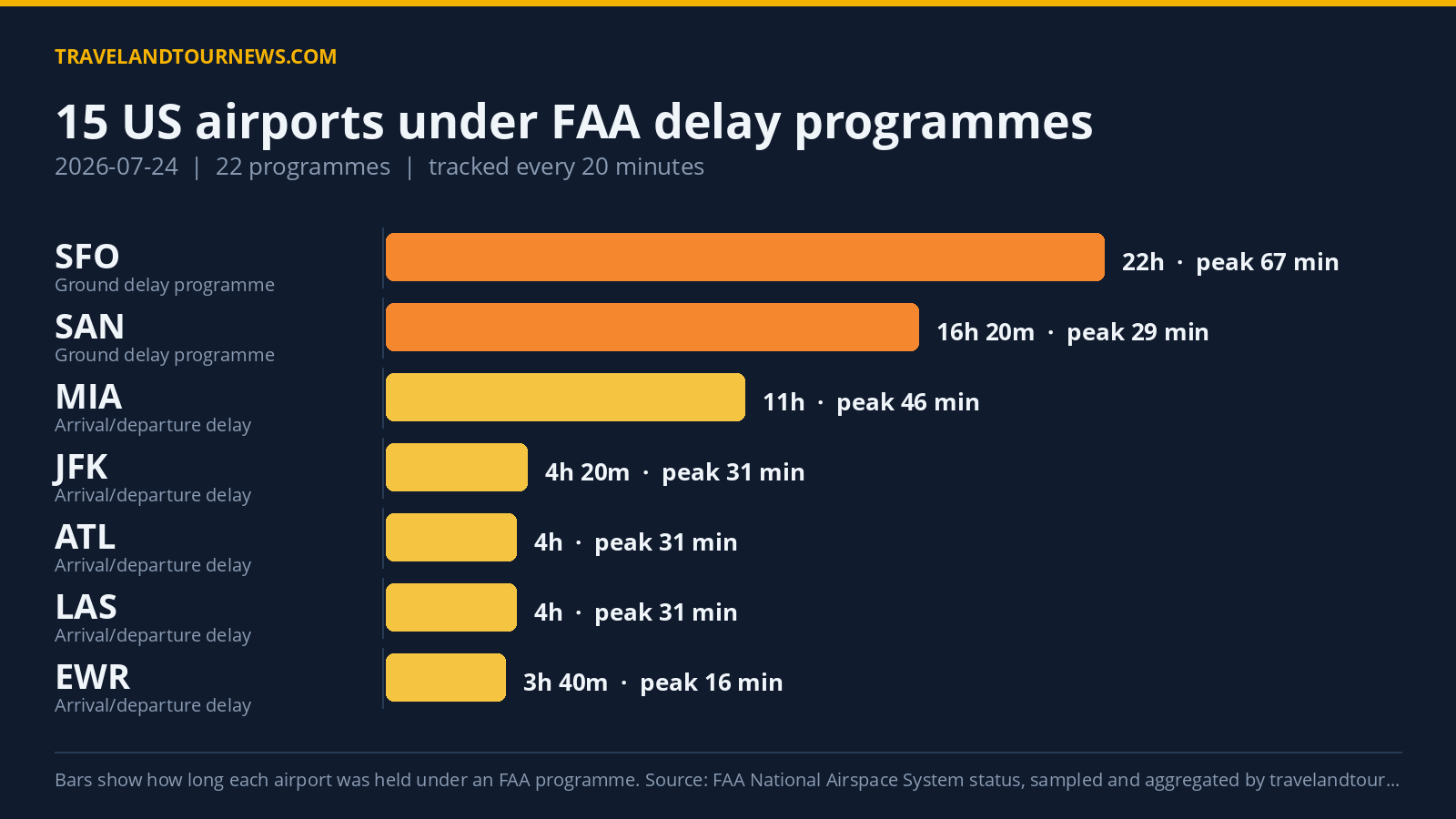

On July 24, 2026, the FAA held 15 airports across the United States under 22 total delay programmes. The worst-hit airport was San Francisco International (SFO), which experienced a peak average delay of 67 minutes during a ground delay programme that lasted 22 hours.
Airport Delay Programmes and Their Duration
The 15 airports affected included major hubs such as Hartsfield-Jackson Atlanta International (ATL), San Francisco International (SFO), Denver International (DEN), and John F. Kennedy International (JFK). Among the 22 programmes, three were ground stop programmes, which hold departing flights at their origin airports to manage traffic flow, and five were ground delay programmes, which meter arrivals by assigning later departure times.
The longest-running programme was the 22-hour ground delay programme at SFO, focused on “other” and “low ceilings” reasons, with peak average delay reaching 67 minutes and a maximum delay of 166 minutes. ATL was under two types of programmes:
a ground stop programme due to thunderstorms lasting 1 hour and 20 minutes with no peak delay recorded during that, and a ground delay programme for thunderstorms lasting 1 hour and 40 minutes with a peak average delay of 63 minutes and a peak max delay of 208 minutes, the highest maximum delay reported for the day.
Other ground stop programmes included Seattle-Tacoma International (SEA) due to low ceilings for 20 minutes, and San Francisco (SFO) for 20 minutes with unspecified “other” reasons. Ground delay programmes at Denver International (DEN) and Harry Reid International (LAS) lasted from 20 minutes to
over three hours with peak average delays ranging from 35 to 56 minutes.
General arrival and departure delay information programmes were recorded at ten airports, including Miami International (MIA), Fort Lauderdale-Hollywood International (FLL), Newark Liberty International (EWR), Boston Logan International (BOS), and Dallas/Fort Worth International (DFW). These lasted between 20 minutes and 11 hours, with peak average delays mostly at or below 46 minutes.
| Airport | FAA programme | Cause | Peak average delay | In force (UTC) |
|---|---|---|---|---|
| Hartsfield-Jackson Atlanta International (ATL) | Ground Stop Programs | thunderstorms; THUNDERSTORMS | – | 18:20 to 19:40 (1 hour 20 minutes) |
| San Francisco International (SFO) | Ground Stop Programs | other | – | 04:40 to 05:00 (20 minutes) |
| Seattle-Tacoma International (SEA) | Ground Stop Programs | low ceilings | – | 15:20 to 15:40 (20 minutes) |
| San Francisco International (SFO) | Ground Delay Programs | other; low ceilings | 67 min | 00:00 to 22:00 (22 hours) |
| Hartsfield-Jackson Atlanta International (ATL) | Ground Delay Programs | thunderstorms | 63 min | 20:00 to 21:40 (1 hour 40 minutes) |
| Denver International (DEN) | Ground Delay Programs | thunderstorms | 56 min | 00:00 to 00:00 (20 minutes) |
| Harry Reid International (LAS) | Ground Delay Programs | other | 35 min | 01:40 to 05:00 (3 hours 20 minutes) |
| San Diego International (SAN) | Ground Delay Programs | airport volume | 29 min | 00:00 to 16:20 (16 hours 20 minutes) |
| Miami International (MIA) | General Arrival/Departure Delay Info | RWY:Disabled Aircraft; TM Initiatives:MIT:VOL; TM Initiatives:MIT:WX | 46 min | 11:00 to 22:00 (11 hours) |
| Fort Lauderdale-Hollywood International (FLL) | General Arrival/Departure Delay Info | TM Initiatives:MIT:WX | 46 min | 20:40 to 22:00 (1 hour 20 minutes) |
| John F. Kennedy International (JFK) | General Arrival/Departure Delay Info | TM Initiatives:MIT:VOL | 31 min | 00:00 to 04:20 (4 hours 20 minutes) |
| Hartsfield-Jackson Atlanta International (ATL) | General Arrival/Departure Delay Info | WX:Thunderstorms | 31 min | 18:00 to 22:00 (4 hours) |
| Harry Reid International (LAS) | General Arrival/Departure Delay Info | STAFF: L30 STAFFING; WX:Thunderstorms | 31 min | 18:00 to 22:00 (4 hours) |
| Newark Liberty International (EWR) | General Arrival/Departure Delay Info | ZBW / VOL:Compacted Demand | 16 min | 16:40 to 20:20 (3 hours 40 minutes) |
Causes Behind the Delay Programmes
The FAA’s official reasons for delay programmes on July 24 were varied but showed clear patterns. The top causes by programme count were unspecified “other” reasons at 38 occurrences, followed by traffic management initiatives for volume
control (TM Initiatives:MIT:VOL) at 26 occurrences. Low ceilings contributed to 24 programmes, airport volume issues to 22, and thunderstorms to 21.
Thunderstorms heavily impacted ATL with both a ground stop and a ground delay programme. San Francisco’s long-running ground delay programme was driven by “other” reasons and low ceilings, while Seattle’s ground stop programme cited low ceilings exclusively.
Airport volume delays mainly affected San Diego International (SAN) during a ground delay programme lasting over 16 hours with peak average delays of 29 minutes. Staff shortages were cited at Boston Logan and Harry Reid International along with thunderstorms at LAS.
Other
specific causes included runway closures due to disabled aircraft at Miami International and construction plus traffic management initiatives at San Francisco.
Trends Compared With Previous Days
Compared to yesterday, when 16 airports were affected by 18 delay programmes, July 24 had one fewer airport under delay programmes, though the total number of programmes increased to 22. The seven-day average for affected airports stands at 21.3, indicating July 24 was below average for this metric. This day was not the worst in the tracking window.
Today’s peak average delay of 67 minutes and peak maximum delay of 208 minutes highlight the significant impact particular programmes, especially
at San Francisco and Atlanta, had during the day.
Methodology. travelandtournews.com samples the FAA’s National Airspace System status feed every 20 minutes throughout the US operating day and aggregates the result. This report is built from 67 samples taken between 00:00 and 22:00 UTC on 2026-07-24. Durations are the observed window between the first and last sample in which a programme was in force, so a programme’s true length may be slightly longer than shown. Ground stops, ground delay programmes, airport closures and general delays are all published by the FAA in real time; the daily aggregation is ours.