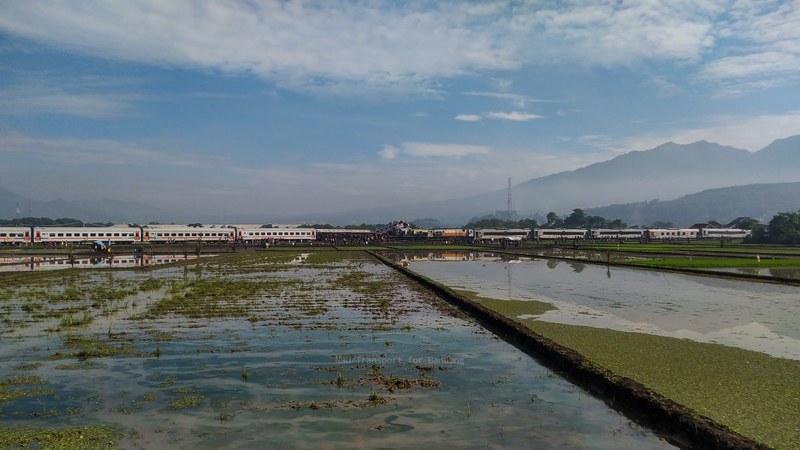
At least 68 people died and about 80 were injured in a high-speed train collision near Urda, Toledo province, in central Spain on the morning of Wednesday, October 28, 2026. The crash involved a moving Renfe AVE train striking the rear of a stationary Iryo train on the Madrid-Seville high-speed rail line, causing two carriages to derail and fall down an embankment.
The Renfe AVE train carried 397 passengers while the Iryo train had 147 aboard at the time of the collision. Emergency services deployed included more than 200 members of the Military Emergencies Unit focused on rescuing survivors and
recovering bodies from the two most damaged carriages. Medical and firefighter teams were dispatched from Madrid, coordinated by Madrid Mayor Jose Luis Martinez-Almeida. Injured people were taken to multiple hospitals, with about 50 seriously injured and 15 critically injured, according to Castilla-La Mancha regional head Emiliano Garcia-Page and Health Minister Monica Garcia.
Spanish railway infrastructure operator ADIF suspended all high-speed rail services between Madrid and Andalusia immediately after the crash, affecting the main route connecting central Spain and the southern Andalusia region. Los Yebenes town council gathered food and supplies for those affected by the collision, with the Civil Guard
sending a disaster investigation team to the site.
Spanish Prime Minister Pedro Sanchez declared three days of national mourning from October 29 to 31, 2026, and pledged a full investigation into the crash. Sanchez said: “We will get to the bottom of this, and if there was negligence, it will be revealed, and if there were system failures, there will be a strong response.” He also noted the tragedy was unacceptable given it was the second deadly rail crash in Spain this year. Sanchez underscored that the causes of this incident and the January 2026 crash appeared unrelated.
The collision
followed a failure in the LZB control signaling system lasting starting around 8:30am local time (07:00 GMT), which affected approximately a 63-kilometer stretch and six trains. Control was switched to the Atocha control post, where the decision was made to allow the Renfe train to resume travel despite the failure. Spanish Transport Minister Oscar Puente described this decision as “inexplicable,” stating: “The decision to resume traffic without the system having been restored corresponds to the control centre.”
This is Spain’s second major fatal train crash in 2026 on the same high-speed route involving the same rail operators, Renfe and Iryo.
The earlier January crash killed 46 people. The collision occurs shortly before Spain’s national elections in November 2026, adding political significance. European Commission President Ursula von der Leyen and French President Emmanuel Macron expressed condolences and solidarity with Spain following the disaster.